The Fifteenth Account: Maxim's Comeback | Upscale

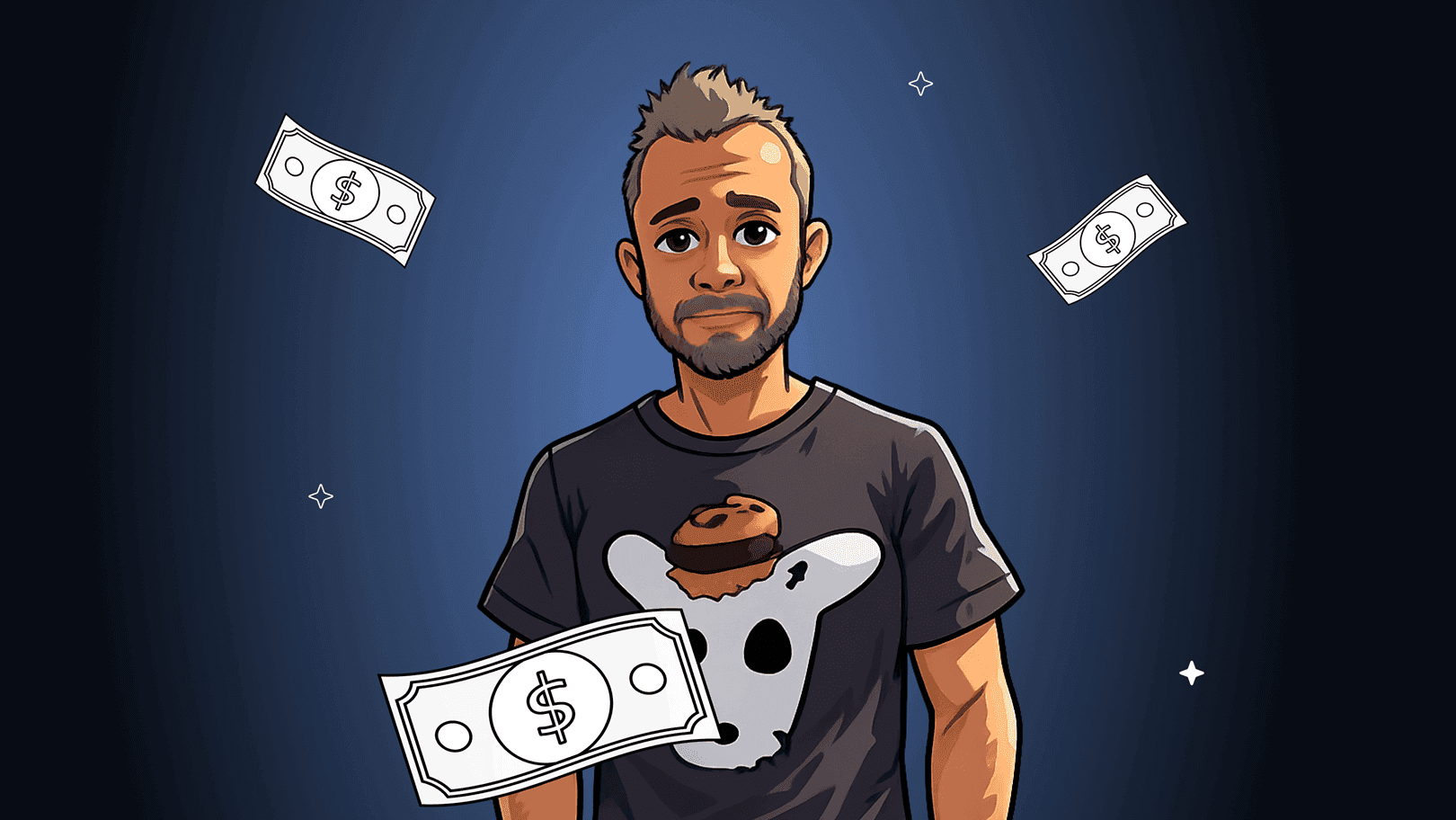
Maxim is a 36-year-old factory worker from St. Petersburg who, over two years, went from a blown first thousand dollars to $6,690 in verified payouts on Upscale. But his story isn't a straight line to success. Between two interviews he blew a $10,000 account and a $100,000 account, spent almost a year unable to return to stability, and only secured a funded account on his fifteenth attempt. What brought him back wasn't a new strategy but a single quality — discipline. This is a story about how strict risk rules and persistence turned out to matter more than any set of indicators.
📺 Full interview with Maxim: https://youtu.be/PibGJhQxpa8
From the Factory Floor to the Charts
Maxim was drawn into trading by a colleague at the factory, who showed him a candlestick chart and said you could earn good money on it — you just had to learn. The idea stuck.
"Big money is always interesting. I figured I needed to learn. I tend to reach every goal I set for myself."
Alongside that, he was mining NotCoin — and it was crypto that pulled him into the industry: that's how he learned what a blockchain, exchanges, and technical analysis were. On NotCoin he earned his first $1,000 — and quickly lost it, because he had neither discipline nor respect for his own rules. He didn't lose heart: he kept studying technical analysis and gradually assembled a strategy from scattered pieces of knowledge.
Maxim's Strategy: Smart Money and Volume
The core of Maxim's approach is Smart Money Concepts: order blocks, liquidity pools, and structure breaks. For this he uses an indicator that automatically marks these elements on the chart, plus a volume indicator. RSI, MACD, and Stochastic are set up too, but as secondary filters — he relies on them maybe ten percent.
This isn't scalping: he holds trades from a few hours to a few days, trading liquid instruments — Bitcoin, Ethereum, Solana, TON. The main principle is selectivity.
"Fewer trades is better, but they'll be higher quality."
His risk model is strict: he enters with 10% of the deposit at 5× leverage and keeps the stop-loss in the 0.2–0.7% range of the account.
The First Funded Account and a Painful Lesson
The path to funding wasn't quick. First came about six $1,000 challenges, on which Maxim tuned his strategy and broke down more than once, oversizing his risk. He lost his first passed funded account almost immediately, in the most frustrating way: after a night shift at the factory he forgot about the daily drawdown, opened a couple of trades in the morning — and the account closed on the limit.
Rather than take another $1,000 challenge, he decided to skip a level — bought a $10,000 challenge and passed it on the first try. That account brought his first serious payouts in the second half of 2025: $860, $1,535, $490, and $800 — $3,685 in total, with $1,535 his record payout.
Maxim put his first payout into his work: he bought a 24-inch all-in-one and a TradingView subscription to analyze the chart more comfortably. Later he set up two workstations — at home and at the factory.
Two Breakdowns on the Way to $10,000
Passing the $10,000 wasn't smooth. Twice during the challenge Maxim lost control: he entered trades without analysis, on emotion, and drew the account down by about $700 — roughly 7%, to $9,300.
"I broke down twice, I was at −$700 twice. And both times I pulled myself together and won it all back with my strategy."
What stopped him was the platform's built-in mechanics. Several times he was just a few dollars away from failing the challenge — and that's when he'd close the terminal and walk away.
"I'd close the terminal and just not trade — rest mentally. The next day I'd look at that deep minus, think 'no big deal,' pull myself together, and trade it all back."
Discipline Beyond Trading

Alongside trading, Maxim was changing his lifestyle too: he quit cigarettes after 27 years of smoking, returned to sport, started reading, and went on a diet. For him these are links in one chain.
"All these things discipline you. You discipline yourself in life — and discipline comes to your trading."
The Fall: Fifteen Accounts Before the Comeback
This is where Maxim's story departs from the typical case. After the first interview he set an ambitious goal — a $100,000 challenge. But things went wrong: he lost both the $10,000 account and the $100,000 one (on the latter he passed the first phase but broke down on the second). And then came the hardest period.
"It was a battle, you could say, to the death."
Over roughly eight months Maxim lost account after account — one $10,000 account after another. The discipline he'd talked about in the first interview broke down completely: he oversized his risk, traded on emotion, didn't take his winning trades, and tried to win back losses — only to go deeper into the red. For a long time he couldn't reach stability.
The Comeback: Discipline as a System
The turning point came in February 2026: his fifteenth $10,000 account brought Maxim back to funding. What helped wasn't new knowledge but a return to strict rules.
"If you can trade but you have no discipline, you'll blow it."
Now he trades strictly by the model: 10% of the deposit, 5× leverage, a stop in the 0.2–0.7% range, always entering with a fixed amount. No going "all in" and no trying to win it back. He names persistence as the main factor in his comeback.
"Even if I blow all these accounts, I won't stop: I'll buy a new challenge and keep going toward my goal until I reach it."
Other Upscale traders took a similar path: Roman blew four challenges in a row before taking a payout on the fifth, and Alexander lost his first prop account to FOMO. They all arrived at the same conclusion: discipline matters more than strategy.
The Updated 2026 Strategy
The core stayed the same — Smart Money and volume — but the approach got cleaner. Maxim stopped drawing patterns, and built some of his tools himself with the help of a neural network (a trading-session indicator, for example). He makes entry decisions on a confluence of confirmations: price arriving at a marked zone plus signals like divergences on RSI and Stochastic.
His asset list changed too. He dropped memecoins and small alts, keeping the liquid BTC, ETH, SOL, and TON. The reason is practical: the short stops of his model require less volatile, more liquid instruments, otherwise the stop has to be placed razor-thin.
Why Prop Trading Feels Calmer Than an Exchange

Maxim explains separately why prop trading feels calmer to him than trading his own deposit. On an exchange the risk was unlimited — and the outcome, in his words, was always the same.
"I used to have no daily drawdown limits — I traded on an exchange. And the outcome was always one thing: liquidation."
He once entered with 20× and 30× leverage, and on Bitcoin once even 125× — and lost almost everything on a sharp move. A funded account is different: you risk not your deposit but only the challenge fee, and you can always start over. And the built-in limits — the daily drawdown and the 5× maximum leverage — work as external discipline.
"Why oversize your risk? You can earn just fine at 5×. And the daily drawdown stopped me and disciplined me."
Maxim's Advice
Maxim boils his experience down to two things that don't work without each other: the ability to trade and discipline.
"If you can trade but have no discipline, you'll blow it. And the other way around: you have discipline but can't trade, you won't earn."
He gives beginners three concrete pieces of advice:
- Respect your risk and always set a stop-loss. Without it, he says, there's nothing to do in trading.
- Don't oversize your risk. Don't go "all in" on the full deposit — the exchange used to punish him for that with liquidations.
- Don't spend too much time in the market. When you sit at the chart too long, your eye gets blurred: you start seeing things that aren't there and drifting from your own plan. You need to rest from the market.
And his trading plan itself is extremely simple.
"I only trade what's clear to me. That's it. I don't trade anything else."
Payout Certificates
In total, across two waves of trading, Maxim withdrew $6,690 — ten payouts from two funded "Basic 10k" accounts: four in 2025 and six after his return in 2026.

Payouts from the 2025 account. Total: $3,685.
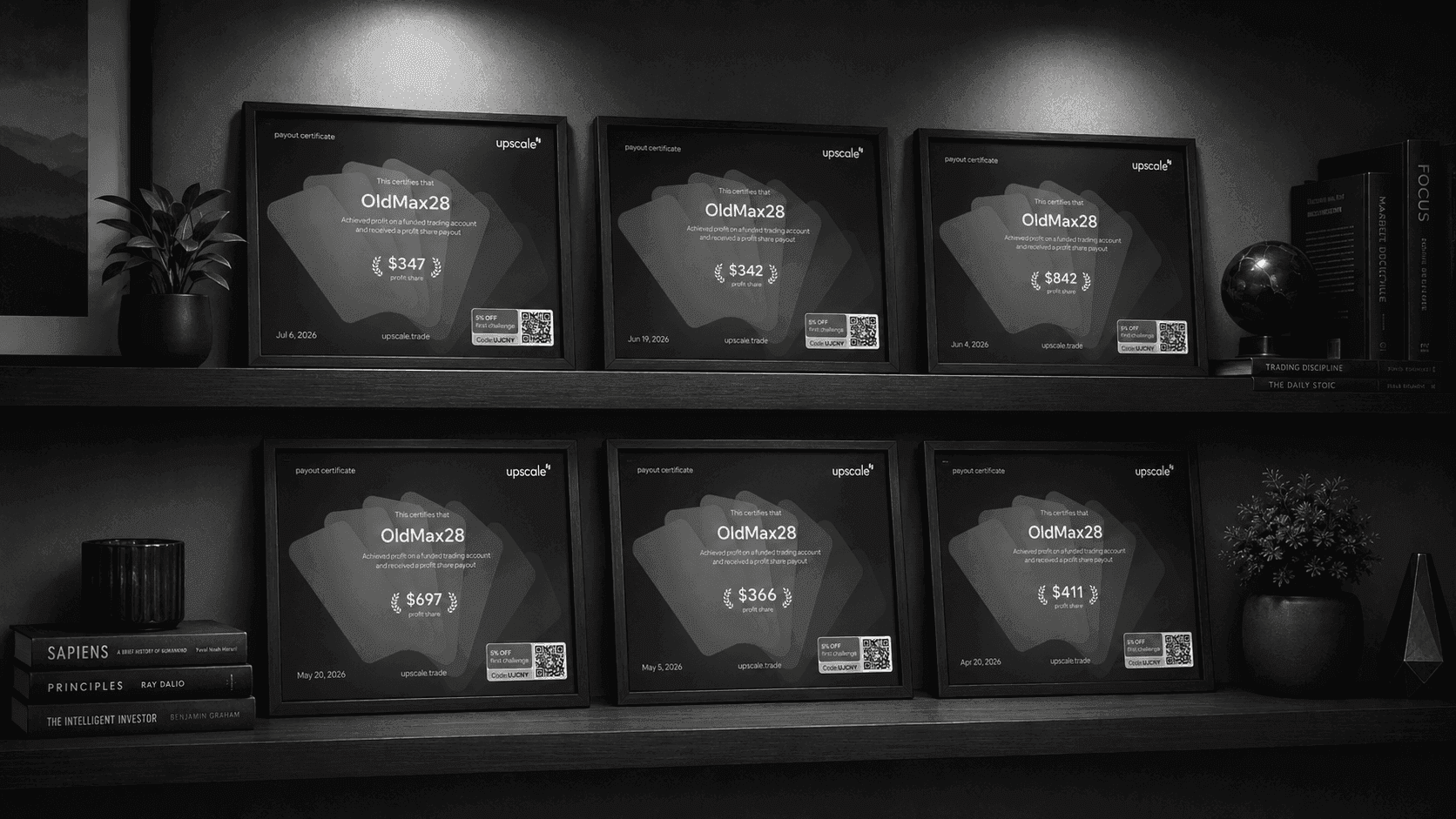
Payouts from the 2026 account. Total: $3,005.
Verified Results
Maxim's results are verified through:
- Two video interviews on the Upscale YouTube channel, with certificates and accounts shown on screen
- Upscale payout certificates from both funded accounts
- A demonstration of his trading strategy on the Bitcoin chart in TradingView
All Upscale payouts are made on-chain and can be independently verified on the blockchain.
Key Takeaways
Maxim's story is a clear answer to the question of what matters more in prop trading: strategy or discipline. His approach barely changed between the failures and the payouts — what changed was his ability to follow his own rules.
Discipline matters more than strategy. The same set of tools led Maxim both to a streak of blown accounts and to steady payouts. The difference wasn't in the chart, but in following risk management.
The system should be simple. Maxim's trading plan is "I only trade what's clear to me": a mandatory stop, fixed risk, and no excess time at the chart. Nothing complex — you can't repeat complex things consistently.
Persistence beats speed. Between his goal and the result lay almost a year of failures and a long streak of blown accounts — he came back to funding only on the fifteenth. He didn't stop, and that, not a lucky trade, is what brought him back to payouts.
Prop trading fits alongside a job. Maxim trades between shifts at the factory, from his phone and from two workstations — the funded model lets him grow as a trader without risking his own capital.
Start now: 👉 Upscale.trade | Telegram Bot
Follow us: 📺 YouTube | 𝕏 Twitter
Community: 💬 Telegram Chat | 🎮 Discord
Frequently Asked Questions
Who is Maxim and how much did he earn on Upscale?
Maxim is a 36-year-old factory worker from St. Petersburg. Across two waves of trading he withdrew $6,690 from Upscale — ten payouts from two funded "Basic 10k" accounts: four in 2025 (including a record $1,535) and six after returning to funding in 2026.
What strategy does Maxim trade?
The core is Smart Money Concepts: order blocks, liquidity pools, and structure breaks, plus volume analysis. He uses RSI, MACD, and Stochastic as secondary filters. Maxim only trades situations that are clear to him and holds trades from a few hours to a few days, rather than scalping.
What risk-management rules does he use?
Entry with 10% of the deposit at 5× leverage, a stop-loss in the 0.2–0.7% range of the account, and a fixed position size. His three main rules: a mandatory stop-loss, no oversizing risk, and limiting time in the market.
What helped Maxim come back after a streak of blown accounts?
Discipline and persistence. After the first interview he lost both accounts and spent about eight months unable to reach stability, losing account after account. Returning to strict risk rules let him get back to funding — on his fifteenth $10,000 account, in February 2026.
What assets does Maxim trade?
Liquid and less volatile ones: Bitcoin, Ethereum, Solana, and TON. He dropped memecoins and small altcoins because the short stops of his model require more liquid instruments.
Can you combine prop trading with a full-time job?
Yes. Maxim trades between shifts at the factory and from two workstations — at home and at work. The funded model lets you trade the firm's capital without risking your own money, which makes combining the two realistic.