$5,600 From a $100K Prop Account: How Exerato Passed a Challenge in 2 Weeks | Upscale

A 21-year-old trader known as Exerato lost over $150,000 on memecoins and cross-margin futures, worked as a chef in Italy, invested his salary into trading — and blew account after account. After 5 years in the markets and 18 months of disciplined trading, he passed a $100,000 challenge on Upscale in 2 weeks and received a $5,600 payout. His strategy: two candlestick models based on fractal sweeps with a Fibonacci grid, a fixed risk-reward of 2.7–3.65, and a win rate of ~70% across 500 backtested trades. According to FPFX Tech data from 300,000 prop firm accounts, only 7% of traders ever receive a payout — Exerato is among them.
Watch the full interview with Exerato on the Upscale YouTube channel:
From the COVID Crash to an Italian Kitchen: Where It All Started
It all began in 2020, when Bitcoin dropped to $9,000 during the COVID crash. Exerato was a college student, living in a dorm, surrounded by classmates talking about how everything had collapsed. That's when the first thought came: invest, make money, retire by 30.
The first profits came quickly — bought the dip, saw green, and assumed trading was simple: press two buttons and watch the money roll in. That illusion didn't last. For the next three years, Exerato traded at a loss, blowing account after account. He once bought a TopStep account and blew it within the first two hours.
During this period, he worked as a chef in Italy for about two years. He's 21, originally from Ukraine, and has been living in Europe for the past five years — currently based in Warsaw. His chef's salary went to rent, groceries, and... trading. Deposit, blow, earn, reinvest. A cycle familiar to every beginner.
Over time, his motivation evolved. The early dream of "retire at 30" gave way to something more grounded: become disciplined, follow a strategy, take responsibility. Money and freedom, Exerato believes, are a byproduct of the right process.
$120,000 Overnight — and $4,000 by Morning: Memecoin Lessons

The most painful loss didn't come from futures — it came from memecoins. Last fall, Exerato and friends bought the BERT token on Solana for $1,000. Within 24 hours, the position was worth around $120,000. He waited for $200,000. He went to sleep. He woke up to $4,000.
The token was rug-pulled after listing on MEXC. He couldn't even move funds to spot in time.
A second major blow came on October 10 — the day many altcoins crashed 90–95% within hours. Exerato had open futures positions on Binance. On cross-margin, not isolated. He describes the amount lost in one phrase: "A nice BMW. A new 4 Series."
Total career losses: over $150,000.
Two key takeaways from these experiences: always trade on isolated margin, and take profits in the moment instead of chasing round numbers.
The Turning Point: From Chaos to System

It was after this series of six-figure losses that Exerato started building a systematic approach — not just a new strategy, but a new way of operating.
He keeps a trading journal (two years running), logging not just numbers but emotions, entry reasons, and what went wrong. This is backed by data: a PipFarm survey of 2,777 prop traders (2025) found that 37.8% cite lack of discipline as their primary cause of failure, while 37.5% blame emotional trading after losses. His daily ritual: wake up, exercise, analyze charts, mark key levels and POI zones, eat breakfast, review the journal. Without this routine, he doesn't trade.
The shift in philosophy was fundamental. A system, in his view, means clear risk management, defined entry and exit rules, a daily analysis ritual, and zero tolerance for impulse trades or revenge trading.
Trading Strategy: Fractals + Fibonacci
Over five years, Exerato tested everything: Elder's strategy (MACD, moving averages, Keltner Channels), scalping, various indicator setups. He eventually arrived at a nearly clean chart with two candlestick models.
Model 1: One-hour inversion. When price takes out a significant fractal (daily, 4-hour), Exerato waits for one hourly candle to wick beyond the fractal and close back. He then stretches a Fibonacci grid over that move and waits for a pullback into his zone of interest for entry.
Model 2: Two-hour inversion. The first hourly candle can close beyond the fractal, but the second hourly candle must engulf the first and close back. Same logic follows: Fibonacci grid, wait for pullback, enter.
Targets are set strictly by Fibonacci levels — no mixing with Smart Money concepts within the same trade. Exerato deliberately avoids combining different systems to prevent signal conflict.
Strategy parameters (from 500-trade backtest):
| Parameter | Value |
|---|---|
| Win rate | ~70% |
| Risk-reward | 2.7 or 3.65 (fixed) |
| Risk per trade | 0.5–1% |
| Style | Intraday |
| Average hold time | 8 hours to 2 days |
| Primary instruments | BTC, ETH |
The strategy also works on Forex — and according to Exerato, even better, thanks to session structure, higher liquidity, and faster price moves. On Forex, you can trade session fractal sweeps (London, New York), which provide additional intraday entry points.
Risk Management: Hard Rules That Protect the Account
Risk per trade: 0.5–1% of equity, depending on the setup. Two stops in a day — and trading stops completely. This is a hard rule designed to prevent revenge trading and overrisk. Research by Locke and Mann (2005), analyzing futures traders at the Chicago Mercantile Exchange, found that traders who cut losses faster earned on average 65% more per year — Exerato learned this principle at the cost of tens of thousands of dollars in personal losses.
Exerato never moves a stop-loss placed according to his system. He never increases position size after a loss. According to FPFX Tech data, 73% of failed prop accounts violated their stop-losses systematically.
Two rules, written on paper and framed opposite his monitor:
- "I have no right to enter the market just because it's moving without me."
- "If there was no move according to my setup, that move doesn't exist for me."
When not to trade: during major news events (with rare exceptions for HTF setups) and when there's no formed POI — no fractal sweep, no zone reaction.
The $100,000 Challenge: Purchase to Payout in One Month
Exerato took a single $100,000 challenge on Upscale. He passed both phases in two weeks and received Funded Trader status on February 10, 2026. The $5,600 payout arrived on February 25, 2026 — 15 days after funding.
He traded primarily Bitcoin and Ethereum. Bitcoin was chosen for its liquidity: minimal spread, instant execution even with large volume. On altcoins, spread noticeably impacts risk management.
The payout was $5,600. Funds arrived within 10 hours of the withdrawal request — first to a crypto wallet, then to an exchange. Withdrawal conditions and limits are detailed in Upscale's withdrawal rules.
Exerato's Certificates

Exerato's funding certificate on the Upscale platform — $100,000, February 10, 2026

Exerato's payout certificate on the Upscale platform — $5,600, February 25, 2026
Experience Across 5+ Prop Firms: How Exerato Chose a Platform
Before Upscale, Exerato traded on five or more prop platforms. His maximum payout across all firms was $15,000 on Funded Pips. After testing multiple firms, he identified four factors that mattered most for his trading style.
First, community and support speed. As a solo trader working from Warsaw, having responsive managers and an active chat made a practical difference — questions about payouts and rules got answered within minutes rather than days.
Second, terminal usability. Lot calculation, trade history, and execution speed needed to work without friction, especially for intraday entries where seconds matter.
Third, rule flexibility. Many prop firms prohibit trading during news events or impose lot limits — restrictions that directly conflict with Exerato's fractal-based strategy, which sometimes requires entries near high-impact events. He needed a platform without these constraints.
Fourth, multi-asset access. Exerato's strategy works on both crypto and Forex, and having both available from one funded account eliminated the need to manage separate challenges for each market. Upscale's trading assets include 200+ instruments across crypto, forex, and commodities in a single account.
Prop Trading vs. Your Own Capital
Exerato once had personal capital comparable to $100,000 — and lost it. More than once. That experience is exactly what brought him to prop trading, and he articulates the advantages clearly:
Psychological comfort. Trading someone else's money removes emotional stress. No fear of losing your own funds — all you pay is the challenge fee.
Built-in discipline. Prop rules (maximum daily drawdown, maximum total drawdown) force you to follow risk management. It's not a limitation — it's protection. On Upscale, maximum daily drawdown is 5% and total drawdown is 10% of starting balance. Research by Locke and Mann (2005), analyzing futures traders at the Chicago Mercantile Exchange (CME), found that traders who cut losses faster earned on average 65% more per year — built-in prop limits enforce this automatically.
Income multiplier. The same trading skill on a prop account yields 10–20x more absolute income compared to trading your own deposit of the same size, because you're not risking your entire capital.
FOMO: More Dangerous Than a Stop-Loss
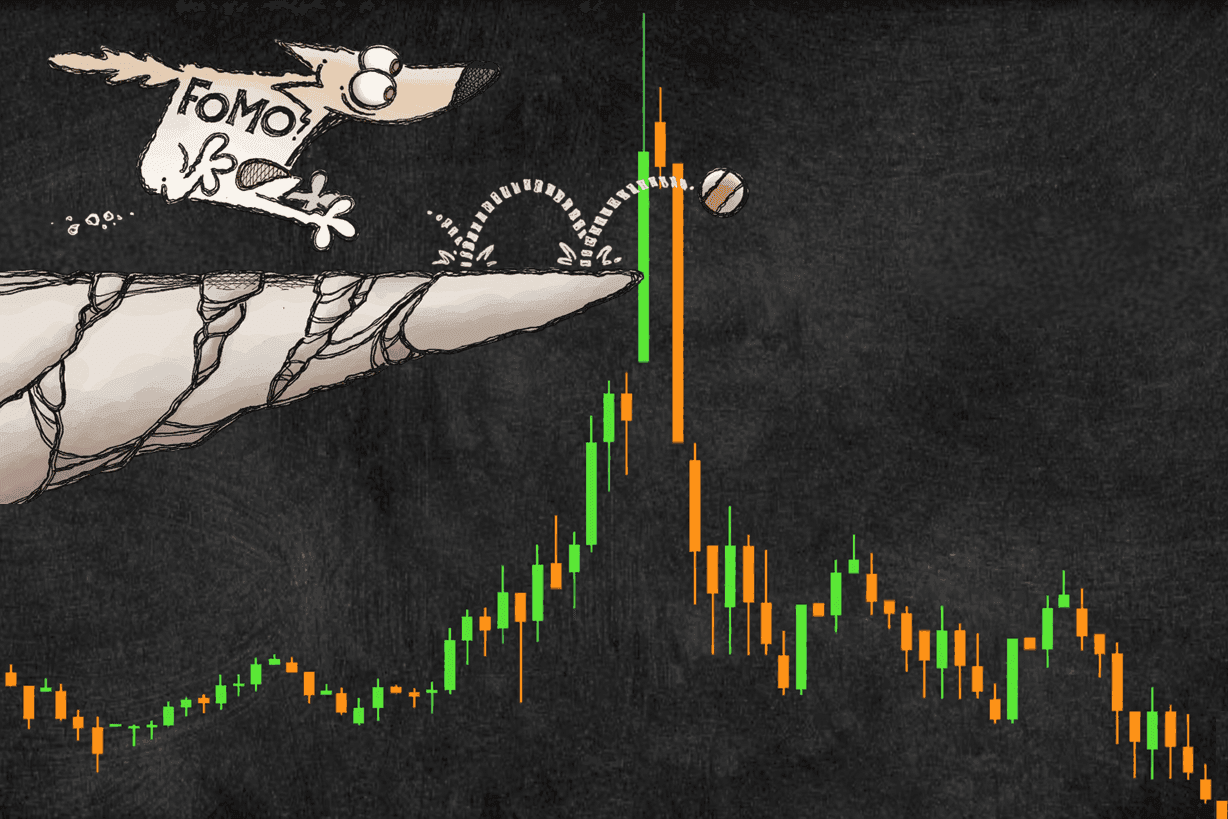
Exerato experienced FOMO frequently — and only became profitable after learning to control it. His framing is precise: a stop-loss is a fixed monetary loss, while FOMO is a loss in discipline. Jared Tendler, a licensed therapist and author of "The Mental Game of Trading," calls such impulse entries "entitlement tilt" — the belief that effort must convert into results.
FOMO leads to re-entries without a setup, increased risk, and revenge trading. One impulsive FOMO trade can erase five solid winning trades.
How Exerato fights FOMO: he returns to the two rules framed on his wall. The first — "I have no right to enter the market because it's moving without me." The second — "If there was no move according to my setup, it doesn't exist for me."
Why Traders Blow Accounts: Two Causes and How to Fix Them
Exerato identifies two root causes of account failure — with concrete fixes for each.
Cause 1: You lose too much. Large losses on a single trade or in a single day. Fix: strict risk management — 0.5–1% per trade, maximum two stops per day, then close the terminal. Never increase position size after a stop. Never move a stop-loss. With this approach, even twenty consecutive stops won't destroy the account.
Cause 2: You lose too often. Win rate below 40–50%, and even with controlled risk, the account bleeds out. Fix: backtest 100 trades on a chart, split them into two groups (profit and stop), find patterns — time of day, news presence, setup quality, volume. Remove what doesn't work. Repeat what does. Ban entries that are statistically unprofitable.
What the Payout Bought
First priority: an iPhone 17 Pro Max — a gift for his girlfriend. The rest is earmarked for scaling: Exerato plans to purchase a $200,000 challenge. The payout arrived on his crypto wallet, then moved to an exchange — the entire process took less than 10 hours.
What's Next
Exerato's ultimate goal is freedom — not tied to one place, not dependent on external factors. Just trading, sustaining life, from anywhere. The immediate next step: buying and passing a $200,000 challenge on Upscale.
Five years, $150,000 in losses, and dozens of blown accounts — that's the real cost of the system Exerato trades today. Prop trading didn't teach him discipline; it gave him a structure where discipline finally pays. A 70% win rate, 0.5–1% risk per trade, two stops and the terminal closes — these aren't textbook rules. They're rules written after watching $120,000 turn into $4,000 overnight.
The $5,600 payout from a $100,000 funded account is the first proof that the system works at scale. The next step — a $200,000 challenge — is already planned.
Ready to start your prop trading journey?
Start now: 👉 Upscale.trade | Telegram Bot
Follow us: 📺 YouTube | 𝕏 Twitter
Story recorded in March 2026. All figures and facts confirmed by payout certificates and platform records.
FAQ — Frequently Asked Questions
Can you make money in prop trading after losing $150,000 on your own?
Yes. Exerato lost over $150,000 on memecoins and cross-margin futures before switching to prop trading and receiving a $5,600 payout from a $100,000 funded account on Upscale. The key factor was adopting a systematic approach: keeping a trading journal, fixing risk at 0.5–1% per trade, and eliminating impulse decisions. According to FPFX Tech data from 300,000 prop accounts, only 7% of traders ever receive a payout — and the primary reason for failure is not lack of strategy but emotional trading and poor discipline.
What is Exerato's fractal and Fibonacci strategy?
Exerato trades on a clean chart using two candlestick models. The first is a one-hour inversion: an hourly candle sweeps a significant fractal and closes back, after which a Fibonacci grid is applied and a pullback to the zone of interest is awaited. The second is a two-hour inversion: the first hourly candle closes beyond the fractal, and the second engulfs it. Targets are set by Fibonacci levels, with a fixed risk-reward of 2.7 or 3.65. Win rate across 500 backtested trades: approximately 70%. The strategy works on both crypto and Forex.
How long does it take to pass a $100,000 prop challenge?
Exerato passed both phases of a $100,000 challenge on Upscale in 2 weeks, trading primarily Bitcoin and Ethereum in an intraday style. He received Funded Trader status on February 10, 2026, and the $5,600 payout on February 25, 2026. Actual timelines depend on strategy, market conditions, and trader discipline.
How do experienced traders choose between prop firms?
After trading on five or more prop platforms, Exerato identified four selection criteria: rule flexibility (some firms ban news trading or impose lot limits, which can conflict with specific strategies), terminal usability, support response time, and multi-asset access. He also notes that pricing varies significantly — entry costs across major prop firms range from $49 to $300+ for comparable account sizes, and profit splits typically fall between 75/25 and 90/10.
What is FOMO in trading and how do you deal with it?
FOMO (Fear of Missing Out) is the urge to enter a trade because the market is moving without you. Exerato considers FOMO more dangerous than a stop-loss: a stop is a fixed monetary loss, while FOMO is a loss in discipline that leads to re-entries without setups, increased risk, and revenge trading. His method: two rules written on paper and framed on his wall — "I have no right to enter the market because it's moving without me" and "if there was no move according to my setup, it doesn't exist for me."
How much does it cost to start prop trading on Upscale?
The minimum entry on Upscale starts at $59 for a Basic challenge on a $5,000 account. Three challenge types are available: Basic (two-phase), Accelerated (single-phase, faster), and Turbo (instant funding with no evaluation phases). Account sizes range from $5,000 to $200,000. Profit split is 80/20 with an option to upgrade to 90/10.