20-Year-Old Student Earns $400 Prop Trading Payout Starting With $200 | Upscale

Albert is a 20-year-old university student from Moscow who started trading at 18 with a $200 deposit and received payouts from two prop firms within two years. His journey includes a blown first prop account, a $170 payout on the second attempt, losing his account at one firm due to geopolitical restrictions on Russian traders, switching platforms, a $400 payout (10% of a $5,000 account) — and an honest breakdown of how post-payout euphoria led to blowing the account. According to FPFX Tech data from 300,000 prop firm accounts, only 7% of traders ever receive a payout — Albert received payouts from two separate firms before turning 21.
Watch the full interview with Albert on the Upscale YouTube channel:
20 Years Old, University, and $200 in Starting Capital
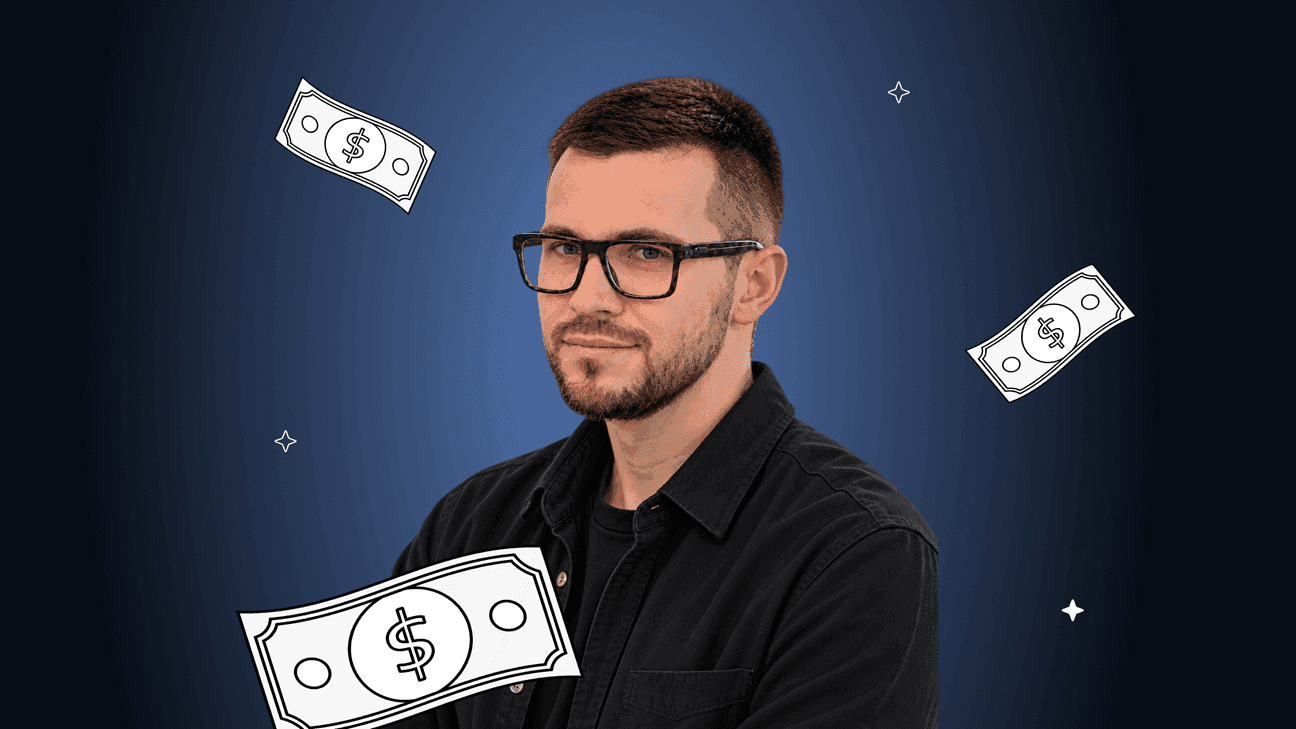
Albert is 20. He studies at a university in Moscow. Besides school — part-time jobs and sports. No "super extraordinary hobbies," as he puts it.
He got into trading at 18. And here's what's unusual: his father invited him in.
"My father had experience with binary options, then decided to move into classic trading and bring me along"
Usually it's the other way around — young people tell their parents about crypto. Here, the older generation opened the door.
First deposit — $200. Where does an 18-year-old student get trading capital?
"Saved from lunch money, from here and there, from part-time work"
From Forex to Crypto: Why He Switched Markets
Albert's first six months were on Forex. Then — again on his father's initiative — he expanded into crypto.
Why?
"Cryptocurrency periodically offers opportunities that no other market can — in terms of volatility and in terms of life-changing potential"
He describes 2025 in one word: terrifying.
"The most unusual experience of my entire life. With Trump coming in, his tariffs, the invalidation of any trading strategy, mass liquidations of a huge number of people I'd been following"
3–4 Months of Backtesting on a Live Chart
Before buying his first prop, Albert did what very few do: tested his strategy for 3–4 months. But not on historical data — on a live chart.
According to FPFX Tech, which analyzed 300,000 prop firm accounts, only 7% of traders ever receive a payout. A key reason is that traders buy challenges before testing their strategy in real market conditions. Albert avoided this mistake.
Why not on historical data?
"Backtesting on old data can distort your perception. As soon as live trades appear where you're risking your own money, fear of opening positions can set in"
He watched the chart in real time, looked for setups according to his system, recorded them. Only then — his first prop.
First Prop Blown. Second — $170 Payout
May 2025. First prop account at $5,000.
Result? Blown.
"Honestly, I didn't blame myself much because I understood — everything was just beginning"
The statistics confirm his calm: according to PipFarm data (survey of 2,777 prop traders, April 2025), only 5–10% of traders pass the evaluation phase on their first attempt. Blowing your first account is the rule, not the exception.
A month later — second prop. July, a volatile month. Passed both phases, generated profit on funded capital, and received his payout.
First payout: ~$170 (3.5% of $5,000)
"It feels good. It's actual money from trading. I decided not to wait for 10% — anti-FOMO kicked in and I withdrew"
What did he do with his first payout? Went to a print shop, printed a certificate, and hung it on the wall.
"It was genuinely a huge source of pride. The money isn't just on a screen — it's on my card"
Why He Left His First Prop Firm
A story familiar to many Russian-speaking traders.
After several payouts, that prop firm stopped working with Russian traders. The account was closed — right after Albert had received account scaling. This is not an isolated case: FTMO, the world's largest prop firm, also blocks registration for Russian residents alongside Iran, Syria, and North Korea.
"I hadn't even gotten an increased payout from the scaled account yet. They took the account — and I started bouncing between other props"
That's how he found Upscale.
How He Chose His Next Platform
Friends had recommended Upscale multiple times. He finally decided to read the rules in the documentation.
What mattered for his trading style:
-
No margin restrictions per trade. For scalping with tight stops, this is critical — you need large position sizes.
-
No limit on stop-loss percentage. Everyone's strategies are different.
-
Support that resolves issues in the trader's favor.
A story about support:
"When withdrawing my first payout, I accidentally set the withdrawal to 1 dollar. I wrote to support, explained the situation. They cancelled the payout, I requested a new one for the full amount. Withdrawn within 24 hours. Seems like a silly situation — but it's still resolved in the trader's favor"
$400 Payout: The Numbers
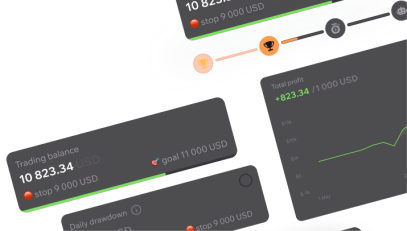
Account: $5,000 Passing both phases: ~3 weeks Time to payout: ~2 weeks Payout: $400 (10% of account, after 80/20 profit split)
"For many people, that's a month's salary depending on the region"
How He Trades: Smart Money on Three Timeframes
Albert learned from a trader on YouTube — for free, everything publicly available.
"It was important for me to understand not just what I'm drawing on the chart, but what it gives me"
Analysis structure:
- Daily chart — identifies the Dealing Range (area for finding trades)
- 4-hour chart — looks for nested levels, liquidity, points of interest (POI)
- 1-hour and 15-minute — entry point
What he trades:
- Imbalances
- Order blocks
- Liquidity grabs
- Premium/Discount zones
Instruments: Forex (EUR/USD) and crypto. Same strategy for both.
"In Forex, assets move based on macroeconomics. Crypto is more subject to narratives — some Elon Musk says he's selling Bitcoin and it tanks"
The One Trade Rule
Albert's main rule — which he "hasn't broken for a very long time":
"Whether the trade ends in a take-profit or a stop-loss — I stop trading for the day"
Why?
"A stop can be frustrating — it takes you out by 1 pip and then flies to your take-profit. In the case of a take-profit — euphoria. Either way, it's emotions. They affect how you perceive the market. The market doesn't forgive that"
PipFarm data supports this approach: 45.1% of successful prop traders make only 1–2 trades per day. Fewer trades — fewer emotional triggers — higher probability of maintaining discipline. Research by Locke and Mann (2005) at the Chicago Mercantile Exchange also found that traders who limited their activity after losses earned significantly more — stepping away is not weakness, it's risk management.
The exception — breakeven. Then he can open one more trade. Two breakevens in a row? Alright, third attempt. But if it doesn't work — step away until the next day or even the next week.
How He Blew His Account After the Payout
Yes, after the $400 payout, his funded account was closed. Albert honestly explains why:
"After receiving the payout, I felt like I was a super-trader. Euphoria kicked in. I started breaking my own plans — setting tighter stops, wider take-profits, holding some positions too long, entering others without enough reasons"
This is a textbook example of what Jared Tendler, author of "The Mental Game of Trading," calls entitlement tilt — the belief that "I deserve profits because I've already proven I can do this." The PipFarm survey shows that 37.5% of prop traders name emotional trading after results (both losses and profits) as their primary problem.
The drawdown reached −6%. He reduced risk, climbed back to −3%. Then fell again to −8%.
"At the −8% stage, I decided to go in with the remaining 2% — try to recover the loss. Price went against me. The account was closed"
Takeaway:
"I went through this situation, reflected on it, drew conclusions. Beyond acceptance, a trader doesn't have much else. You can be angry at the market, start increasing risk — but nothing good comes from that"
Albert's Certificates
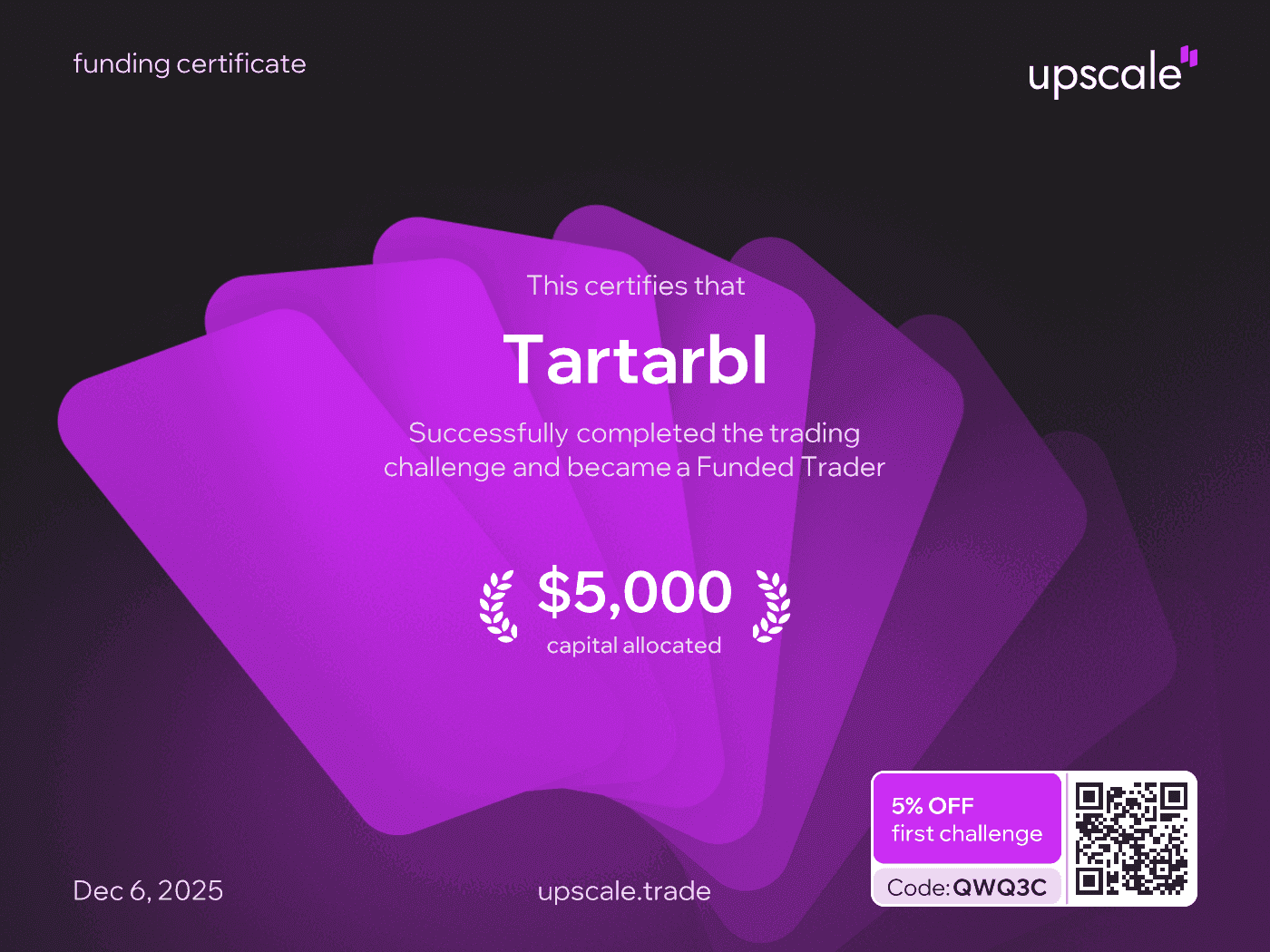
Certificate for passing the $5,000 challenge
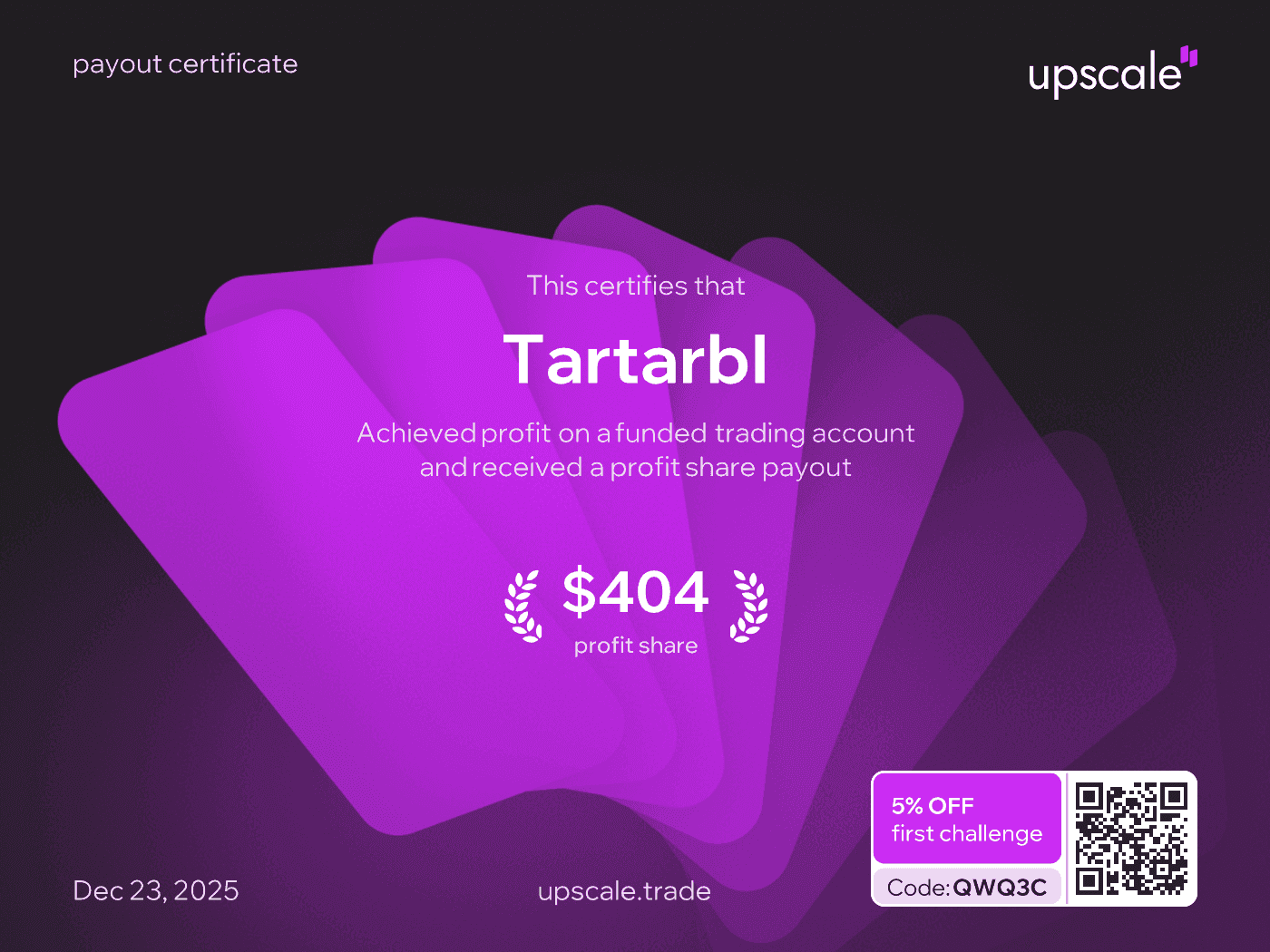
$404 payout certificate
Why He Continues After Blowups
After 2 years in trading, only about 10% of traders remain active. What keeps Albert going?
"I see that trading isn't a scam. It's a fully legitimate profession, provided you dedicate enough time and your approach is serious"
And a comparison with business:
"It works on a delayed gratification system. A business doesn't bear fruit on the first day. You work at a loss for a while, then break even, then revenue comes, then you enjoy the rewards. Trading is exactly the same"
Albert's Advice
1. Don't jump into props without preparation. Demo first, understanding your psychological profile, your reactions to losses and drawdowns.
2. Don't invent a strategy from scratch. Find someone with a working system that's freely available. Understand it. Adapt it to yourself.
3. Keep a trading journal. To understand how and why you entered, and to find mistakes over time.
4. The one trade rule. After a take-profit or a stop-loss — no more trading for the day. Emotions kill accounts.
5. Don't try to make it back. That's the path to blowing your account.
6. Don't look for the holy grail. A perfect system with no drawdowns doesn't exist.
"Try, don't be afraid. The market isn't some scary crocodile. Sure, it bites sometimes. But nobody truly knows what you're capable of except you"
Where Did the Payout Go?
It coincided with family birthdays — he bought gifts.
And rewarded himself:
"It's important to feel the fruits of your work. I set aside 10% of the payout, went to a restaurant. Had some meat, fish, drank some wine. Gave the gifts and ate the fish"
Key Takeaways
Albert's path to funded trading wasn't smooth — and that's exactly what makes it instructive. A blown first account, a $170 payout that proved the system works, a firm that dropped Russian traders overnight, and a $400 payout on Upscale followed by a euphoria-driven account blow-up. Every stage taught a lesson that no course could replicate: test before you buy, one trade per day, and the most dangerous moment in trading isn't the loss — it's the win that makes you feel invincible.
At 20, with $200 in starting capital and no formal trading education, Albert has payouts from two prop firms and a framework built on delayed gratification. The next challenge is already planned.
Ready to start your prop trading journey?
Start now: 👉 Upscale.trade | Telegram Bot
Follow us: 📺 YouTube | 𝕏 Twitter
Story recorded in 2025. All figures and facts confirmed by payout certificates.
Frequently Asked Questions
Can beginners make money in prop trading?
Yes, but the statistics require realistic expectations. According to FPFX Tech data (300,000 accounts), only 7% of prop traders ever receive a payout. Albert is proof it's possible even at 20 years old with $200 in starting capital, but it took 3–4 months of strategy testing and several blown accounts before he started receiving consistent payouts.
How long does it take to pass a prop firm challenge?
Albert passed both phases of his challenge in about three weeks, then received his payout within two weeks. However, timelines depend on strategy and market conditions. PipFarm data shows that 45.1% of successful prop traders make only 1–2 trades per day — speed of passing doesn't correlate with long-term success.
What is the one trade rule?
A rule Albert follows: after one completed trade (whether profit or loss), trading stops for the day. The reason — both take-profits and stop-losses trigger emotions (euphoria or frustration) that distort market perception and lead to discipline violations. The exception is if a trade closes at breakeven.
How much does it cost to start prop trading?
Entry costs vary by platform and account size. On Upscale, the minimum is $59 for a two-phase challenge (Basic) on a $5,000 RWA account. Accounts range from $5,000 to $200,000 with three challenge types: Basic (2 phases), Accelerated (1 phase), and Turbo (instant funding). Profit splits across major prop firms typically range from 75/25 to 90/10.
Is it normal to blow your first prop account?
Yes. According to PipFarm data, only 5–10% of traders pass the evaluation phase on their first attempt. Albert blew his first prop in May 2025 but passed the challenge and received a payout by July. The key takeaway: a blown account isn't the end of a career — it's part of the learning process, provided you analyze your mistakes and adjust your approach.
What strategy does Albert use?
Albert trades using the Smart Money (ICT) concept across three timeframes: daily chart for Dealing Range identification, 4-hour for finding liquidity and points of interest, 1-hour and 15-minute for entry points. He trades imbalances, order blocks, liquidity grabs, and Premium/Discount zones on both Forex and crypto.