12 Payouts From One Account: Kirill's Story | Upscale

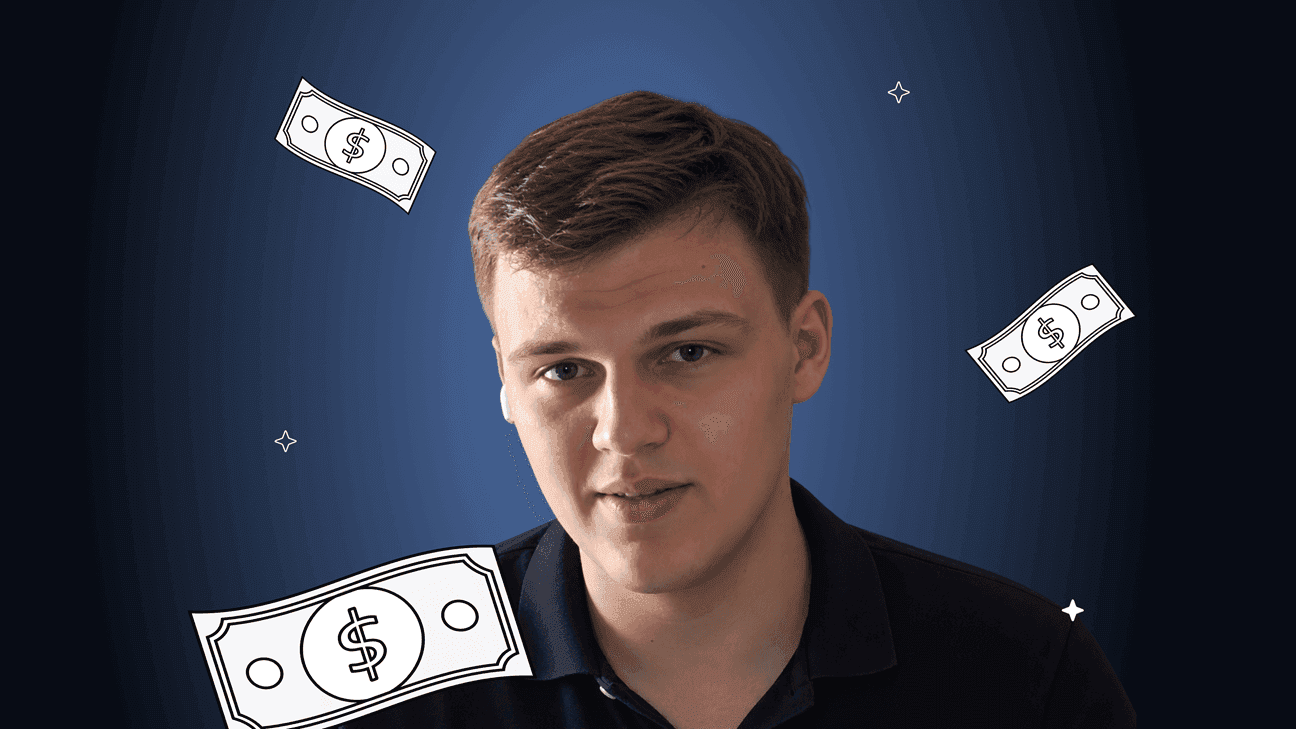
None of Kirill's 12 payouts is larger than $366. Together, though, they add up to $2,922 from a single $10,000 account — and the account itself has been running for over a year without ever being closed for a daily or maximum drawdown breach. Kirill is a product manager in fintech who trades BTC and ETH only in the mornings before work, and he explains why the account is still alive in a very unheroic way: "I'd just hate to lose it."
Before Upscale, he blew his deposit on 20× leverage and up, and failed challenges at several prop firms. This is the story of what changed, why he takes profit even when it's just 1%, and what he does when the account does go into the red.
"Everyone wants to be Bobby Axelrod"

Kirill is 27 and has been trading consciously for about four years. What brought him in was the TV series Billions — and crypto, with its easy entry.
"Everyone wants to be Bobby Axelrod when they watch that show. It's this pipe dream: you're on a beach with a laptop, sipping juice, trading an hour a day. Of course it hooked me — I fell for that trading propaganda."
The beach picture quickly fell apart. A different motive remained: Kirill likes being right — and the satisfaction that comes when a trade plays out exactly the way you planned it. He describes the cost of that feeling without any romance:
"It's hard to get into trading when you're watching a one-minute chart and your heart is moving pretty much the same way while you're in a trade. I don't think that's normal."
And one detail that surprises almost everyone who gets to know Kirill: he's a professional dancer.
Three stages of accepting risk

Kirill's path to prop trading is a path toward the external limits he was missing on his own account.
Stage 1: the stop is the liquidation
On the exchange, he never traded below 20× leverage, and liquidation did the job of a stop-loss. The deposit ran out quickly.
Stage 2: a risk model on paper
Then came books and the realization that he needed a risk model: a set number of risks per day, in percent or in dollars. Kirill introduced the model, but couldn't stick to it.
"The gambling itch got the better of me. You always think you're smarter than the market and can win it back — and your two risks a day turn into 'oh damn, I've already given away five.'"
Stage 3: limits you can't get around
On a prop account, the same scenario ends differently: the daily drawdown simply stops trading. In essence it's the same liquidation, but the cost of the mistake is the challenge fee, not your own money.
"On a prop account I'd have hit the daily drawdown and calmed down. That's clearly less than what I'd have lost on the exchange with my own money. If you didn't lose it, you earned it."
There was a practical reason too. Kirill trades before work and only takes a couple of trades each morning. For that volume to produce a meaningful result, he needs a large account — and he wasn't ready to put a large sum of his own money on an exchange. He doesn't recommend trading with borrowed money to anyone. Prop trading solved the problem: the same trades, but an account several times larger. And the rules gave him what he lacked himself:
"I still can't say I've fully formed as a trader. And on a subconscious level I understood that a prop firm would give me structure. All the drawdown rules only work in my favor, not against me."
Seven prop firms before the main one
Upscale isn't Kirill's first prop firm. He has tried about seven in total, and according to him, a crypto trader's choice is limited: most prop firms are still focused on forex and indices. He blew his challenges at BrightFunded, Breakout and FundingPips.
"It was my own fault, of course, but MetaTrader probably shares some of the blame — I just never got used to it."
Today he has live accounts at two prop firms. He kept the second one because of its familiar exchange-style terminal. The main one is Upscale:
"Upscale is my main prop firm. And I hope it stays that way — I have no desire to leave at all."
Strategy: consolidation breakouts on BTC and ETH
Kirill trades almost exclusively bitcoin and ether — judging by his account analytics, BTC makes up about half of all his trades. His strategy is breakout-based: he needs a consolidation that price will exit with momentum.
He marks levels on the 4-hour chart, ideally on the daily. But he admits that over the past year there have been almost no clean daily levels: the market keeps chopping. Bitcoin may draw messy charts, but it still forms clear consolidations — which means there's somewhere to put a stop.
"If I can place a stop, half the job is done — I can enter."
He doesn't hold positions for long: momentum is what matters to him. No momentum — the trade gets closed. Judging by his account analytics, Kirill is right in roughly every second trade.
Mornings only
Kirill's trading window is the morning before the US session opens. At that time, in his words, the market is "dead" and moves predictably — exactly what he needs for targets of 1:1 to 1:3 to risk. After the US open, especially on days when the Fed speaks, the predictability is gone:
"The market starts doing such crazy things that no matter what your strategy is, it would rip you apart on the short first, and then once more on the long."
The 30-minute rule
Hence his news filter. On days with economic data releases and Fed meetings, he tries not to trade at all. And if he does trade intraday, he doesn't open positions within 30 minutes after a release: first he watches where the market goes, and only then acts. Sudden statements and social media posts can't be predicted, but scheduled events are visible in the calendar in advance.
"When they come out to say something, I step away from the computer."
12 payouts: withdraw at every opportunity

Kirill received his first payout from the funded account on March 6, 2026, and the latest one as of the interview on September 18. That's 12 payouts totaling $2,922, around $244 on average. The largest was $366 (July 3), the smallest $130 (June 17).
Behind this regularity is a simple rule: take profit in every payout period. On Upscale, a payout can be requested no earlier than 14 calendar days in and with at least five profitable days, and the count restarts after each withdrawal (withdrawal rules). Kirill makes the most of it:
"Once the fourteen-day period is over, if I have anything in profit, I always withdraw it. Even if it's, say, one percent — I'll take it and withdraw it."
The logic is simple: profit that has been withdrawn can't be taken back by the market. And Kirill explains his caution in a far from heroic way:
"As a smart trader, I'll say I have a risk management plan that I follow. But as a not-so-smart person who spent a very long time passing this challenge — I'd just hate to lose the account."
For him, the value isn't in the amount:
"What matters to me isn't the amount, it's that I can withdraw money every month. Just knowing that I trade consistently: I've found something, the system works."
For his consistent results, Upscale granted Kirill a $25,000 challenge placed straight at the funded stage.
Where the payouts go
Kirill has put about 70% of his payouts into new prop accounts — including on other platforms.
"You shouldn't put all your eggs in one basket either."
The goal is to grow his total funded account notional so that the same 2.5–5% a month he says he withdraws on average comes from a larger base. And ultimately — free cash and financial independence.
Being honest about the drawdown
At the time of the interview, both of Kirill's accounts were down about 7% — in his words, the biggest drawdown he has ever had.
The reason is a market that doesn't suit his strategy. Bitcoin spent a week and a half in a narrow range: every dip and every rally got bought or sold back, and breakouts didn't follow through. In that chop Kirill got "jerked around" — and so did his balance. A similar scenario is covered in Dmitry's story, about how a sideways market slowly eats an account.
The key episode was a single day when he lost 2.5–3% on both accounts. That's twice his personal daily limit.
"Tilt won."
The account still stayed within the platform's limits and keeps running. And Kirill's takeaway sounds simple, but it's the hardest one to follow:
"The main thing I've learned: you need to keep doing what you were doing, no matter what's happening."
Kirill's advice
Unsubscribe from trading channels
The first thing Kirill recommends to beginners is to cut out other people's noise.
"Unsubscribe from all the Telegram channels that talk about trading, send news and break down trades."
Accept the losses
Losing trades are normal. There's no need to beat yourself up and try to win it back on the spot: you should have a loss limit and understand that the market isn't going anywhere.
"You don't have to trade the whole market today. You can come back tomorrow, find something for yourself the day after. And sometimes it may be time to take a vacation and not trade."
Don't fidget in a trade
"Once you're in a trade, that's it — don't fidget. If you had reasons to enter the trade, then you have no reasons to exit it."
Other Upscale traders have reached the same conclusion — that discipline matters more than strategy — in their own way, for example Artem, who now trades only on prop accounts after losing 70% of his deposit.
Payout certificates
All 12 of Kirill's payouts come from a single $10,000 funded account purchased in August 2025.
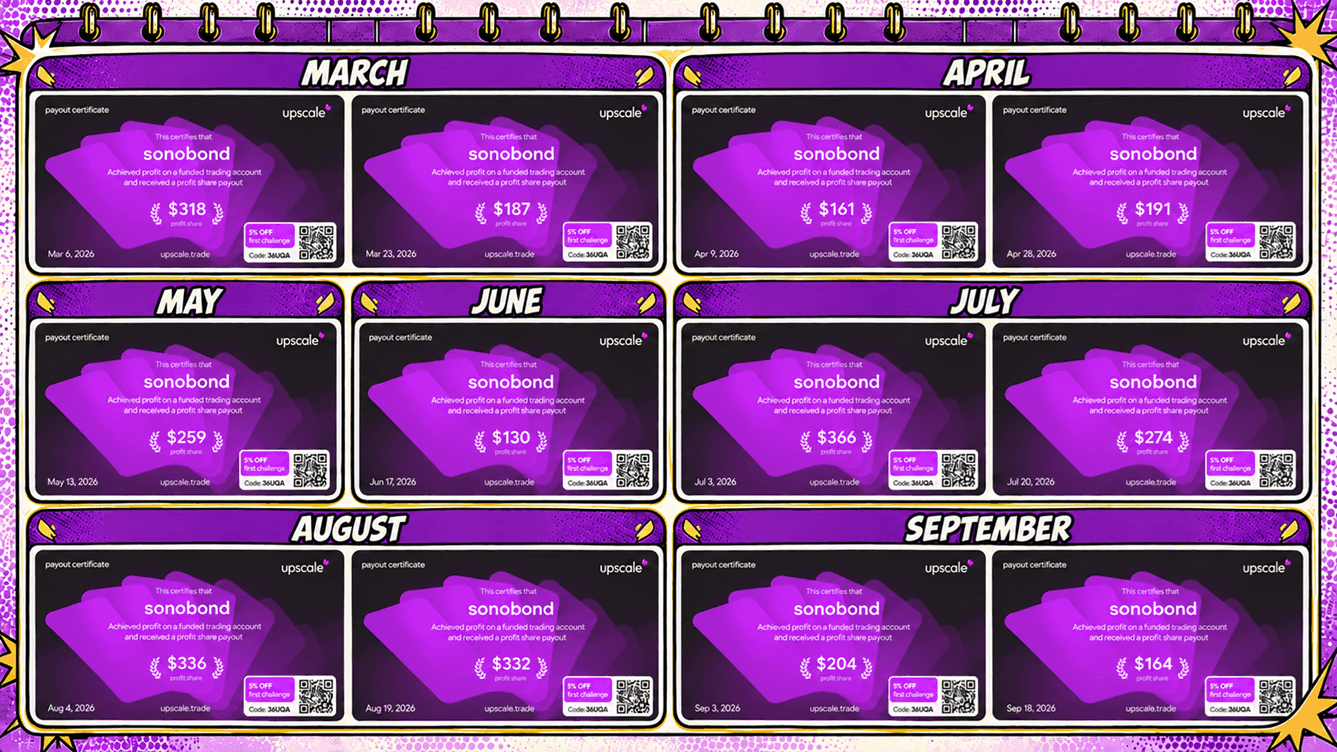
Kirill's payouts from a $10,000 funded account: $318 (March 6), $187 (March 23), $161 (April 9), $191 (April 28), $259 (May 13), $130 (June 17), $366 (July 3), $274 (July 20), $336 (August 4), $332 (August 19), $204 (September 3), $164 (September 18, 2026). Total: $2,922.
Verification
Kirill's results are verified by:
- An interview on the Upscale YouTube channel with payouts shown on screen
- 12 Upscale payout certificates from the $10,000 funded account
- Account analytics in the platform interface
All Upscale payouts are made on-chain and can be independently verified on the blockchain.
Key takeaways
Kirill's story shows that consistency matters more than size. None of his 12 payouts exceeds $366, but together they add up to $2,922 from a single $10,000 funded account that has been running for over a year without a single rule breach. The habit of withdrawing profit in every payout period, even when it's 1%, turns profit on the screen into money in the wallet and leaves the market no chance to take back what's been earned. And the motive behind it is very human: an account he spent a long time passing is simply too valuable to lose.
The second takeaway is about structure. On his own deposit, Kirill went down the classic path: 20× leverage and up with liquidations, then a risk model that kept breaking under the urge to win losses back. Prop limits did what willpower couldn't: extra risk in a day stopped costing the deposit and started costing a halt to trading. On top of those limits, Kirill built his own rules — trade only in the mornings before the US open, never enter without a clear stop, and don't open positions within 30 minutes after major news.
The third takeaway is about drawdowns. Even a trader with 12 payouts in a row goes through periods when the account is down 7% and he himself breaks his own limit on one of the days. Kirill doesn't hide it and doesn't rebuild his system under pressure: he keeps doing what worked, takes breaks when the market doesn't suit his strategy, and spreads risk across several accounts. His advice to beginners is to unsubscribe from other people's signals, accept losses as part of the job and, once in a trade, not to fidget.
Start now: 👉 Upscale.trade | Telegram Bot
Follow us: 📺 YouTube | 𝕏 Twitter
Community: 💬 Telegram chat | 🎮 Discord
Frequently Asked Questions
How much has Kirill earned on Upscale?
$2,922 across 12 payouts from a $10,000 funded account between March 6 and September 18, 2026. The average payout is around $244, and the largest is $366. The account was purchased in August 2025 and has never been closed for a daily or maximum drawdown breach. For his consistent results, Upscale granted Kirill a $25,000 challenge placed straight at the funded stage.
How often does Kirill withdraw profit?
At every opportunity — roughly every two weeks. On Upscale, a payout can be requested 14 calendar days after moving to the funded account or after the previous withdrawal, with at least five profitable days. If the account is in profit at the end of the period, Kirill withdraws, even if it's only about 1%.
What strategy does Kirill trade?
Consolidation breakouts on BTC and ETH, with BTC accounting for about half of his trades. He marks levels on the 4-hour and daily charts, enters only when it's clear where to place the stop, and closes the position if there's no momentum. He trades in the mornings before the US session opens, with targets of 1:1 to 1:3 to risk.
Why doesn't Kirill trade during news?
Fed speeches and economic data releases cause sharp moves in both directions that knock out stops whatever the strategy. On those days he tries not to trade at all, and intraday he doesn't open positions within 30 minutes after a release — first he watches where the market goes.
Why does Kirill trade on a prop account instead of his own deposit?
He only takes a couple of trades in the morning before work, and that volume produces a meaningful result only on a large account — he isn't willing to risk a comparable sum of his own money. On top of that, drawdown limits stop him exactly where, on an exchange, he would keep trying to win losses back: the most he can lose is the challenge fee.
Is it normal to be in drawdown on a funded account?
In Kirill's experience — yes. At the time of the interview, his account was down about 7% after a week and a half of sideways BTC and one day when he lost twice his personal daily limit. The main thing, he says, is to keep doing what worked and not try to win it back.
What does Kirill advise beginners?
Three things: unsubscribe from Telegram channels with news and trade breakdowns; accept losing trades as normal, keep a loss limit and don't be afraid to skip a day or take a break; and don't fidget in an open trade — if you had reasons to enter, you have no reasons to exit.