What is Prop Trading? How It Works in 2026 | Upscale

Prop trading (proprietary trading) is a model where a trader uses a firm's capital instead of their own. The trader pays a challenge fee ($59–$999), passes an evaluation proving risk management skills, and receives a funded account ranging from $5,000 to $200,000. Profits are split between the trader and the firm — typically 80/20 or 90/10 in the trader's favor. According to FPFX Tech data from 300,000 prop firm accounts, only 7% of traders ever receive a payout. Below is a breakdown of how the model works, how it compares to trading personal capital, and what beginners need to know before their first challenge.
How Prop Trading Works
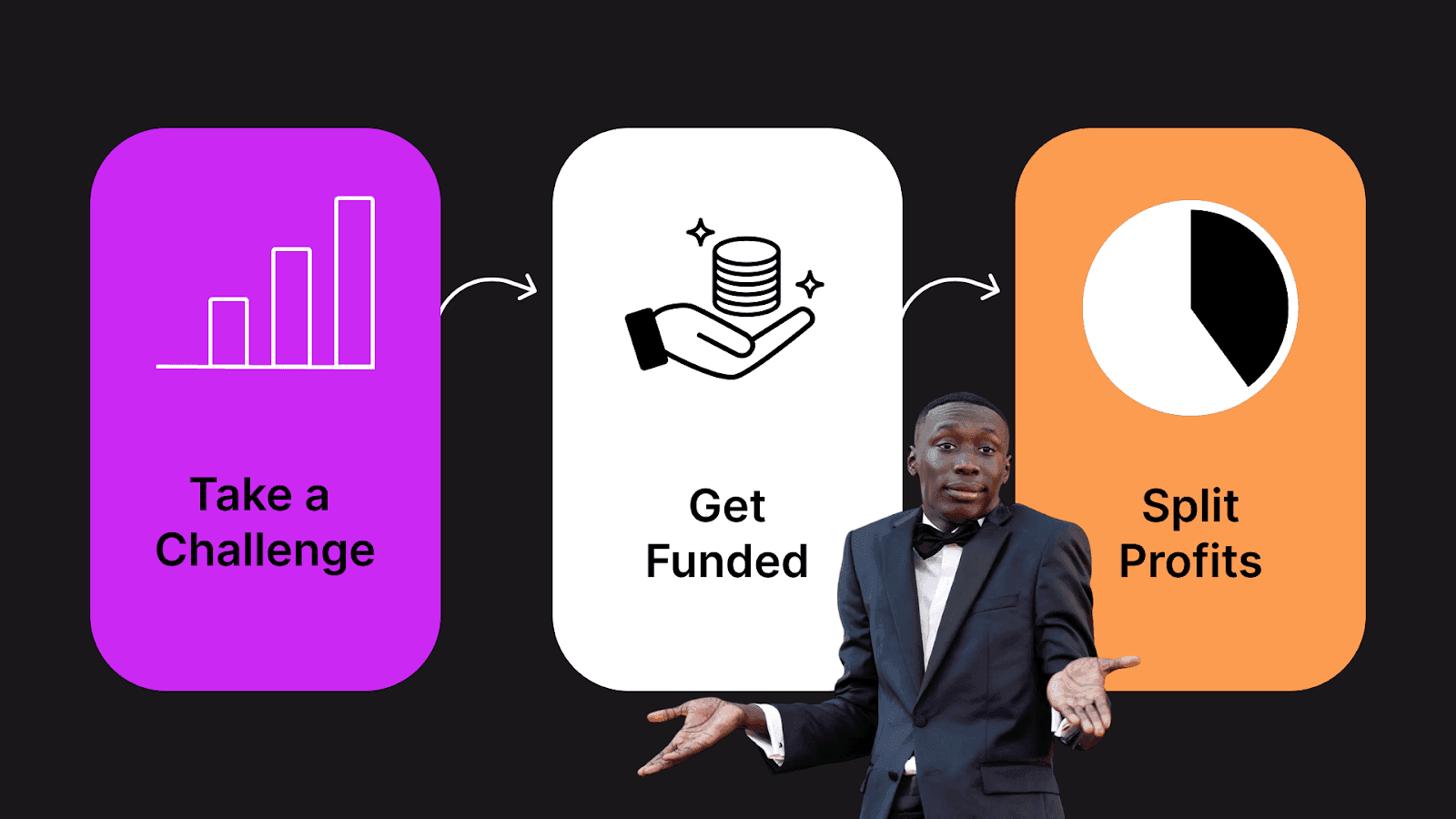
The prop trading model has three stages: evaluation, funded trading, and profit withdrawal.
Stage 1 — Evaluation (challenge). The trader pays a fee and trades on a demo account with real market data. The goal: reach a profit target (typically 5–10%) without exceeding drawdown limits. This proves the trader can manage risk before being entrusted with real capital.
Stage 2 — Funded account. After passing the evaluation, the trader receives access to a funded account. Position sizes, instruments, and strategies are up to the trader — within the firm's risk parameters (daily drawdown and maximum drawdown limits).
Stage 3 — Profit withdrawal. Profits are split according to the agreed ratio. Industry standard ranges from 75/25 to 90/10 in the trader's favor. Payouts typically occur after a minimum trading period (often 14 days) and require a minimum number of profitable trading days.
A concrete example: A trader pays $540 for a $50,000 challenge. They pass both evaluation phases in 20 days, receive a funded account, and generate $14,000 in profit over two weeks. With an 80/20 split, their payout is $11,200 — a 20x return on the challenge fee. This is not hypothetical: it's the verified result of trader speculator1337, documented with payout certificates.
Why the Model Exists: The Economics Behind Prop Firms
Prop firms aren't charities — they operate on a simple economic model. Challenge fees provide revenue from the ~93% of traders who don't reach a payout (FPFX Tech data). The 7% who do receive payouts are profitable enough that the firm earns from its share of the split.
For the trader, the math works differently. Research by Barber and Odean (2000), studying 66,465 households with brokerage accounts, found that the average individual investor underperforms the market by 2–5% annually — largely due to emotional trading, overconfidence, and poor risk management. Prop firms address two of these three problems structurally: drawdown limits enforce risk management, and the challenge model filters for traders who can maintain discipline under pressure.
Prop Trading vs. Trading Your Own Capital
The differences go beyond capital size. The structural constraints of prop trading fundamentally change trading behavior.
| Parameter | Prop Trading | Trading Personal Capital |
|---|---|---|
| Capital at risk | Challenge fee only ($59–$999) | Entire deposit |
| Account size | $5,000–$200,000+ | Limited to personal savings |
| Risk management | Enforced by platform (daily drawdown, max drawdown) | Self-discipline only |
| Profit share | 75–90% to trader | 100% to trader, but from smaller capital |
| Psychological pressure | Lower — "not my money" effect | Higher — every dollar feels personal |
| Scaling | Buy a larger challenge | Save more money or take more risk |
The psychological dimension deserves emphasis. A PipFarm survey of 2,777 prop traders (2025) found that 37.5% named emotional trading after losses as their primary problem, and 37.8% cited lack of discipline. Multiple funded traders — including those profiled in verified success stories — report that built-in drawdown limits taught them more discipline than years of trading personal accounts.
Research by Locke and Mann (2005) at the Chicago Mercantile Exchange confirms this: traders who cut losses faster earned on average 65% more per year. Prop drawdown limits enforce fast loss-cutting automatically.
What a Prop Trading Challenge Looks Like
Challenge structures vary across firms, but the core mechanics are similar:
Profit targets. Typically 5–10% of the account balance, measured in realized PnL (closed trades only). Some firms use a single-phase evaluation; others use two phases with different targets.
Drawdown limits. Two types: daily drawdown (maximum loss allowed in a single day, usually 3–5%) and maximum drawdown (total loss allowed across the entire evaluation, usually 6–10%). Exceeding either limit terminates the challenge.
Minimum trading days. Most firms require 3–10 trading days to prevent lucky single-trade passes. This ensures the trader demonstrates consistency, not just one good position.
No time limit. Many modern prop firms have removed maximum time limits — the trader can take as long as needed to reach the profit target, provided they don't violate drawdown rules.
For specific challenge parameters and pricing across different account sizes, see the participation requirements.
Who Prop Trading Is For
Prop trading isn't for everyone — but it addresses specific problems that affect different types of traders.
For beginners with limited capital: The minimum entry cost ($59 on some platforms) provides access to accounts 50–100x larger than what most beginners can fund personally. The built-in risk limits prevent the kind of catastrophic mistakes that wipe out personal accounts in the first weeks.
For experienced traders who lack capital: A trader with a proven strategy on a $1,000 personal account can apply the same edge to $50,000–$200,000. The same 5% monthly return yields $50 on personal capital versus $2,500–$10,000 on a funded account.
For traders who struggle with discipline: The enforced drawdown limits serve as external guardrails. Jared Tendler, author of "The Mental Game of Trading," describes this as "structural discipline" — external constraints that protect traders when self-control breaks down. Multiple traders in published case studies confirm that prop limits changed their behavior permanently.
For those in regions with limited financial access: In countries where access to western financial instruments is restricted or banking transfers are complicated, prop firms with cryptocurrency payouts (USDT, USDC) provide a path to earning from trading without dependence on the banking system.
Common Mistakes in Prop Trading Challenges
According to industry data, only 5–10% of traders pass the evaluation on their first attempt. Here are the most common reasons for failure:
Trading too aggressively to hit the target fast. The profit target creates urgency. Traders increase position sizes, skip stop-losses, or take low-quality setups. PipFarm data shows that 45.1% of successful prop traders make just 1–2 trades per day — patience, not volume, correlates with success.
Ignoring the daily drawdown limit. Many traders focus on the maximum drawdown but underestimate the daily limit. One bad day can terminate a challenge even when the overall account is healthy. Setting a personal daily limit at 50–70% of the firm's limit provides a safety buffer.
Not testing the strategy on a demo first. Buying a challenge without confirming your strategy works in current market conditions is the most expensive mistake. FPFX Tech's 7% payout rate reflects, in part, the number of traders who skip this step.
Revenge trading after losses. A PipFarm survey found that 37.5% of traders identify emotional trading after losses as their primary problem. The fix: a hard rule — after 2–3 consecutive stops, take a mandatory break of at least 30 minutes.
Tips for Passing Your First Challenge
1. Start with the smallest account. A $5,000 account with a $59 fee is a low-risk way to learn how prop rules work before committing to larger challenges.
2. Risk 0.5–1% per trade maximum. This ensures that even a streak of 10 consecutive losses won't exceed your drawdown limits. Position sizing is the single most important variable in prop trading.
3. Keep a trading journal. Log every trade: instrument, direction, risk, and — critically — your emotional state. After 30 days, you'll see patterns that no indicator can reveal.
4. Follow the one-trade rule. After one completed trade (whether profit or loss), consider stopping for the day. Both wins and losses trigger emotions that distort judgment on subsequent trades. PipFarm data shows that 45.1% of successful prop traders make just 1–2 trades per day.
5. Treat the challenge as 100 trades, not one exam. One losing trade isn't failure — it's a normal event in a probabilistic system. If your strategy is profitable across a series, individual losses are operating expenses.
For more on managing trading psychology, see our guides on the "Best Loser Wins" philosophy and five types of trading tilt.
Key Takeaways
Prop trading solves three problems at once: limited capital, weak self-discipline, and the catastrophic losses that come from trading personal savings without external constraints. The trader pays a small fee, proves they can manage risk on a demo account with real market conditions, and gets access to capital that would take years to save. The trade-off is the profit split — typically 80/20 or 90/10 in the trader's favor — but a 5% return on $50,000 dwarfs a 5% return on $500.
The model isn't a shortcut. Only 7% of prop traders ever receive a payout, and only 5–10% pass on their first attempt. But the reasons for failure are well-documented: emotional trading, lack of discipline, ignoring drawdown limits — not lack of strategy. The traders who succeed treat the challenge as a 100-trade probabilistic system, not a one-shot exam. They use the firm's drawdown limits as architecture, not as enemies. And they understand that position sizing matters more than indicators, timing, or technical analysis. For anyone with a working edge but limited capital, prop trading is the most efficient way to scale.
Ready to start your prop trading journey?
Start now: 👉 Upscale.trade | Telegram Bot
Follow us: 📺 YouTube | 𝕏 Twitter
Frequently Asked Questions
What is prop trading and how does it work?
Prop trading (proprietary trading) is a model where a trader uses a firm's capital instead of their own. The process has three stages: the trader pays a challenge fee and passes an evaluation (demonstrating profitable trading within risk limits), receives a funded account ($5,000–$200,000+), and withdraws profits split with the firm (typically 80/20 or 90/10 in the trader's favor). According to FPFX Tech data from 300,000 accounts, only 7% of traders ever receive a payout.
How much does it cost to start prop trading?
Challenge fees vary by platform and account size. Entry costs across major prop firms range from $29 to $999+ depending on the account size ($5,000 to $200,000). On Upscale, the minimum is $59 for a $5,000 Basic RWA account. Three challenge types are available: Basic (two-phase), Accelerated (single-phase), and Turbo (instant funding with no evaluation).
Can you lose money in prop trading?
Your risk is limited to the challenge fee. If you fail the evaluation or violate drawdown rules on a funded account, you lose access to the account — but not personal funds beyond the fee. This is the fundamental difference from trading personal capital, where the entire deposit is at risk.
What percentage of traders pass prop firm challenges?
Industry data suggests 5–10% of traders pass on their first attempt. According to FPFX Tech data from 300,000 accounts, only 7% ever receive a payout. The primary causes of failure are emotional trading (37.5%) and lack of discipline (37.8%) according to a PipFarm survey — not lack of strategy.
What happens if you break prop firm rules?
Exceeding daily drawdown or maximum drawdown limits results in immediate account termination. All open positions are closed, and the trader loses access to the funded account. The trader can purchase a new challenge and start over. Some platforms offer drawdown protection — a paid option that allows surviving one daily limit breach without losing the entire challenge.
Can you combine prop trading with a full-time job?
Yes. Prop trading is fully remote and online. Many funded traders — including those in published success stories — trade from phones during commutes, analyze charts before work shifts, and manage positions during breaks. Strategies based on higher timeframes (4-hour, daily) require minimal screen time.
How do you choose a reliable prop firm?
Key factors: transparent rules documented in detail (not just FAQ pages), verified trader payouts (ideally with certificates or video interviews), independent reviews (Trustpilot, community forums), clear pricing without hidden fees, and responsive support. Avoid firms that promise guaranteed profits — that's the primary indicator of fraud in the prop trading market.
What instruments can you trade at a prop firm?
Available instruments vary by firm. Some focus exclusively on forex, others on crypto, and some offer both. The most versatile platforms offer crypto perpetual futures, forex pairs, and commodities (gold, silver, oil) — sometimes all accessible from a single account.