Maximum Drawdown: How to Calculate and Reduce MDD | Upscale


Maximum drawdown (MDD) is the largest peak-to-trough decline in portfolio value, expressed as a percentage. The formula is straightforward: (Trough Value − Peak Value) ÷ Peak Value × 100. A portfolio dropping from $150,000 to $120,000 has a −20% MDD. The metric matters because it reveals the worst-case scenario a strategy produced historically, determines how much recovery is required to reach new highs, and anchors the risk limits enforced by prop trading firms. According to FPFX Tech data from 300,000 prop firm accounts, only 7% of traders ever receive a payout — and drawdown violations are one of the primary causes of failure. Most strategies die not because the edge disappeared but because the drawdown exceeded the trader's psychological or financial tolerance. Below is a breakdown of how to calculate MDD correctly, what real-world examples look like, how it compares to other risk metrics, and three strategies for reducing it.
How to Calculate Maximum Drawdown
Maximum drawdown calculation follows four systematic steps. Accuracy matters because MDD determines risk limits in funded accounts and reveals the true shape of a strategy's risk profile.
Step 1: Track portfolio values at regular intervals. Daily or weekly recording captures all movements accurately. Monthly snapshots miss intraday volatility and underestimate true MDD.
Step 2: Identify all peak values where the portfolio reached new highs. Each new peak starts a potential drawdown measurement. Multiple peaks occur throughout trading history, and each requires separate evaluation.
Step 3: Find the lowest trough following each peak before the next new high. The trough represents maximum decline from that specific peak. Recovery to a new high ends that drawdown period, and the next decline starts a fresh drawdown measurement.
Step 4: Calculate (Trough − Peak) ÷ Peak × 100 for each peak-trough pair. Select the most negative result as MDD. This represents the worst historical decline from any peak.
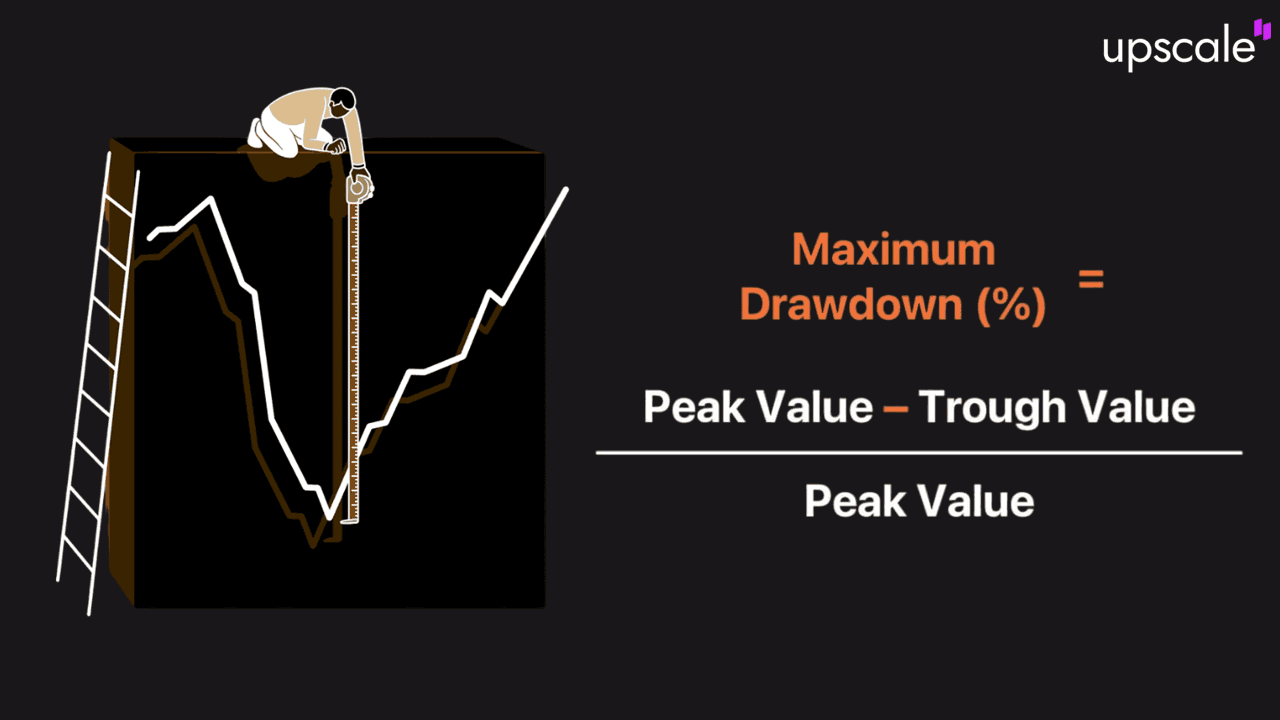
A detailed worked example demonstrates the calculation. A portfolio reaches a $500,000 peak on June 15, declines to $350,000 trough by August 3, then recovers to $450,000 by September but never exceeds the original $500,000 peak. Calculation: ($350,000 − $500,000) ÷ $500,000 × 100 equals −30% MDD.
Recovery to $450,000 does not end the drawdown period. The portfolio remains −10% below the peak even after partial recovery. Only reaching a new high above $500,000 closes the drawdown and starts a fresh measurement cycle.
A common mistake is calculating from the starting balance instead of the highest peak value. MDD is always measured from the peak, not the initial investment. This distinction becomes critical after account growth. Example: an account starts at $100,000 on January 1, grows to a $150,000 peak by March 15, then drops to $120,000 by May 30. MDD equals −20% from the $150,000 peak, not −20% from the initial $100,000. The starting balance becomes irrelevant after growth occurs.
Another example demonstrates multiple drawdown periods. An account starts at $100,000, grows to $140,000 (first peak), drops to $120,000 (first trough = −14.3% drawdown), recovers and grows to $160,000 (new peak), then drops to $130,000 (second trough = −18.75% drawdown). MDD equals −18.75% — the larger of the two drawdowns. Peak-to-trough measurement captures true risk exposure at each point.
Real-World Maximum Drawdown Examples
Historical benchmark data provides context for typical MDD ranges. Recent examples show real market conditions and recovery dynamics.
COVID-19 Crash (2020)
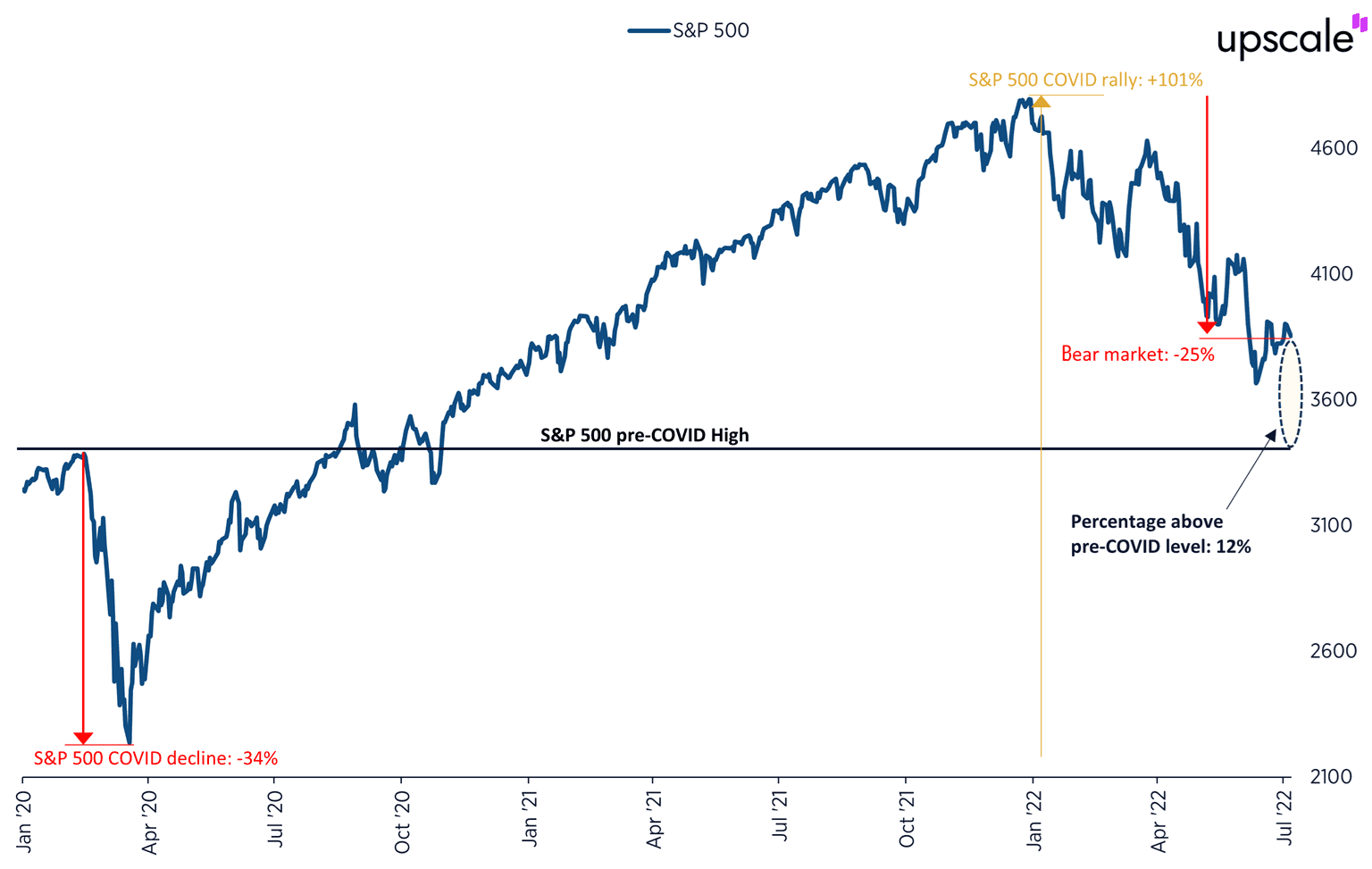
The S&P 500 experienced −34% MDD from the February 19, 2020 peak (3,386 points) to the March 23, 2020 trough (2,237 points). The fastest recovery in history followed — return to new highs took just five months, reaching them by August 18, 2020. The entire crash lasted only 32 days peak-to-trough, showcasing the extreme volatility modern markets can produce. Federal Reserve intervention and fiscal stimulus drove the rapid bounce, producing a V-shaped recovery that defied historical precedent.
The lesson: even the worst crashes can recover quickly with proper policy response. Traders who sold at the trough locked in permanent losses; those who maintained positions through the volatility recovered fully. But this assumes they could psychologically survive a 34% decline in five weeks — which most cannot.
2022 Bear Market
The S&P 500 suffered −25.4% MDD from the January 3, 2022 peak ($4,818) to the October 12, 2022 trough ($3,577). Federal Reserve rate hikes and inflation concerns drove the sustained decline, and recovery to new highs took until January 2024 — roughly 24 months from peak.
This drawdown demonstrated different characteristics than 2020: a slow grinding decline rather than a rapid crash. Multiple failed rallies trapped optimistic buyers, and the duration created a psychological challenge that tested patience severely. Long drawdowns often prove harder to endure than fast ones because they wear down discipline over months rather than days.
Sector Comparison and Recovery Mathematics
The Nasdaq 2022 suffered −36% MDD, showing technology sector vulnerability. Individual stocks faced even larger declines — Netflix dropped −77% from peak, and Meta declined −74% during the same period. These examples show that individual stock risk substantially exceeds index risk. The S&P 500 declined −25% while the average component dropped −40% or more. Diversification reduces MDD significantly.
Recovery mathematics creates an asymmetric challenge. A 50% loss requires a 100% gain to break even. The breakdown by drawdown size:
| Drawdown | Required Gain to Recover |
|---|---|
| 10% loss | 11.1% gain |
| 20% loss | 25% gain |
| 30% loss | 42.9% gain |
| 50% loss | 100% gain |
| 75% loss | 300% gain |
A strategy generating 20% annual returns needs approximately five years to recover from a 50% drawdown. The same strategy recovers from a 20% drawdown in roughly one year. The asymmetry is why professional risk management focuses obsessively on limiting drawdown size — the math punishes deep holes exponentially.
These recent drawdowns show why prop firms enforce strict drawdown limits. Smaller drawdowns enable faster recovery, and tight limits protect both firm capital and trader psychology. According to a PipFarm survey of 2,777 prop traders (2025), 73% of failed accounts violated their own stop-losses in more than 30% of cases — and violating stops is exactly how small controlled drawdowns turn into account-ending catastrophes.
Maximum Drawdown vs. Other Risk Metrics
MDD-based metrics complement volatility-based measures for complete risk assessment.
Calmar Ratio
The Calmar Ratio equals Annual Return divided by MDD. It measures return per unit of drawdown. Values above 2.0 indicate strong risk-adjusted performance.
Example calculation: a 25% annual return with 12% MDD equals a Calmar Ratio of 2.08 — excellent risk-adjusted performance. A 25% return with 35% MDD equals a Calmar of 0.71 — substantially weaker despite the same headline return, because the path to get there involved much deeper holes.
Sharpe Ratio Comparison
The Sharpe Ratio uses standard deviation (volatility) instead of MDD as the denominator. A Sharpe above 1.0 represents acceptable performance; above 2.0 is very good.
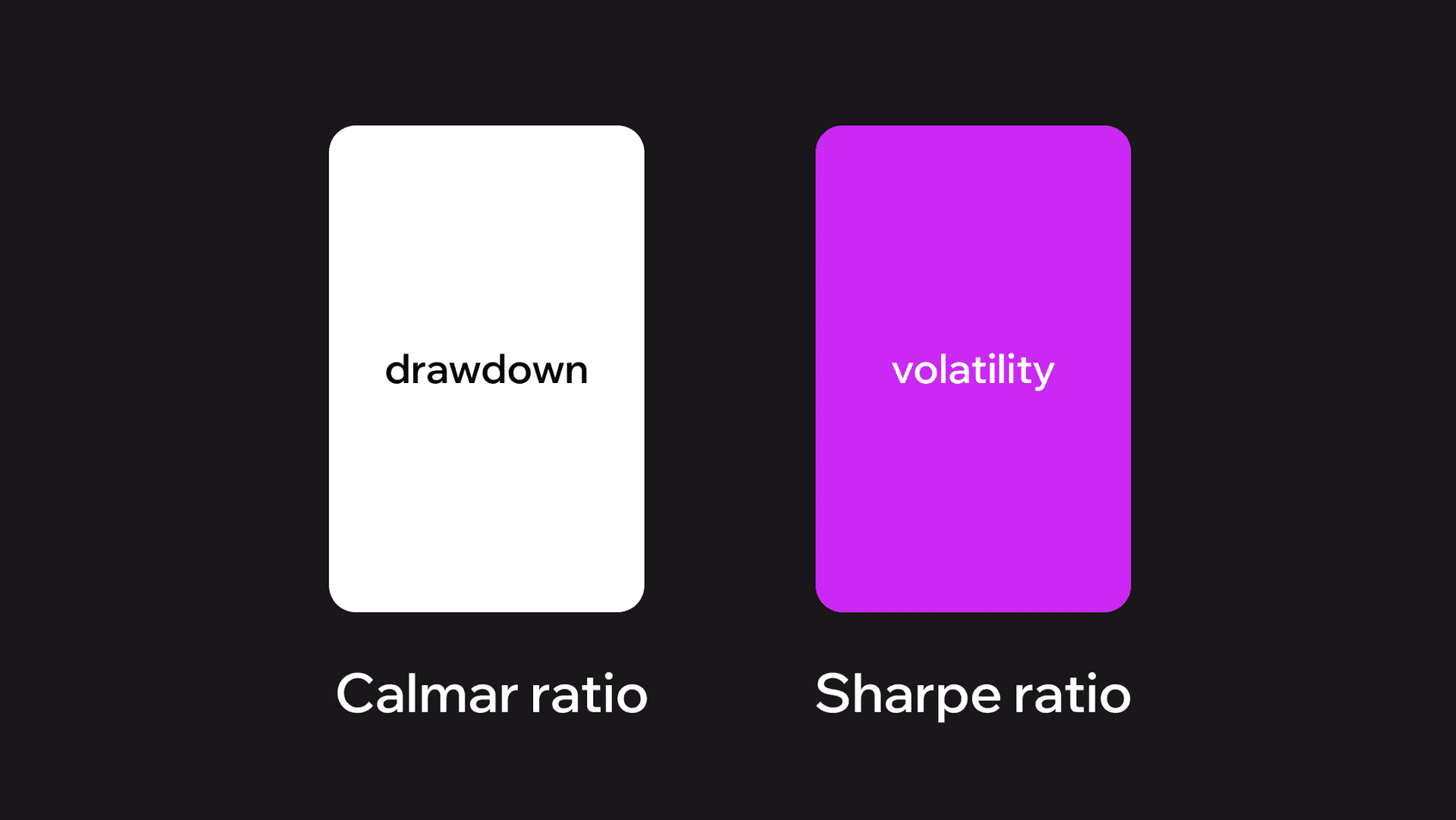
Key distinction: Calmar focuses on downside risk (actual losses), while Sharpe measures total volatility (both up and down moves). Different perspectives reveal different insights. A strategy with high upside volatility but low drawdowns will have mediocre Sharpe but strong Calmar — and from a risk management perspective, that's a good strategy. A strategy with stable monthly returns punctuated by occasional severe drawdowns will have good Sharpe but poor Calmar, and is more dangerous than the headline numbers suggest.
Practical Application
Calmar works better for drawdown-sensitive contexts like prop trading, where maximum loss limits exist in funded accounts and MDD is measured directly against these limits. Using both metrics together provides a complete picture: high Sharpe with low Calmar signals a volatile path to returns, with severe drawdowns occurring despite a positive overall volatility profile.
Three Strategies to Minimize Maximum Drawdown
Practical risk management techniques reduce MDD effectively. Implementation requires discipline, but results prove worthwhile.
Strategy 1: Position Sizing
Risking 1–2% per trade maximum creates mathematical protection against catastrophic drawdowns. A $100,000 account risking 2% per trade needs 10 consecutive losses before reaching 20% drawdown — unlikely with proper edge and decent setup selection. A conservative approach uses 1% risk per position, which requires 20 straight losses for 20% drawdown — virtually impossible with a positive expectancy system.
Calculation example: a $100,000 account with 1.5% risk per trade. A single trade risks $1,500 maximum. A $50 stock with a $2 stop distance allows 750 shares ($1,500 ÷ $2).
Many traders violate position sizing during winning streaks. Confidence grows after successes, position sizes increase unconsciously, and a single large loss wipes out multiple small gains. Research by Barber and Odean (2000), studying 66,465 households with brokerage accounts, found that the most active traders underperformed the market by 6.5 percentage points annually — largely because overconfidence drove them into oversized positions at exactly the wrong moments. Mechanical position sizing removes this emotional degradation from the process.
Strategy 2: Trailing Stop Losses
Trailing stop losses lock in profits as positions move favorably, reducing peak-to-trough distance automatically. Example: a trade gains 15%. Setting a trailing stop at the +10% profit level guarantees 10% profit capture even if a reversal occurs. As price continues to climb, the stop adjusts upward — never down — converting unrealized gains into protected floors.
Research by Locke and Mann (2005), analyzing futures traders at the Chicago Mercantile Exchange, found that traders who cut losses faster earned on average 65% more per year. Trailing stops automate exactly that discipline in the profit-protection direction, removing emotional override from exit decisions.
Strategy 3: Diversification
Holding 6–10 uncorrelated positions prevents simultaneous drawdowns. One sector crash does not sink the entire portfolio when independent price movements create natural hedges. Correlation matters more than quantity — ten correlated positions offer little protection, while six truly uncorrelated positions provide substantial risk reduction. A correlation coefficient below 0.5 indicates sufficient independence.
Example: a portfolio holding technology stocks, energy commodities, treasury bonds, international equities, and real estate has natural diversification. A technology crash does not impact energy commodities simultaneously, so the total portfolio drawdown stays well below the worst individual component's drawdown.
Combined Effect
A trader using all three strategies together — mechanical position sizing at 1–2% per trade, systematic trailing stops on winning positions, and 6–10 uncorrelated holdings — typically experiences substantially lower drawdowns than a trader relying on a single risk control. The psychological benefit matters as much as the mathematical one: smaller drawdowns are easier to endure emotionally, which prevents the rule-breaking that converts manageable losses into account-ending ones. A PipFarm survey of 2,777 prop traders found that 37.8% of failed traders cite lack of discipline as their primary problem — not lack of strategy. Risk management isn't about avoiding losses; it's about surviving inevitable drawdowns to trade when the edge returns.
For a deeper breakdown of the psychological architecture required to hold discipline through drawdowns, see the "Best Loser Wins" framework and the five types of trading tilt.
What Is a Good Maximum Drawdown?
Strategy-specific MDD benchmarks provide realistic targets. Context matters significantly for appropriate assessment.
Conservative Long-Term Portfolios
Target 10–15% MDD for wealth preservation strategies. A traditional 60/40 stock-bond allocation historically achieves 15–20% MDD during bear markets. All-equity portfolios experience 30–50% drawdowns during severe corrections. Example: a portfolio targeting 8% annual returns with 12% maximum drawdown represents conservative positioning that accepts lower upside for downside protection.
Swing Trading
20–30% is acceptable due to multi-day position exposure. Overnight gaps and extended holding periods create higher drawdown potential. Swing traders accept larger drawdowns in exchange for larger profit targets. Example: an average hold time of 5–7 days, position sizing at 2% risk per trade, and a historical MDD of 24% over a three-year period — acceptable given a 35% annual return achieved over the same period.
Day Trading
Below 10% MDD is expected given intraday timeframes. Overnight risk avoidance eliminates gap exposure, and closing positions before market close limits cumulative losses naturally. Example: only intraday positions with stop losses at 0.5–1% per trade, a self-imposed 3% daily loss limit, and a historical MDD of 7% over a two-year period.
Prop Trading
Strict 5% daily and 8–10% total drawdown limits are standard across funded account providers. A breach triggers immediate suspension. This protects firm capital while testing the trader's risk discipline.
For a firm providing $100,000 in capital, a 10% total drawdown limit caps the firm's maximum loss at $10,000 per account. A 5% daily drawdown limit prevents single-day catastrophic loss. Most prop traders fail due to drawdown violations rather than lack of profitable strategy. FPFX Tech data from 300,000 prop firm accounts confirms this — only 7% of traders ever receive a payout, and the overwhelming majority of failures trace back to drawdown breaches rather than strategies that never had an edge. For context on how prop trading structure specifically addresses drawdown discipline through enforced limits, see our guide on what is prop trading.
Personal Tolerance Framework
Multiplying MDD by account size visualizes the actual dollar loss. A $100,000 account with 20% MDD equals a $20,000 decline. The honest question: can you endure this psychologically?
The sleep quality test provides a straightforward assessment. If drawdowns keep you awake at night, the threshold is too high — regardless of what statistics suggest. Stress damages decision quality, and a mathematically acceptable MDD that produces sleepless nights will degrade execution on every subsequent trade.
What counts as a "good" MDD depends on personal psychological resilience. Some traders handle 30% drawdowns calmly; others panic at 10%. Knowing yourself matters more than knowing the textbook answer. Start with tighter limits than feel necessary, then expand only after proving discipline at smaller sizes.
Key Takeaways
Maximum drawdown reveals more about a strategy's sustainability than any other single metric. Annual returns measure what a trader achieved; MDD measures what the trader had to endure to get there — and the second number determines whether the strategy survives long enough to compound. The asymmetric recovery mathematics is the key insight: a 50% loss requires a 100% gain to break even, and a 75% loss requires 300%. Strategies that produce spectacular returns alongside catastrophic drawdowns rarely recover because the mathematical burden of recovery eventually breaks the trader's patience, capital, or both.
The three reduction strategies aren't independent tools — they work together. Mechanical position sizing at 1–2% per trade creates the mathematical floor that prevents any single loss from exceeding a manageable limit. Trailing stops convert unrealized gains into protected floors, pulling the peak-to-trough distance tighter as positions develop. Diversification across uncorrelated instruments prevents simultaneous losses across a portfolio. A trader implementing all three typically experiences drawdowns measured in single digits during normal periods and 10–15% during severe market events, rather than the 30–50% drawdowns that untreated strategies produce during the same conditions.
The FPFX Tech data should guide how seriously to take this: only 7% of prop traders ever receive a payout, and drawdown violations drive most failures. The traders who succeed aren't the ones with the most clever strategies — they're the ones whose MDD stays small enough to survive bad stretches and recover quickly enough to compound before the next challenge. Start by measuring your current MDD honestly. Set targets that match your psychological tolerance rather than industry averages. Implement the three reduction strategies mechanically. Then track results over at least 100 trades before adjusting anything.
Ready to start your prop trading journey?
Start now: 👉 Upscale.trade | Telegram Bot
Follow us: 📺 YouTube | 𝕏 Twitter
Frequently Asked Questions
What is an example of maximum drawdown?
A portfolio grows to $150,000 peak, then declines to $120,000 before recovering. Calculation: ($120,000 − $150,000) ÷ $150,000 × 100 equals −20% MDD. Recent real-world examples include the S&P 500 experiencing −34% MDD during the COVID-19 crash (February–March 2020) with a 5-month recovery, and −25.4% MDD during the 2022 bear market requiring approximately 24 months to recover to new highs. Individual stocks can face much larger drawdowns — Netflix dropped −77% and Meta declined −74% during the 2022 decline.
What does 5% drawdown mean?
A 5% drawdown means the portfolio has declined 5% from its peak value. In prop trading, a "5% daily drawdown limit" means losing 5% in a single day triggers immediate account suspension. Example: a $100,000 account dropping to $95,000 in one day breaches the limit, resulting in immediate trading restriction regardless of overall account performance. Daily drawdown limits force discipline on position sizing and prevent catastrophic single-session losses.
What is the difference between max loss and max drawdown?
Max loss equals the largest single trade or position loss in isolation. Maximum drawdown equals the largest cumulative peak-to-trough portfolio decline over time, including multiple trades and market moves. MDD considers the entire equity curve evolution, tracking all gains and losses. Max loss focuses on individual position outcomes independently. A trader can have a small maximum single-trade loss but large MDD if many small losses accumulate without recovery.
Why is max drawdown important?
MDD reveals the worst capital loss that required psychological endurance and recovery time. Large drawdowns need disproportionate returns to recover: a 50% loss requires a 100% gain to break even, creating an asymmetric recovery challenge. MDD helps assess strategy sustainability, compare risk-adjusted performance via the Calmar Ratio, and determine appropriate position sizing for capital preservation. A high-return strategy with massive drawdowns is less attractive than a moderate-return strategy with small drawdowns, because compounding breaks down when the trader can't survive the worst periods.
How do I calculate maximum drawdown?
Four steps: (1) Track portfolio values at regular intervals (daily or weekly), (2) Identify all peak values where the portfolio reached new highs, (3) Find the lowest trough after each peak before the next new high, (4) Calculate (Trough − Peak) ÷ Peak × 100 for each peak-trough pair and select the most negative result as MDD. Always measure from peaks, not the initial investment, because MDD captures risk exposure at each point in the strategy's evolution rather than just against the starting capital.
How long does it take to recover from a drawdown?
Recovery time depends on drawdown size and strategy returns. A 20% drawdown needs a 25% gain to break even; a 50% drawdown requires a 100% gain to recover. With 15% annual returns, recovering from a 50% MDD takes approximately 5 years. Recovery mathematics creates an asymmetric challenge: larger drawdowns exponentially increase required recovery time. This is why professional risk management focuses obsessively on limiting drawdown size — the math punishes deep holes disproportionately.
Why do most prop traders fail drawdown limits rather than lose money on strategies?
According to FPFX Tech data from 300,000 prop firm accounts, only 7% of traders ever receive a payout. The primary failure mode isn't lack of edge — it's drawdown violations driven by emotional responses to losses. A PipFarm survey of 2,777 prop traders found that 37.5% cite emotional trading after losses as their primary problem, and 37.8% cite lack of discipline. Traders who can't absorb small drawdowns without moving stops or oversizing recovery trades convert manageable 3% losses into account-ending 10% breaches. The mechanism is always the same: rule-breaking during psychological stress. This is why prop firms enforce strict drawdown limits — they're designed to reveal discipline problems before they destroy capital.