How Much to Risk per Trade in Prop Trading: Formula and Tables


How much should you risk per trade in prop trading? You base your risk on the account's limits, not on how confident you feel about a setup. First, take the daily loss limit, divide it by the number of trades you plan per day and multiply by 0.7. That gives you a risk ceiling with a buffer for a losing streak. Then check the result against the maximum drawdown: the account should survive 8–10 losing trades in a row. Use whichever number is lower, which in practice usually means 0.5–1% of the starting balance. On an Upscale Basic challenge with a $10,000 account and two trades a day, that is up to $100 per trade; on Accelerated, up to $60. Below we explain where the formula comes from, how to use the tables for every account size and how to turn dollar risk into position size.
We break down how daily and maximum drawdown work, and what makes dynamic drawdown different, in Prop Firm Drawdown Types. To see how much traders who already receive payouts risk per trade, read Strategies of Traders Who Reached Payouts.
Why risk is calculated differently in prop trading
On your own account, the classic guideline is to risk a small share of your balance. In its risk management course, CME Group advises new traders to risk 1–3% of the account on a single trade. Many traders follow the even stricter 1% rule: at that level, ten losing trades in a row mean a drawdown of about 10%, not a wiped-out account.
The statistics show why caution matters. According to 2018 data from the European regulator ESMA, 74% to 89% of retail CFD accounts typically lost money. Without risk control, even a working strategy doesn't get the chance to show results.
A prop account adds hard limits on top of that. On Upscale, there are two:
- daily drawdown: 5% on the Basic challenge and 3% on Accelerated, measured from the balance at the start of the day and reset at 00:00 UTC;
- maximum drawdown: 10% of the starting balance on Basic and 6% on Accelerated. Turbo has no daily limit, and its maximum drawdown is dynamic: 6% of the highest balance reached.
Breaching either limit closes the account immediately, and accumulated profit is voided. Both drawdowns include unrealized PnL, so an open losing position can breach a limit before you even close it. All parameters are listed on the Challenge & Trading Rules page.
That is why risk per trade on a prop account is not just a matter of comfort. It has to fit within both limits at once.
What counts as risk per trade
Risk is the amount you lose if your stop-loss is hit. It depends on position size and the distance from entry to stop, not on collateral or leverage.
Risk = position size × distance from entry to stop + fees
Leverage only changes how much collateral is locked for the position. A 1 ETH position with a stop $50 below entry risks $50 at both x2 and x5 leverage. So calculate risk from the stop first, then pick leverage to fit the resulting position size.
The risk per trade formula based on the daily limit
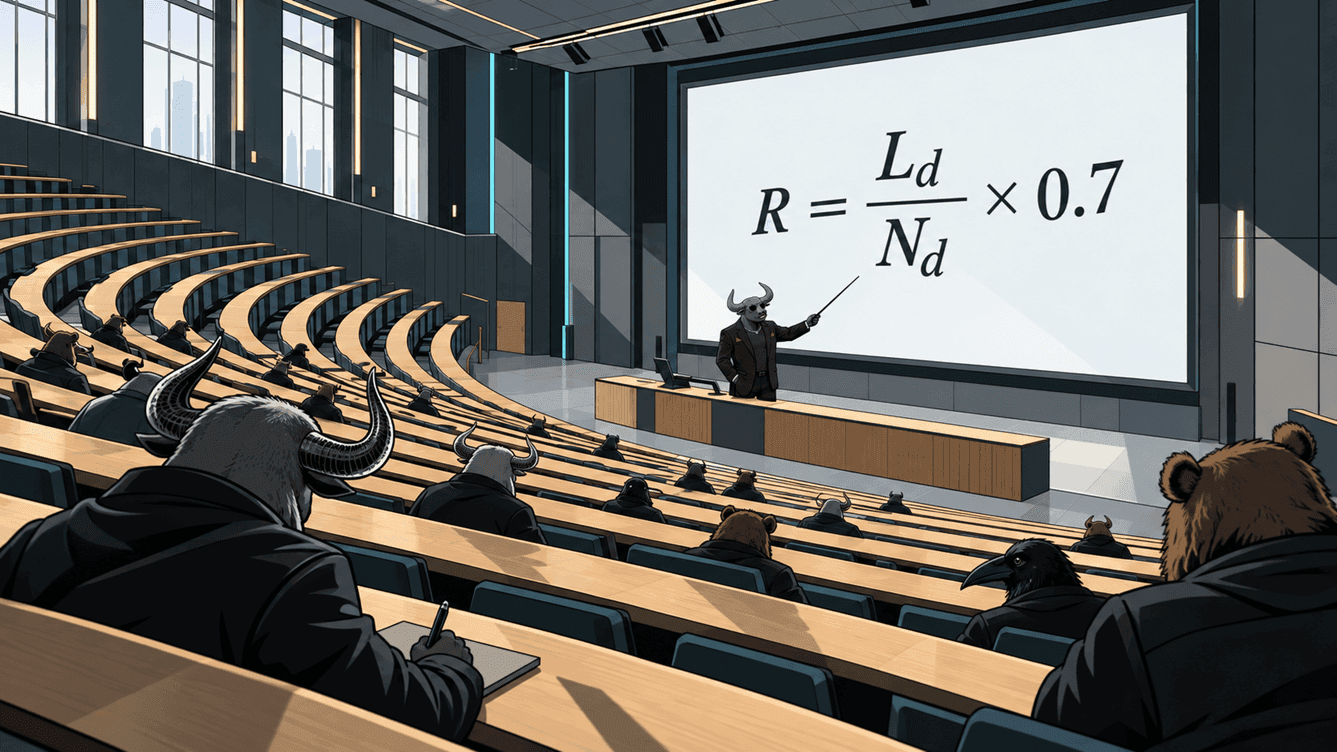
The first step is to set a risk ceiling so that even a bad day doesn't cost you the account:
Risk per trade = daily loss limit ÷ trades per day × 0.7
The 0.7 multiplier keeps 30% of the daily limit in reserve. That buffer covers slippage, fees, spread and the case where every planned trade of the day hits its stop.
For example, on a $10,000 Basic account, the daily limit is 5%, or $500. If you plan two trades a day, the risk ceiling is $500 ÷ 2 × 0.7 = $175 per trade. With one trade a day, it's $350; with five, $70.
Table for the Basic challenge
The daily limit is 5% of the balance at the start of the day. Each cell shows a range: the first number is for the lower trade count, the second for the higher one.
| Account size | Daily loss limit | 1–2 trades | 3–5 trades | 10–20 trades |
|---|---|---|---|---|
| $5,000 | $250 | $175–$87 | $58–$35 | $17–$8 |
| $10,000 | $500 | $350–$175 | $116–$70 | $35–$17 |
| $25,000 | $1,250 | $875–$437 | $291–$175 | $87–$43 |
| $50,000 | $2,500 | $1,750–$875 | $583–$350 | $175–$87 |
| $100,000 | $5,000 | $3,500–$1,750 | $1,166–$700 | $350–$175 |
| $200,000 | $10,000 | $7,000–$3,500 | $2,333–$1,400 | $700–$350 |
Table for the Accelerated challenge
The daily limit is 3%, so the allowed risk is noticeably lower.
| Account size | Daily loss limit | 1–2 trades | 3–5 trades | 10–20 trades |
|---|---|---|---|---|
| $5,000 | $150 | $105–$52 | $35–$21 | $10–$5 |
| $10,000 | $300 | $210–$105 | $70–$42 | $21–$10 |
| $25,000 | $750 | $525–$262 | $175–$105 | $52–$26 |
| $50,000 | $1,500 | $1,050–$525 | $350–$210 | $105–$52 |
| $100,000 | $3,000 | $2,100–$1,050 | $700–$420 | $210–$105 |
| $200,000 | $6,000 | $4,200–$2,100 | $1,400–$840 | $420–$210 |
How to use the tables: find your account size and the column for your number of trades per day. For a trade count in between, such as four, calculate the risk with the formula or take the lower value in the range.
Turbo: no daily limit
Turbo has no daily drawdown, so the daily-limit formula doesn't apply. The general guideline for these accounts is no more than 1% of the balance per trade, but the real ceiling is set by the 6% dynamic drawdown. At 1% risk, the account survives only 5 stops in a row; at 0.6%, it survives 9. Keep in mind that the drawdown is recalculated from every new balance high, so your room before the threshold doesn't grow along with profit.
The second check: maximum drawdown

The daily-limit formula protects you from one bad day. But a losing streak can stretch over several days, and then it's the maximum drawdown that closes the account.
Take a $10,000 Basic account and one trade a day. According to the table, the risk ceiling is $350, or 3.5% of the balance. Two stops in a row mean a $700 loss, and the third brings it to $1,050, breaching the 10% limit. The account closes on the third losing day, even though the daily limit was never breached.
Losing streaks happen even to profitable strategies. If a strategy wins half of its trades, then over 100 trades a streak of five stops in a row has about an 81% chance of happening, six about 55% and eight about 17%. These estimates come from a simple probability calculation for independent trades. That's why risk should be chosen so the account survives 8–10 losing trades in a row.
| Risk per trade | Stops in a row before maximum drawdown on Basic (10%) | On Accelerated (6%) | On Turbo (6% of the high) |
|---|---|---|---|
| 0.25% | 39 | 23 | 23 |
| 0.5% | 19 | 11 | 11 |
| 1% | 9 | 5 | 5 |
| 1.5% | 6 | 3 | 3 |
| 2% | 4 | 2 | 2 |
The table shows how many stops in a row the account survives: the next stop breaches the limit. The calculation is based on the starting balance and excludes fees, so the real buffer is slightly smaller.
Final risk: take the lower of the two
Your final risk per trade is the lower of two values: the ceiling from the daily limit and the maximum drawdown divided by 10. With the second, the account survives 9 stops in a row, and the tenth brings the loss to the limit.
| $10,000 account, two trades a day | Ceiling from daily limit | Ceiling from maximum drawdown (limit ÷ 10) | Final risk |
|---|---|---|---|
| Basic | $175 | $100 | $100 (1%) |
| Accelerated | $105 | $60 | $60 (0.6%) |
| Turbo | not applicable | $60 | up to $60 (0.6%) |
For other account sizes, the amounts scale proportionally: on $100,000 they are $1,000, $600 and $600, respectively. The exception is new $200,000 Basic accounts: in Phase 2 and at the funded stage, maximum drawdown is 8%, so the ceiling is 0.8%, or $1,600. If you take many trades a day, the daily limit is usually the deciding factor. With one or two trades a day, maximum drawdown sets the limit.
How to convert risk into position size
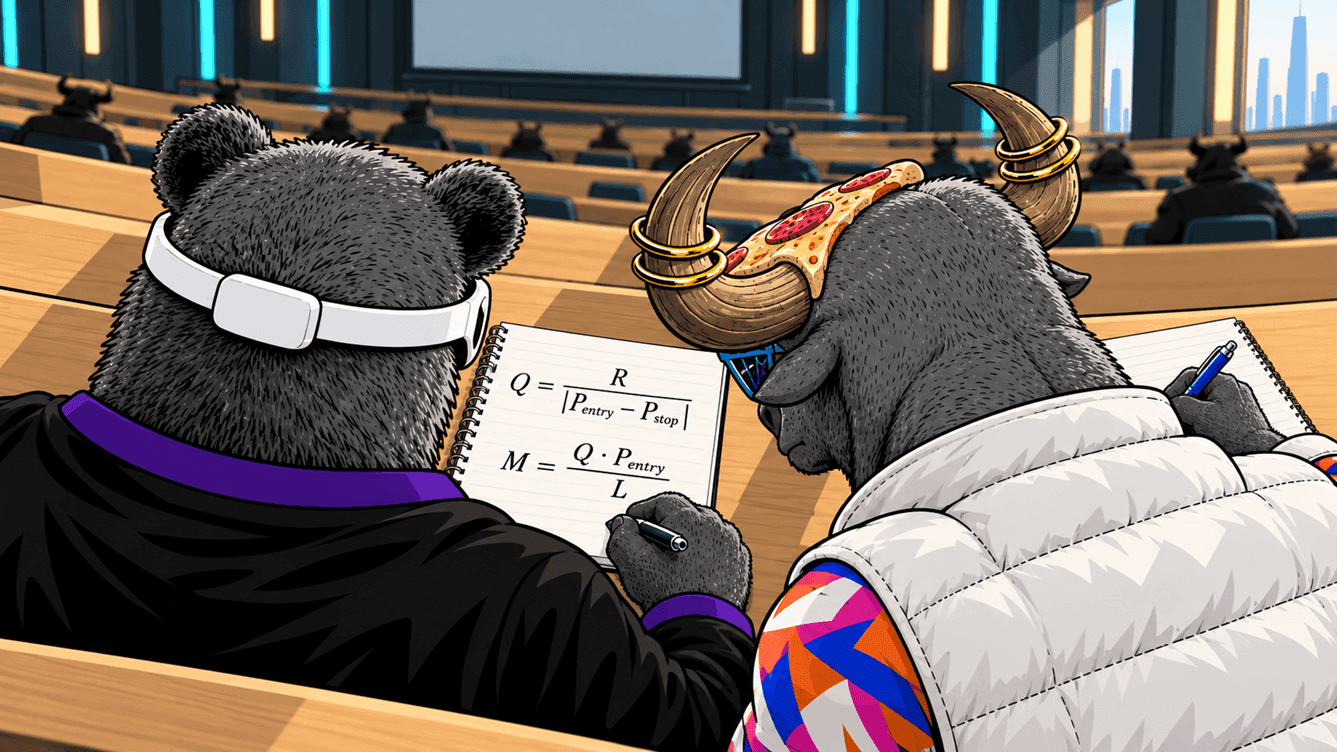
Upscale has no lots: position size is set as a quantity of the asset itself, such as
0.1 BTC2 ETHPosition size = risk per trade ÷ distance to stop
Collateral = position size × entry price ÷ leverage
Example: risk is $100, long ETH from $2,000, stop at $1,950. The distance to the stop is $50, so the position size is $100 ÷ $50 = 2 ETH. The position's notional value is $4,000, and collateral at x5 leverage is $800. If you move the stop closer, to $1,975, the position size grows to 4 ETH with the same $100 risk.
In the terminal, you can enter the asset quantity directly by choosing the matching input mode. The minimum position size is the equivalent of $10. Input modes and available leverage are described on the Positions and Leverage page.
What eats into your safety buffer
The calculation shows risk under ideal conditions. In practice, a loss at the stop can be larger, which is why the 30% buffer and the maximum drawdown check are not overkill:
- Stop execution. On crypto, Stop Loss fills at the trigger price, while on forex, commodities, indices and 24/7 stocks it executes at market, where slippage is possible. Details are on the Order Types page.
- Fees and funding. Fees are charged on every trade, funding is charged while you hold a position, and both increase the actual loss.
- Several open positions. If three positions are open at once, their combined risk counts against the daily limit, not just the risk of one.
- Unrealized loss. Limits include open positions, so a trade without a stop or with a distant stop eats into the limit while the price is moving.
When to lower your risk
Risk per trade doesn't have to stay the same for the whole challenge. Consider lowering it in these situations:
- After a losing streak. If less than half of your room before the maximum drawdown is left, cut risk in half so you can recover without sharp swings.
- Close to the profit target. When you are one or two winning trades from the target, there's no point in risking full size: one stop sets you back more than a winning trade moves you forward.
- On a funded account after Accelerated. The limits stay strict: 3% daily drawdown and 6% maximum.
- When you're emotional. The urge to win back a loss is a common reason traders breach limits. We cover the signs of tilt and how to deal with it in 5 Types of Trading Tilt.
On Basic and Accelerated challenges, you can add Daily Drawdown Protection: once per challenge, it keeps the account alive when the daily limit is hit. But it's insurance against one bad day, not a reason to raise your risk: the protection doesn't cover maximum drawdown.
You can practice position sizing and see how your strategy handles losing streaks on a free demo account with the same limits as a paid challenge.
In prop trading, risk per trade is set by the account's limits. The first guideline comes from the daily-limit formula: divide the daily loss limit by the number of trades and multiply by 0.7. That way one bad day won't cost you the account even if every planned stop is hit, and the buffer covers slippage and fees.
The second check is the maximum drawdown. Losing streaks happen even to profitable strategies, so your risk should let the account survive 8–10 stops in a row. Use the lower of the two values: usually 0.5–1% of the starting balance on Basic and no more than 0.6% on Accelerated and Turbo.
Dollar risk is converted into position size through the distance to the stop, and leverage is chosen to fit the resulting size. Lower your risk after a losing streak, near the profit target and whenever you feel the urge to win back losses. You can practice the calculations without risking real money on a free demo account with the same limits as the challenge.
Start now: 👉 Upscale.trade | Telegram Bot
Follow us: 📺 YouTube | 𝕏 Twitter
Community: 💬 Telegram chat | 🎮 Discord
What percentage of the account should you risk per trade in prop trading?
Usually 0.5–1% of the starting balance. The exact value depends on the challenge limits and how many trades you take per day: calculate the ceiling from the daily limit, then check that the account can survive 8–10 stops in a row before the maximum drawdown. Use the lower of the two values.
How do you calculate risk per trade from the daily drawdown?
Divide the daily loss limit by the number of trades per day and multiply by 0.7. For example, on a $10,000 Basic account the daily limit is $500, and with two trades a day the risk ceiling is $175 per trade. The 0.7 multiplier leaves a buffer for slippage, fees and a losing streak.
Why multiply by 0.7?
The multiplier keeps 30% of the daily limit in reserve. A loss at the stop can be larger than planned because of slippage, spread and fees, and without a buffer the last stop of the day could breach the limit.
How many stops in a row can a prop account survive?
It depends on your risk per trade. On the Basic challenge with a 10% maximum drawdown, the account survives 9 stops in a row at 1% risk and 19 at 0.5%. On Accelerated, with a 6% limit, it's 5 and 11 stops, respectively.
How do you convert dollar risk into position size?
Divide the risk by the distance from the entry price to the stop. With $100 of risk and a stop $50 below a long ETH entry, the position size is 2 ETH. Collateral equals position size times entry price divided by leverage: at a $2,000 entry and x5 leverage, that's $800.
Does leverage affect the risk of a trade?
No, as long as position size and stop stay the same. Leverage only determines how much collateral the position needs. Risk depends on position size and the distance to the stop, so size the position from the stop first and then choose leverage.
How much should you risk on a Turbo account?
Turbo has no daily limit, so the general guideline is no more than 1% of the balance per trade. But its maximum drawdown is dynamic, 6% of the highest balance, and at 1% risk the account survives only 5 stops in a row. That's why it's better to keep risk at 0.5–0.6%: the account then survives 9–11 stops in a row.