$1,308 in 2 Months With Level Trading: Ernest's Story | Upscale

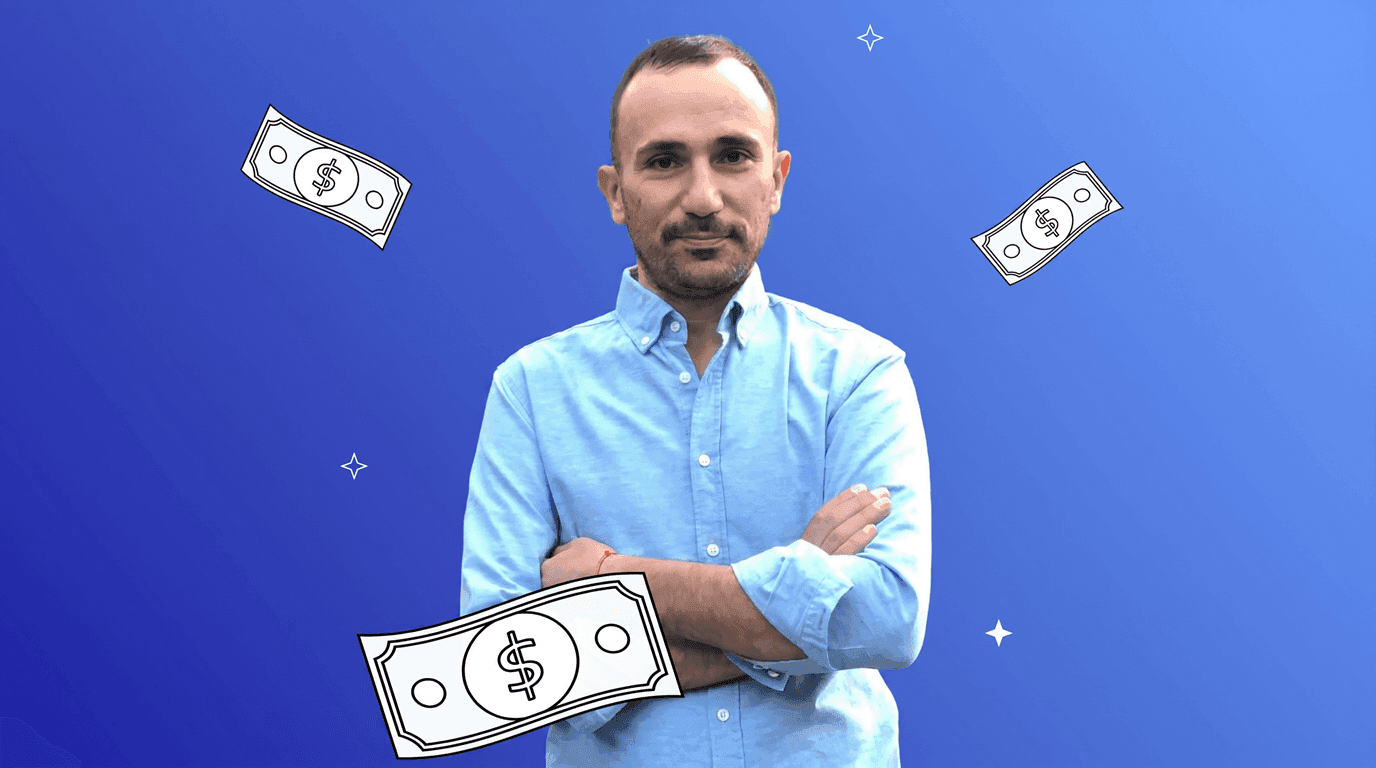
Ernest is a 47-year-old former business owner from Moscow who sold his offline retail operation for the freedom to travel — and six years later found consistency in trading, not on his first or third market, but after cycling through US equities, the Moscow Exchange, Forex, crypto, and three different prop firms. His path is not an overnight success story: five years without stable results, two rounds of training under the Gerchik trading system, and a gradual evolution from swing trading to intraday level-based entries on 1-minute charts. Positive results appeared only in 2025–2026, when a system refined over thousands of trades and documented in a meticulous trading journal began producing consistent 6–7% monthly returns. On Upscale, Ernest passed a $10,000 Basic challenge in 22 days on his first attempt, received four payouts totaling $1,308 over two months ($603 in March, $705 in April), and immediately scaled — purchasing two $200,000 challenges. His formula: "The foundation of a healthy trader is a clear trading system, keeping a trading journal, and following everything you've written down." It wasn't strategy that made him profitable — the discipline of documenting every trade allowed him to see what works and cut everything else.
Watch the full interview with Ernest on Upscale's YouTube channel:
From Offline Business to Trading: 6 Years Across 5 Markets
Ernest's trading story doesn't start with a chart — it starts with a constraint. At 47, he had an established offline retail business in Moscow (shops, resale). The business worked, but it anchored him to one location.

"I wanted to travel the world. The business didn't give me that opportunity. Offline business — you need to constantly monitor everything and control everything."
Around 2016 he discovered trading — saw people who traded, earned, and weren't tied to an office. Started studying the topic. In the summer of 2019, he first sat down at a demo account on Forex in MetaTrader. But deliberate, post-training trading only began in 2020, during the COVID lockdown — when offline retail shut down and free time appeared.
First phase: swing trading US equities on Interactive Brokers. Training completed under Alexander Gerchik's system — level-based trading. But swing trades didn't deliver what he was looking for.
"I needed specifics — to know that I'd consistently make about 5–10% per month. On swing trading, I couldn't see that."
He decided to switch to intraday. It didn't work — for a long time. Lost significant capital on Interactive Brokers. Completed a second training — also under the Gerchik system, but this time for intraday trading on the Moscow Exchange (futures). Still didn't click.
"I tried everything. US stock market, Moscow Exchange, Forex. And then I came to crypto."
Prop Trading: From CFT to Upscale
In crypto, Ernest initially traded his own capital. Then learned about CryptoFundTrader (CFT) and the Inplay system — trading coins showing explosive moves on high volume. Got a funded account at CFT and traded successfully.
In parallel, he tried other prop firms: FundedNext (Forex) and Trade the Pool (US equities). Gathered experience across four different platforms before arriving at Upscale.
"The market is dead right now — bearish, very few coins firing on Inplay. Started looking for something new — and chose Upscale alongside everything else."
What attracted him to Upscale specifically:
- Low commissions — crypto trading commission substantially lower compared to CFT
- Russian-language support — fast responses, "they won't leave you alone until your questions are answered"
- Terminal updates — trade markers, new features, responsiveness to trader feedback
- Demo account — to test the strategy on the platform's specific charting before committing real money
Upscale for Ernest isn't his only prop firm — it's part of a diversified portfolio of prop accounts. He trades in parallel across multiple platforms, different strategies, different markets — and this is a deliberate choice.
"When you trade different systems across different markets, even if one system hits a drawdown — you have a second, third, fourth. You'll be earning and withdrawing somewhere."
The Challenge: $10,000 in 22 Days, First Attempt
Ernest started with a demo account on January 4, 2026 — testing how his system performed on Upscale's charting. In parallel, on February 4, he purchased a $10,000 Basic challenge.
Phase 1 completed in 6 days (February 4–10). Phase 2 completed by February 26 — totaling 22 days from purchase to funded account. First attempt.
"It's an entire written system, an algorithm that includes everything. You follow it — daily risk limits, weekly risk limits. It's also important that the market cooperates."
He also completed the demo account — passed on March 30 (approximately 2.5 months). This became the signal to scale: immediately after, he purchased two $200,000 challenges.
"What else to do? What's the point of sitting on one account? Could've taken two at $100K, but I went with two at $200K."
On the psychological pressure of large numbers on screen:
"I try to measure everything in risk, not in money. Whether it's $10,000 or $100,000 — the risk is the same."
Strategy: Gerchik's Levels Adapted for Crypto and NASDAQ
Ernest's trading style is pure intraday. Trades last from one minute to an hour, all closed within the day. Maximum: 3 trades per day per account.

Markets and account allocation:
- One funded account dedicated to Ethereum — separate strategy
- Two $200,000 accounts for NASDAQ — different strategy
- Considering S&P 500, but considers it virtually identical to NASDAQ in behavior
- Does not trade Forex
Session: US market hours only. Doesn't trade before the US open (4:30 PM Moscow time), doesn't trade on US weekends.
"I only trade when America opens. That's when I look for my entry points."
Multi-Timeframe Analysis
The analysis process runs top-down, from daily to 1-minute:
- Daily chart — determines direction. Yesterday's daily candle close provides the signal: if the close is bearish, he looks for shorts the following day
- 30-minute chart — local timeframe for confirming direction and identifying accumulation zones
- 1-minute chart — working timeframe. This is where entries happen, where stop-losses and take-profits are placed
"I switch to the 1-minute — that's my working timeframe where I do everything."
Entry Logic
The strategy is based on local level trading — an adaptation of the Gerchik system for crypto and indices. Key elements:
For Ethereum: entry possible almost immediately after the US open — within 1–2 minutes. Levels are identified on the 30-minute and 1-minute charts. Entry on a level breakout after accumulation forms.
For NASDAQ: waits 15–30 minutes after the open. Marks two levels (upper and lower) of the accumulation zone from the open. Waits for a breakout from the range — up or down — and enters in the breakout direction.
"NASDAQ could sit in that range for an hour, two hours. I'd wait for the exit from that channel — either up or down."
Indicators
Minimal: ATR only — to determine stop-loss size. Doesn't use volume on Upscale (unlike CFT, where he trades the Inplay system based on volume patterns). No oscillators, no moving averages, no other indicators.
"Indicators — I mainly use just one: ATR, for stop size. That's it. No other indicators."
Risk Management
Risk-reward ratio: target 4:1, minimum acceptable 3:1. In the demonstrated ETH trade, take-profit was set at 4:1, exited at 3:1 — a conscious decision, not panic.
Three-trade rule: maximum 3 trades per day per account. On the day shown — 4 trades total across 3 accounts.
Risk in percentages, not dollars: Ernest emphasizes thinking in percentage of deposit, not absolute numbers. This allows identical trading on $10,000 and $200,000.
"I try to measure everything in risk, not in money. Whether it's $10,000 or $100,000 — the risk is the same."
News: completely ignored. Trades are short, hitting a news window is rare. Stops and take-profits are always in place.
"I completely ignore news. Trades are very fast, very short. I have take-profits and stop-losses set — I don't look at news."
This approach aligns with what the PipFarm survey of 2,777 prop traders (2025) shows: 45.1% of successful traders make only 1–2 trades per day. Ernest's "maximum 3 trades" rule falls within this range — selectivity matters more than frequency.
The Trading Journal: Core of the System

If Ernest's strategy is level-based trading, his real edge is the trading journal. He has maintained it since the start of his trading career, by hand, in a custom Excel template.
What he records:
- Date and time of trading
- Entry and exit times
- Ticker (instrument)
- Stop-loss size
- Take-profit size
- What the system was supposed to do — and what he actually did
- Difference between plan and execution, and why it arose
- Comments on each trade
- How far the instrument moved after his exit — the critical parameter for optimization
"Trading often takes me less time than maintaining the trading journal."
How the Journal Improves the System
The key mechanism: Ernest collects statistics over 2–3 months (approximately 100 trades) and analyzes where the instrument went after his exit.
"Out of 100 trades I look: I was exiting at 2:1 or 3:1, but the instrument shows that in 90% of cases it goes further — 4:1, 5:1. I start adjusting the system, start paying attention to that."
This is literally what academic literature describes as iterative data-driven system optimization. Not intuition, not "market feel" — concrete numbers from 100+ trades showing where the system underperforms.
The trading journal serves another function — discipline. When every trade is recorded with justification, deviations from the plan become visible. You can't deceive yourself that "it was a deliberate trade" when the journal shows the entry didn't match system criteria.
"The foundation of a healthy trader is a clear trading system, keeping a trading journal, and following everything you've written down."
For more on the psychology of discipline and how emotional deviations destroy accounts, see the trading tilt guide.
Psychology: 5 Years Without Results
The most unusual part of Ernest's story is the duration of the "zero period." Positive results appeared only in 2025–2026, roughly 5 years into active trading. This isn't a slow start — it's five years without stable profitability, across multiple markets and two training programs.
"The trading system started showing positive results around 2025–2026."
What kept him going:
1. Financial cushion. Trading wasn't his only income source. Revenue from selling the business and other sources allowed him not to depend on trading results — and not to trade in desperation.
"I have income that I live on. When I came into trading, I understood: the question is whether it'll work out and how quickly."
2. Love of the process. Not of money — of the analysis itself, the studying, the documenting.
"You have to love trading. That's one. And second — discipline."
3. System diversification. When one strategy doesn't work, switching to another doesn't mean quitting trading. It's rebalancing, not capitulation.
"Better to have several systems. If one gives a series of stops — that's normal, it happens. But on the second or third system, you'll be earning."
4. Evolution, not revolution. He didn't overhaul his approach — he refined it. The Gerchik system remained the foundation, but adapted from US stocks to MOEX futures, then to crypto and indices.
"If you train one punch for 10,000 hours, nobody will be your equal in a fight. That's exactly how you sharpen your craft on charts."
The Locke and Mann (2005) finding at the Chicago Mercantile Exchange — that faster loss-cutters earned 65% more annually — is something Ernest arrived at through 5 years of practice and thousands of journal entries, not through theoretical knowledge, but through empirical confirmation on his own data.
Results and Certificates
Funded account activated: February 26, 2026 — Basic $10,000 (passed in 22 days)
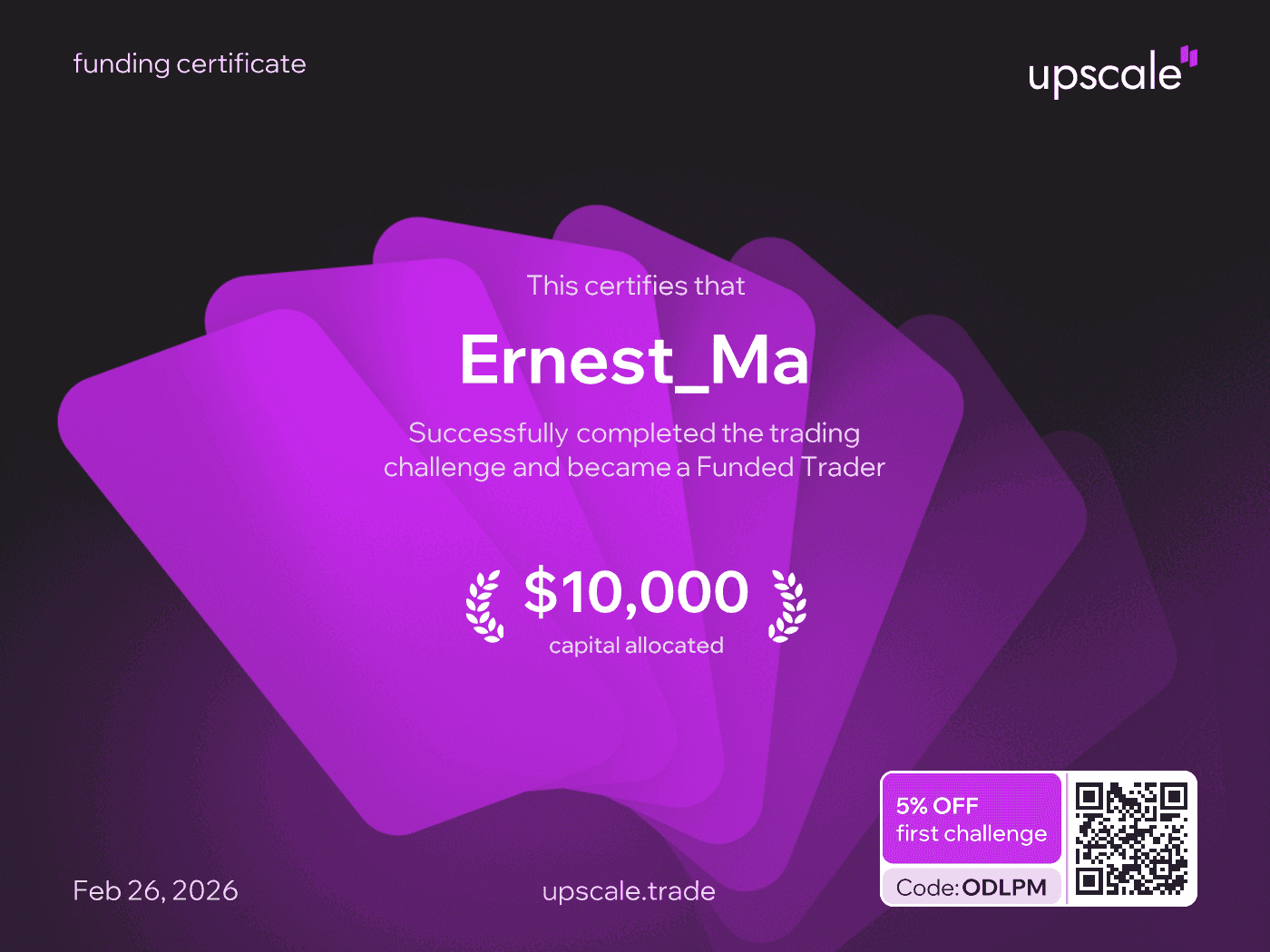
Funding certificate for the $10,000 Basic account, February 26, 2026
Four payouts over two months:
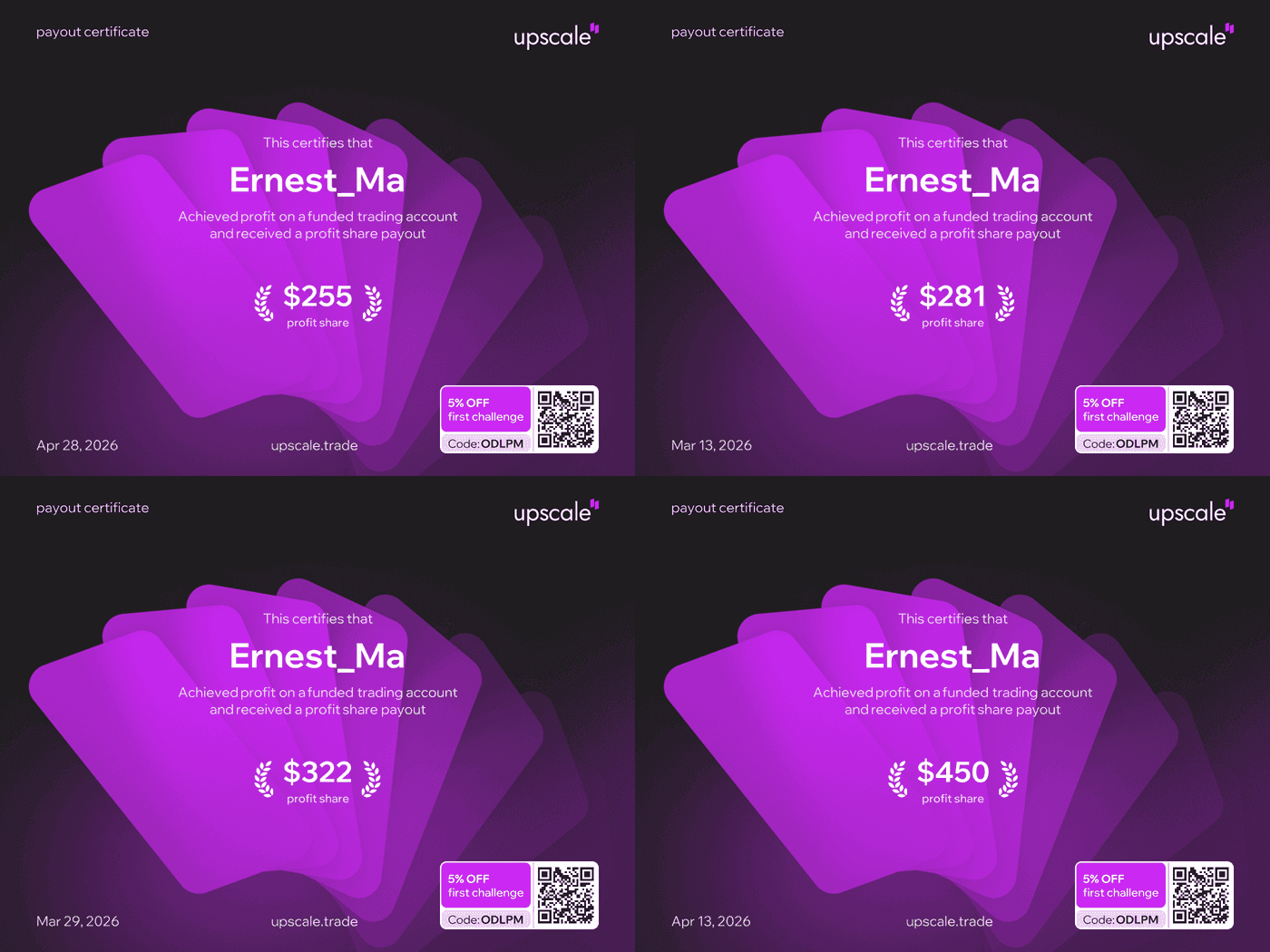
Payout certificates: $281 (March 13), $322 (March 29), $450 (April 13), $255 (April 28, 2026)
Total withdrawn: $1,308 over ~2 months (February 26 — April 28, 2026)
- March: $281 + $322 = $603 (6.03% on $10,000 account)
- April: $450 + $255 = $705 (7.05% on $10,000 account)
Average monthly return: ~6.5%
Annualized return (extrapolated): ~78%
Scaling: after initial payouts and demo completion, purchased two $200,000 challenges
"I withdrew $700 and bought two at $200K. I also withdraw from another prop account — CryptoFundTrader. I track all of this, balance it."
All payout figures are based on certificates issued by Upscale and confirmed via the platform interface shown on camera during the video interview.
Scaling and Prop Account Diversification
Ernest's approach to prop trading is a portfolio approach, not a bet on a single platform:
- Upscale: funded $10K + two $200K challenges (ETH + NASDAQ)
- CryptoFundTrader: funded account, Inplay system (crypto on volume)
- Previously: FundedNext (Forex), Trade the Pool (US equities)
Each platform serves a different strategy, a different market, a different set of rules. This isn't scatter — it's deliberate diversification: when one market is "dead" (his word for the current bearish crypto environment under the Inplay system), another provides setups.
This approach contrasts with the typical beginner pattern: buying the maximum account on one platform and trying to "recoup" the challenge cost as quickly as possible. Ernest started with $10,000, withdrew profits, and only then scaled — using earned money, not savings or credit.
For traders considering a similar portfolio approach to prop accounts, the key question is platform architecture differences. For more on why a crypto-native prop firm is structurally different from a forex-first one, see the crypto prop trading guide.
Key Takeaways
Ernest's case is a story of iteration, not talent. Six years across five markets and two training programs before the system began consistently producing profits. This is a timeline that the data confirms: the Brazilian day-trader study (Chague, De-Losso, Giovannetti, 2020) found that 97% of those who continued trading beyond 300 days lost money — but Ernest belongs to the remaining 3%, and the path there took not 300 days but over 2,000. His edge wasn't built from a secret indicator or a unique strategy — level-based trading under the Gerchik system is neither new nor complex. The edge was built from thousands of trading journal entries that transformed subjective "something isn't working" into objective "the instrument moves past my take-profit in 90% of cases — I need to change the target."
The structural insight of this story is prop account diversification as a professional approach. Ernest isn't tied to one platform and one strategy. ETH on Upscale, Inplay on CFT, NASDAQ on separate accounts — each market matched to its own system, each system with its own statistics. When the crypto market is "dead" for Inplay, NASDAQ keeps delivering level-based setups. This is portfolio logic applied not to assets but to trading systems — and it works because it's based on journal data, not feelings.
For traders currently in the middle of their own "zero period" — and that's the majority — Ernest's story offers a concrete recipe: journal every trade, don't overhaul the system but refine it, start with demo and minimum accounts, scale only from profits, and accept that 5 years to consistency is not failure but a normal timeline. As Ernest himself put it: "If you train one punch for 10,000 hours, nobody will be your equal."
Start now: 👉 Upscale.trade | Telegram Bot
Follow us: 📺 YouTube | 𝕏 Twitter
Community: 💬 Telegram Chat | 🎮 Discord
Frequently Asked Questions
What strategy does Ernest use on Upscale?
Intraday level-based trading — an adaptation of the Gerchik system for crypto and indices. Top-down analysis: the daily chart determines direction, 30-minute chart identifies zones, 1-minute chart provides entries. Two separate approaches: for Ethereum — entry almost immediately after the US open, for NASDAQ — waiting 15–30 minutes for an accumulation zone to form, then entering on breakout. The only indicator is ATR for determining stop-loss size. Target risk-reward ratio is 4:1, minimum acceptable is 3:1. Maximum 3 trades per day per account.
How much has Ernest earned on Upscale?
$1,308 in four payouts over two months from a $10,000 funded account: $281 (March 13), $322 (March 29), $450 (April 13), $255 (April 28, 2026). March totaled $603 (6%), April totaled $705 (7%), with an average monthly return of approximately 6.5%, extrapolating to roughly 78% annualized. The challenge was passed in 22 days on the first attempt (Phase 1 in 6 days, Phase 2 in 16 days). After initial payouts, he scaled — purchasing two $200,000 challenges. Figures are based on certificates issued by Upscale.
How did Ernest pass the challenge on his first attempt?
Three factors. First: he started with a demo account (January 4, 2026), testing his strategy on Upscale's charting before purchasing the real challenge. Second: a written algorithm with daily and weekly risk limits — not improvisation, but system adherence. Third: 6 years of experience across five markets, which allowed adapting the Gerchik system to crypto and indices without needing to learn from scratch. In his words: "It's an entire written system, an algorithm that includes everything. You follow it."
Why does Ernest trade only during the US session?
Two reasons. First: his NASDAQ strategy is tied to the US market open — accumulation zones and breakouts form in the first 15–30 minutes of the session. Second: Ethereum also shows the most predictable behavior during US hours, when institutional flow and equity market correlation are highest. He doesn't trade on weekends — insufficient liquidity and volatility for level-based strategies on his markets.
Why does Ernest keep a trading journal?
The journal serves three functions. First — optimization: recording how far the instrument moved after exit allows calibrating take-profits (if the instrument moves further than the target in 90% of cases — the target gets raised). Second — discipline: when every trade is documented with justification, deviations from the plan become visible. Third — adaptation: statistics from 100 trades reveal which setups work best, at what times, and on which instruments. Ernest emphasizes that journaling often takes more time than the actual trading.
Does Ernest trade only on Upscale?
No — Ernest uses a portfolio approach to prop accounts. On Upscale, he trades ETH and NASDAQ (funded $10K + two $200K challenges). In parallel, he trades on CryptoFundTrader (Inplay system — crypto on volume). Previously traded on FundedNext (Forex) and Trade the Pool (US equities). Different platforms for different strategies and markets. When one market doesn't offer opportunities, another compensates.
What can other traders learn from Ernest's approach?
Four transferable principles. First: the trading journal matters more than strategy — without documentation, objective optimization is impossible. Second: start with demo and minimum accounts, scale only from profits — Ernest started at $10K, withdrew $1,308, and only then purchased $200K. Third: diversification of systems and markets protects against periods when one strategy underperforms. Fourth: 5 years without stable results is a normal timeline if you have a financial cushion and the process itself brings satisfaction.
What advice does Ernest give beginners?
Start with a demo account: test the strategy on historical data, then try it on the platform's charting for 2–4 weeks. When you understand everything works — buy a minimum account ($5,000–$10,000). Grow from payouts, not from deposits. Maximum risk is losing time and the challenge cost, not all your capital. In his words: "Prop companies are the best thing for this. And grow gradually: study, dig in."