$412 From Prop Trading With One Indicator: Alexey's Story | Upscale

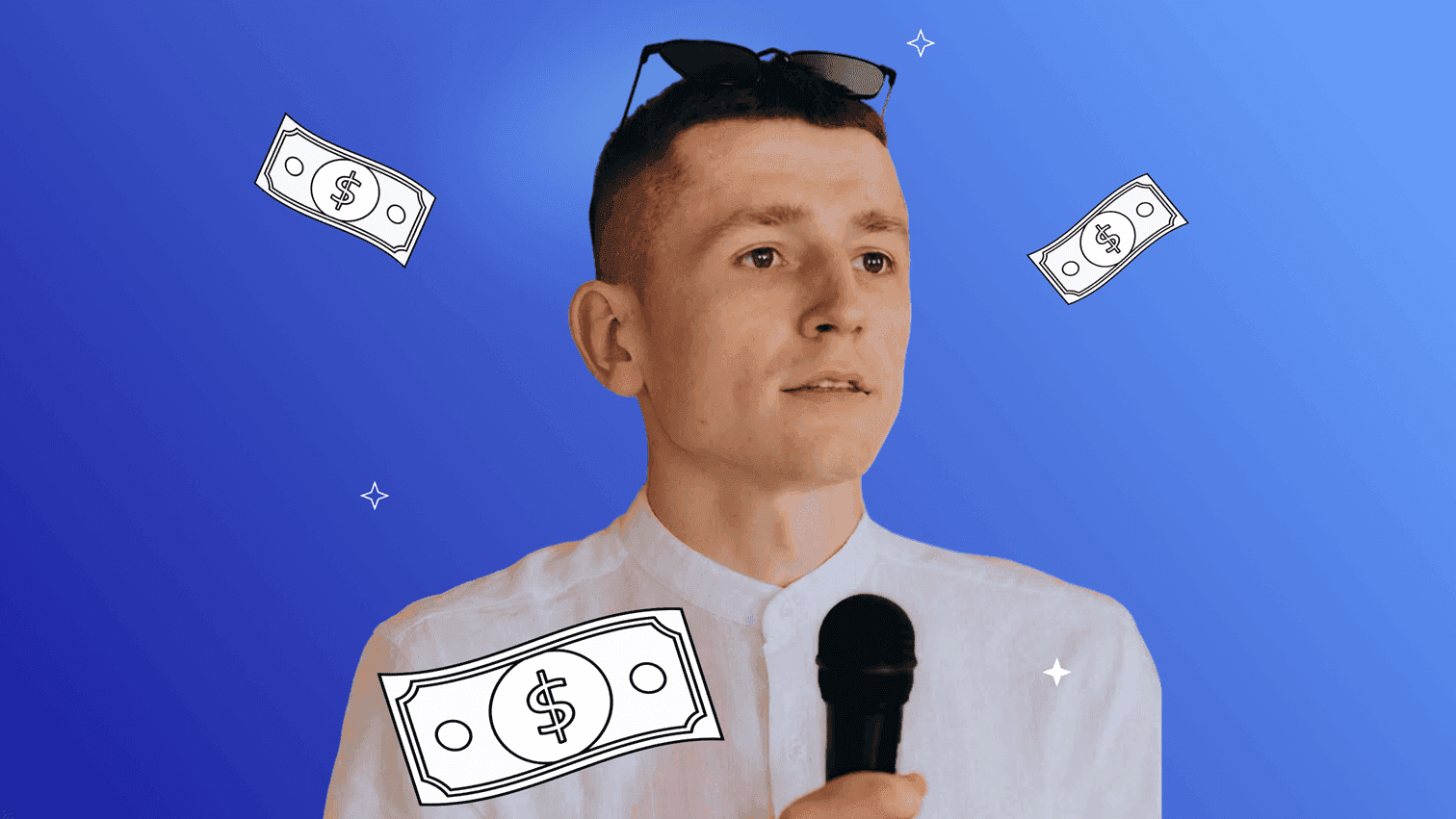
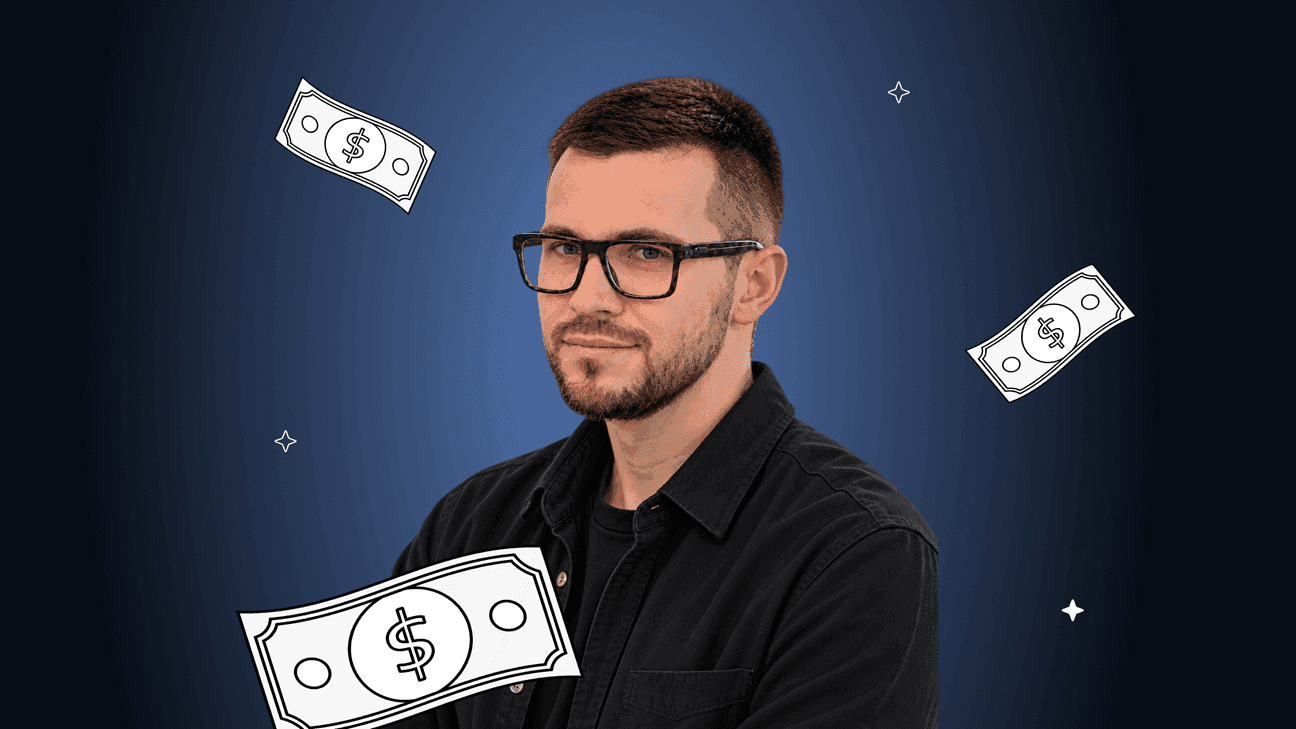
Alexey is a 29-year-old full-time airdrop hunter who has been working in cryptocurrency since 2017. His primary income comes from airdrops and Telegram community management, not trading — a distinction he makes openly and repeatedly. He came to prop trading through Upscale in autumn 2025, not because he wanted to become a professional trader, but because his personal capital was locked in living expenses and a deeply underwater spot portfolio, and he needed a way to act on trading ideas without risking money he couldn't afford to lose. After failing his first Basic $10,000 challenge during the October 2025 market crash, he passed the second using a single-indicator strategy — Bollinger Bands on the 1-hour timeframe with 5x leverage — and received his funded account on February 17, 2026. Two payouts followed: $111 on March 4 and $168 on March 19, totaling $279 in the first month — approximately 2.8% monthly return on a $10,000 account. A third payout of $133 followed on April 8, bringing the total to $412 over 50 days — approximately 2.5% average monthly return, which extrapolates to roughly 30% annualized. The results are modest by the standards of traders who chase triple-digit returns, but they are real, documented, and achieved without a single day of panic trading. His philosophy: "You don't need to trade more to earn more — you need to eliminate the trades that didn't work."
Watch the full interview with Alexey on Upscale's YouTube channel:
From Micro-Tasks to Airdrops to Trading
Alexey's path into cryptocurrency didn't start with charts or indicators — it started with online micro-task services in 2011, the kind where you'd solve captchas, write reviews, and register on websites for fractions of a dollar. In December 2016, one of those task descriptions mentioned the word "Bitcoin." He went to search what it meant. Bitcoin was trading at roughly $600–800 at the time.
"I saw the word Bitcoin in one of those tasks. I'm a curious person by nature, so I went to Google it — an unfamiliar, unknown word. And I got interested. Back then there wasn't much structured information, no blogs, no articles, no visual explanations of how blockchain works. I was reading forums."
He started collecting satoshis from faucets, registered on an exchange to withdraw them, and gradually noticed the concept of "airdrop" appearing in his information space. By 2017–2018, airdrops became his primary focus. He missed the ICO boom entirely — not by choice, but because he was a student with no investment capital.
"I didn't have the resources to invest. I was a student who was happy to have any side income at all."
In May 2020, he launched a Telegram channel covering various online income methods, and by the end of that year it had pivoted entirely to airdrops. He received a Uniswap airdrop worth approximately $1,000 at the time — the moment he realized the airdrop model could sustain full-time work. By 2021, he was fully committed.
The trading experiments came alongside the airdrops, not as a deliberate career move. When airdrop earnings arrived, the question was always: what to do with the money between drops? DeFi farming was one option. Spot portfolio was another. Futures were a third.
"I had airdrops, I got money from them. While there were no other airdrops, I needed to do something with that money. And gradually I started trying to trade."
Late 2020 brought a "significant loss on futures" — the first real collision with leveraged trading. It was painful enough to reshape his relationship with derivatives permanently.
"After the futures loss, I understood that this needs to be treated with caution. I had people telling me: 'Don't touch futures, it'll burn you to the ground someday.' I thought — no way, looks fine. And then when I experienced it, all my questions disappeared."

Late 2021, he built a spot portfolio — at exactly the worst possible time, the end of the bull market. Many of those positions are still with him in 2026, down 90% or more. The experience taught him that timing matters as much as conviction, and that holding losing assets indefinitely is itself a form of poor risk management.
Why Prop Trading — The Capital Problem
By late 2025, the economics of Alexey's situation created a specific problem that prop trading solved directly.
Airdrops were producing diminishing returns. The spot portfolio was deep underwater. His Telegram channel needed fresh content and new directions. And the personal capital he'd accumulated couldn't be risked on trading because it was allocated to basic living expenses — rent, food, operational costs for his airdrop infrastructure (proxies, anti-detect browsers, various services).
"Upscale gives me the ability to act on a trading idea that I don't have the money for. That's it. That's the whole story."
He discovered Upscale through Telegram in autumn 2025. It was his first prop firm — he'd known the concept existed but had never tried one. He read reviews, explored the platform, and bought his first Basic $10,000 challenge.
The prop model solved his specific constraint: it separated trading capital from living capital. He could take positions on market moves without touching the money reserved for survival. This is a structurally different situation from a trader with discretionary capital — the risk profile is limited to the challenge fee rather than the trading balance.
The First Challenge: Failed on a Market Crash
The first attempt didn't survive October 2025. A broad market crash — likely around October 10, based on Alexey's recollection — hit while he had a long position open.
"My first challenge coincided with a major crash around October 10. It just finished me off — my account was already not in great shape."
Whether the stop-loss was set or not, the result was the same: account blown. This is a common pattern documented across the prop trading industry — according to FPFX Tech data, 73% of failed prop accounts violated their own stop-losses in more than 30% of cases. External market events are the trigger, but the failure mechanism is almost always related to risk management rather than strategy.
Alexey returned for a second challenge — this time with a different approach. The Bollinger Bands strategy that would produce his funded account started here.
The Second Challenge and the Funded Account
For the second challenge, Alexey adopted the strategy that would carry him through to funding and his first payouts. The approach centered on a single customized indicator — a Bollinger Bands variant configured by the Crypto Family community (attributed to Yura Frantsiska), which adds "Top and Bottom" signals indicating overbought and oversold zones.
The key change wasn't the indicator itself — it was the discipline around it. After the first challenge failure, Alexey understood that the problem was less about signal accuracy and more about filtering when to act and when to stand aside.
He passed the second challenge and received his funded account on February 17, 2026.
The One-Indicator Strategy
Alexey's trading setup is deliberately minimal: one indicator, one timeframe, and a set of contextual filters that determine whether to act on what the indicator shows.
Indicator: Bollinger Bands with custom "Top and Bottom" signals (Crypto Family community configuration). The setup adds visual markers — red signals when price reaches the upper boundary (overbought/overvalued zone), green signals at the lower boundary (oversold/undervalued zone).
Timeframe: 1-hour chart.
Leverage: 5x.
Assets: Primarily altcoins — DASH, Polkadot (DOT), Aptos (APT), Bitcoin SV (BSV), Immutable X (IMX), and others that rotate through the watchlist. Rarely Bitcoin, because the indicator fires less frequently on BTC and the percentage moves are smaller than on altcoins.
DASH in particular holds a special place in the watchlist because Alexey previously arbitraged it on smaller exchanges and knows its behavioral patterns — notably its tendency to move against the broader market during certain conditions. The November 2025 episode where DASH tripled from $50 to $150 while Bitcoin showed no comparable move is an example he cited.
"I rarely trade Bitcoin — I'm more interested in capturing larger percentage moves on altcoins. DASH often shows itself against the market, and I watch it because I used to arbitrage it heavily."
Entry Logic
The indicator generates signals, but the signal alone doesn't trigger an entry. Alexey applies contextual filters:
-
Calm news environment. No major announcements, no Fed decisions, no scheduled volatility events. He doesn't want to play guessing games with binary outcomes.
-
Not all coins signaling simultaneously. If every coin in the watchlist shows the same signal in the same direction, it usually means the entire market has already moved — entering at that point offers poor risk-reward. He's looking for divergence: a coin that hasn't moved yet while the rest of the market has.
-
Watchlist hygiene. Coins that repeatedly produce false signals (get stopped out despite showing clean indicator readings) are removed from the watchlist and replaced. The watchlist is constantly rotated rather than fixed.
"If I see that all coins in the watchlist have already moved and they all look the same — I don't touch anything. I wait for something on the market that's more attractive."
Risk Management
Margin per trade: $200–400 standard, occasionally up to $600 when conviction is high. On a $10,000 account, this represents 2–6% of capital allocated per position.
Stop-loss: 15% of margin. On a standard $300 margin trade, the stop triggers at $45 loss — less than 0.5% of the total account. This is the non-negotiable rule: no trade is allowed to lose more than 15% of its margin.
"If I made a mistake entering a trade and it's already down 15%, I don't look at it anymore. I stop looking."
Take-profit: None fixed. Instead, Alexey uses a trailing stop approach. If a trade moves into profit, he progressively tightens the stop:
- At +15% profit: stop moved to approximately +7.5–8%
- At +40–50% profit: stop moved to +20–30%
- If a strong impulse happens overnight: may close manually on waking
This means winning trades are never capped by a predefined target — they run as far as the market takes them, with the trailing stop protecting accumulated gains. The trade-off is that some moves reverse before hitting a meaningful profit, but the math works over a large sample: small losses (capped at 15% of margin) and variable-sized wins (from a few percent to the full extent of the move).
Trade frequency: Low. After receiving the funded account, Alexey deliberately reduced his number of trades.
"I realized that I don't need to trade more to earn more. I need to eliminate the trades that didn't work — and everything will be fine."
A Sample from the Trade Log
The early weeks on the funded account included a characteristic pattern: several small losses followed by one larger win that covered them all.
- Three consecutive stops at roughly $30 each = $90 loss
- One successful short on FortCoin with $300 margin: closed at +$124
This is the mathematical structure of his approach — tight stops that cap downside, with occasional winners that more than compensate. The win rate doesn't need to be high as long as the risk-reward ratio on winners exceeds the cumulative cost of stops.
Over the first payout period, this produced $111 in profit. Over the second, $168 — achieved with slightly larger position sizes as confidence grew. Total: $279 in approximately one month.
Psychology: "Not Quite My Thing"
What makes Alexey's case unusual among funded traders is his self-awareness about his relationship with trading. He doesn't identify as a trader. He calls himself an "amateur" and an "airdrop hunter who sometimes trades."
"I can clearly feel what I'm capable of and what I'm not. This is not quite my thing, but it's something I could force myself to do as an additional income source."
This honesty, paradoxically, may be the source of his edge. A PipFarm survey of 2,777 prop traders (2025) found that 37.8% cite lack of discipline as their primary cause of failure — often driven by overconfidence in their analytical abilities. Alexey's lack of overconfidence means he doesn't overtrade, doesn't over-leverage, and doesn't convince himself that his analysis justifies a bigger position than his rules allow.

His emotional control framework is built on several principles:
1. Real-money mental accounting. He treats P&L on screen as actual money with purchasing power, not abstract numbers.
"When everything is tied to real things — monthly rent, a full tank of gas — gambling simply has no place. Rethink how much is sitting in your open trade. Maybe it's a month's rent."
2. Emotional baseline requirement. He doesn't trade when emotionally elevated or depleted — whether from a good day (birthday party, fishing trip) or a bad day. He waits until he's in his default emotional state.
"If I'm coming back from somewhere and I'm either very tired or very excited — I need to cool down. Not just to open the terminal, but even to open the watchlist."
3. Desire-as-signal. If he feels the urge to open a trade simply because he has no positions open, he closes the terminal. The urge itself is the signal that market conditions don't justify an entry.
"If the desire to open a trade appears because I have nothing open — I close the terminal. Because if that desire appeared, it means there aren't enough situations on the market to exploit, and you're starting to invent them."
4. Sport as emotional reset. Physical exercise — specifically weight training — serves as the primary emotional discharge mechanism. The negative energy goes into the weights rather than into the market.
This approach aligns with what Jared Tendler describes as the distinction between "the urge to trade" and "a trading opportunity" — the former is emotional, the latter is analytical, and conflating them is one of the most common causes of account failure. For a broader framework on managing tilt and its variants, see the trading tilt guide.
The Minimalist's Edge
There's an irony Alexey articulated during the interview that deserves highlighting. His strategy uses one indicator. Many viewers, he predicted, would say that's not enough.
"Many people will watch this and think: what I'm using isn't sufficient. But that's also why I'm here. If you need a pile of indicators that you think gives you more accuracy, you need more time for analysis, which gives you more confidence, so you load up bigger positions — and with high probability you drive into a wall."
The logic: more analysis → more confidence → bigger positions → bigger losses when wrong. Fewer tools with lower conviction leads to smaller positions with tighter stops — which is exactly the risk profile that survives in prop trading, where the daily drawdown limit is the binding constraint.
This echoes Locke and Mann's (2005) finding at the Chicago Mercantile Exchange that traders who cut losses faster earned 65% more annually. The mechanism is the same: limiting downside per trade is more important than optimizing upside, especially on funded accounts where the cost of a blown account is not just the losses but the fee to re-enter.
Results and Certificates
Funded account activated: February 17, 2026 — Basic $10,000
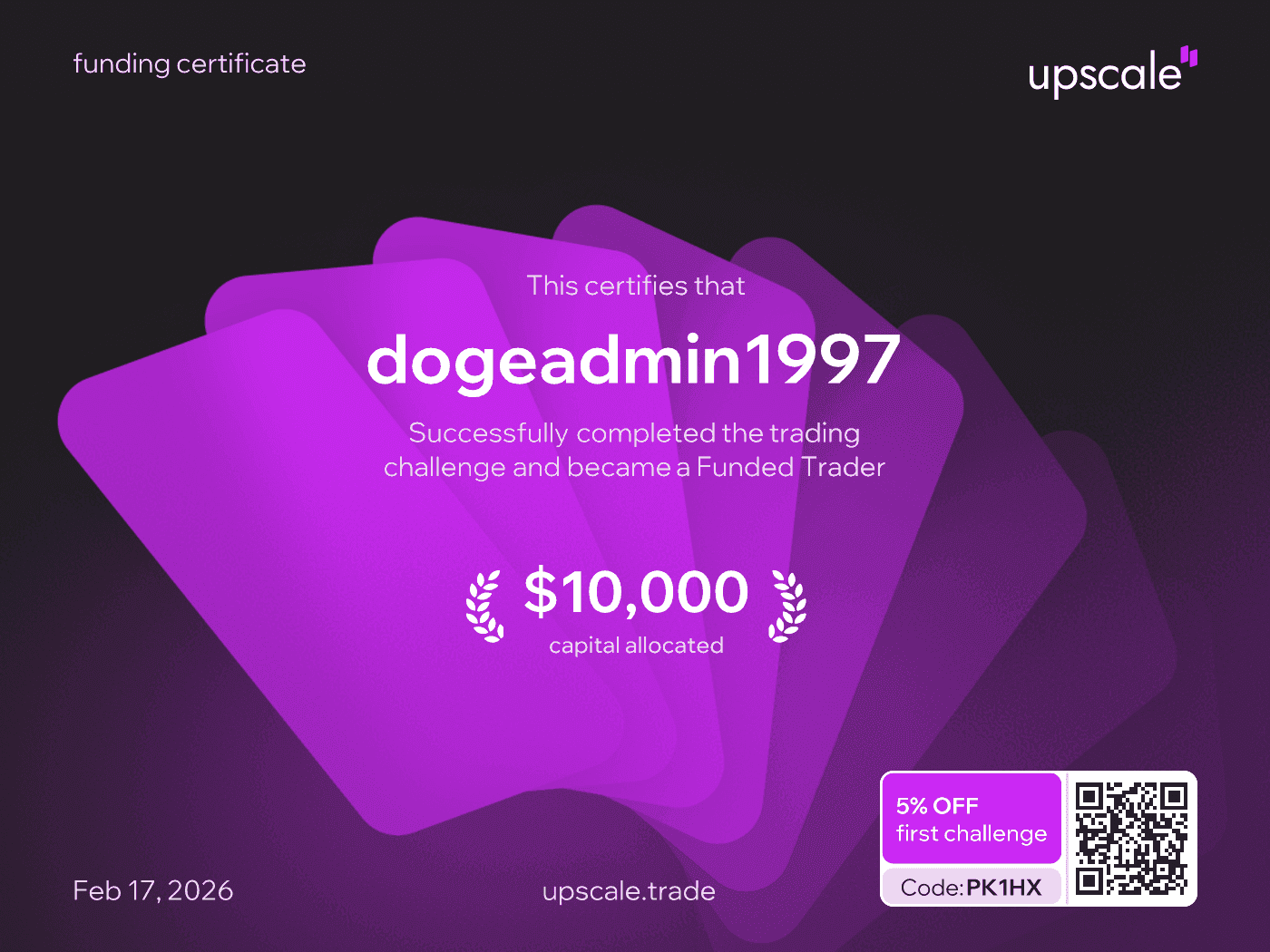
Funding certificate for the $10,000 Basic account, February 17, 2026
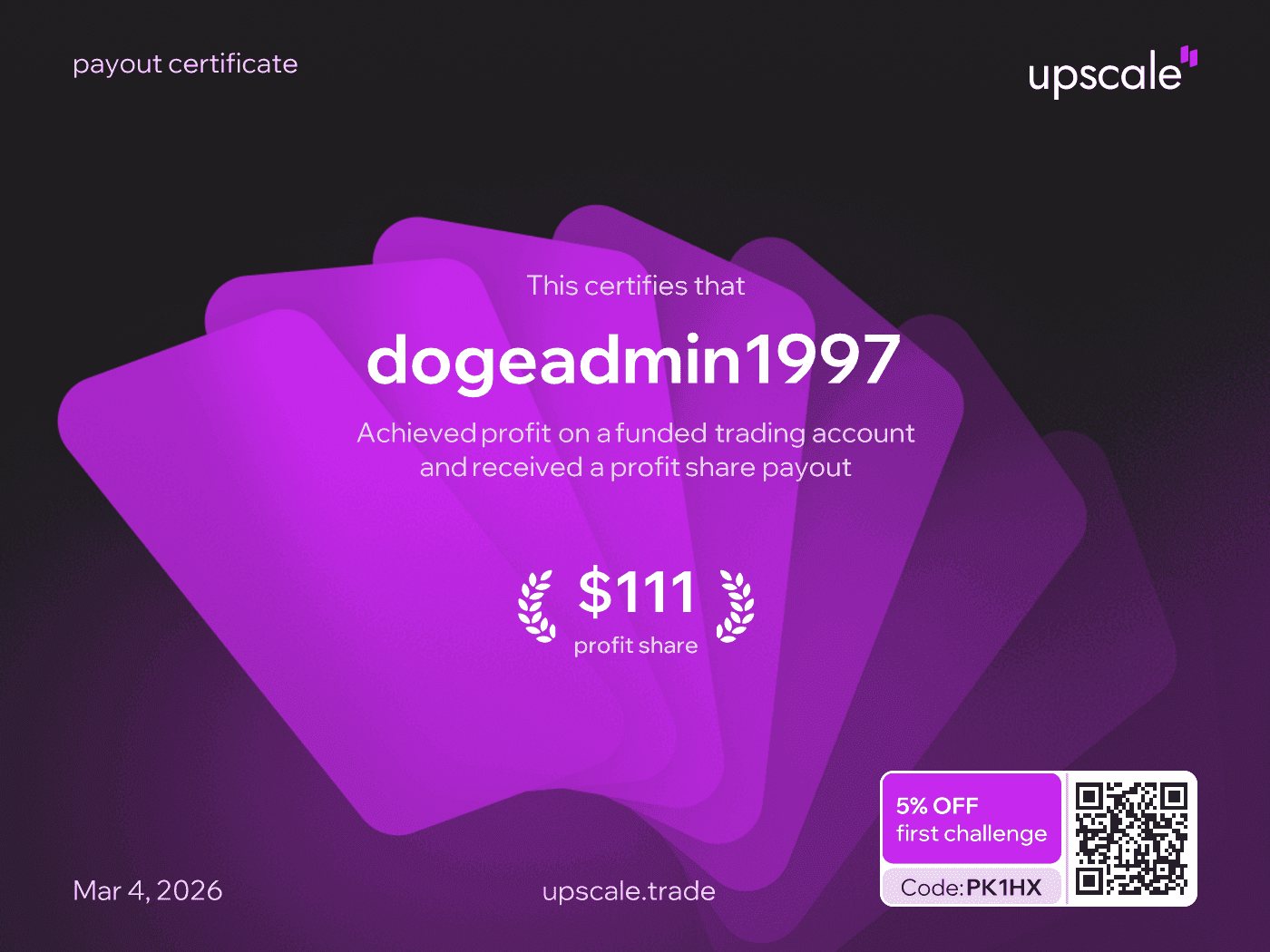
Payout certificate: $111, March 4, 2026
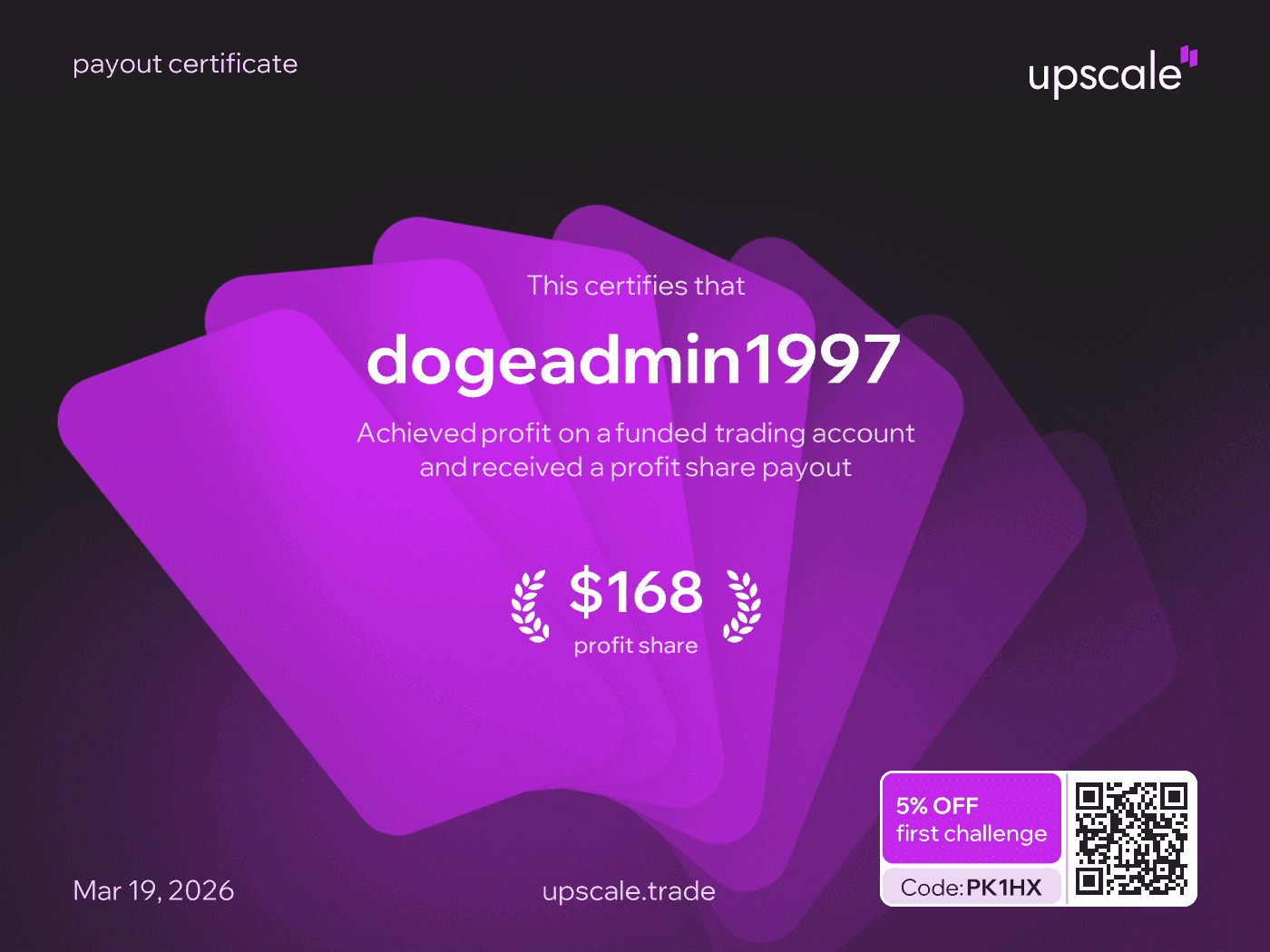
Payout certificate: $168, March 19, 2026
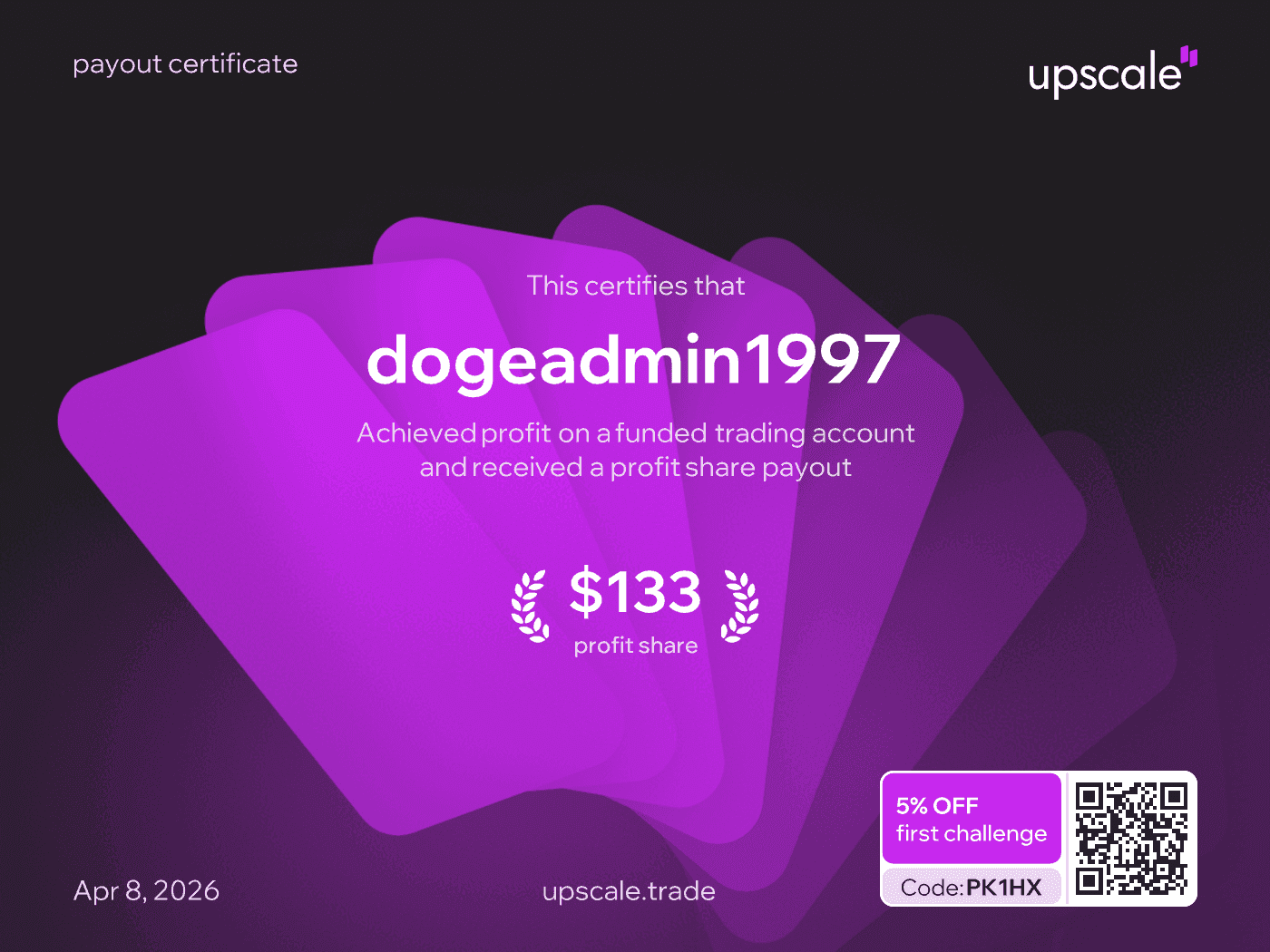
Payout certificate: $133, April 8, 2026
Total withdrawn: $412 over approximately 50 days
Average monthly return: approximately 2.5% on $10,000 account
Annualized return (extrapolated): approximately 30%
These returns are modest compared to traders who target aggressive monthly returns. But 30–35% annualized, achieved consistently with sub-1% risk per trade, represents a sustainable approach that the drawdown limits are designed to protect — and that the academic literature consistently associates with long-term survival. Albert, another Upscale funded trader profiled in the success stories collection, achieves similar consistency through a different mechanism (one trade per day, Smart Money Concept), illustrating that the path to stable funded-account returns is disciplined risk management, not a specific strategy.
All payout figures are based on certificates issued by Upscale and verified against the trader's account history shown during the interview.
Key Takeaways
Alexey's case challenges the assumption that successful prop trading requires full-time dedication to trading, extensive technical education, or an identity built around markets. He's an airdrop hunter who trades on the side, using one indicator on the hourly timeframe with 5x leverage and stops that never risk more than 0.5% of the account. His results — $412 in payouts from a $10,000 Basic account over approximately 50 days funded, representing approximately 2.5% average monthly return — won't headline a highlight reel, but they demonstrate something more valuable than spectacular returns: a sustainable system that doesn't require the operator to be a trading savant.
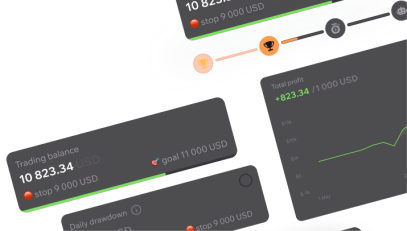
The structural insight is that prop trading served a specific capital allocation problem. Alexey's personal capital was either underwater in a spot portfolio from late 2021 or allocated to living expenses and airdrop infrastructure. He had trading ideas but no risk-free way to execute them. The prop model provided exactly that — a $10,000 account accessible for the cost of a challenge fee, with built-in drawdown limits that enforced the discipline he needed. The mechanism worked because the constraints of the funded account (5% daily drawdown, 10% total) aligned with his natural risk tolerance: small positions, tight stops, and the willingness to stand aside when conditions didn't warrant a trade.
The psychological framework is the most transferable element of this story. Treating P&L as real purchasing power, not abstract numbers. Closing the terminal when the urge to trade comes from boredom rather than opportunity. Reducing trade count after receiving funding, not increasing it. These are the behaviors the data consistently associates with prop trading survival — and they don't require talent, just self-honesty. As Alexey summarized: "If you feel the desire to open a trade because you have nothing open — close the terminal. Because if that desire appeared, it means there aren't enough situations on the market, and you're starting to invent them."
Start now: 👉 Upscale.trade | Telegram Bot
Follow us: 📺 YouTube | 𝕏 Twitter
Community: 💬 Telegram Chat
Frequently Asked Questions
What strategy does Alexey use on his funded account?
A single customized Bollinger Bands indicator on the 1-hour timeframe with 5x leverage. The indicator variant (configured by the Crypto Family community) adds "Top and Bottom" signals marking overbought and oversold zones. He trades primarily altcoins (DASH, DOT, APT, BSV, IMX), rarely Bitcoin. Entry requires the indicator signal plus contextual filters: calm news environment, the coin showing divergence from the broader market (not moving with the crowd), and no emotional pressure to trade. Stop-loss is fixed at 15% of margin, no exceptions. Take-profit is handled through a trailing stop that progressively tightens as the trade moves into profit.
How much has Alexey earned from prop trading?
$412 in total payouts from a $10,000 Basic funded account over approximately 50 days: $111 on March 4, 2026, $168 on March 19, 2026, and $133 on April 8, 2026. This represents approximately 2.5% average monthly return, which extrapolates to roughly 30% annualized. The account was funded on February 17, 2026. These figures are based on payout certificates issued by Upscale and verified during the video interview.
Why did Alexey's first challenge fail?
The first Basic $10,000 challenge coincided with a broad market crash around October 10, 2025. Alexey had a long position open that was stopped out during the crash, which — combined with an account that was already under pressure — resulted in the account being blown. He returned for a second challenge with a modified approach, specifically adopting the Bollinger Bands strategy and stricter risk management, and passed.
How much does Alexey risk per trade?
Less than 1% of the account per trade. Standard margin per trade is $200–400 (2–4% of $10,000), with a hard stop-loss at 15% of margin — meaning maximum loss per trade is typically $30–60. In rare high-conviction situations, margin may increase to $600 (6% of account), with maximum loss capped at $90 (0.9% of account). He never risks more than 15% of margin on any single trade, regardless of conviction level.
Why does Alexey trade altcoins instead of Bitcoin?
Two reasons. First, the Bollinger Bands indicator fires less frequently on Bitcoin because BTC's price action is smoother and less prone to the sharp overbought/oversold extremes that the indicator is designed to capture. Second, altcoins offer larger percentage moves — a 3–5% move on an altcoin in a day is routine, while the same on Bitcoin is an event. Alexey specifically mentions DASH as a preferred instrument because he knows its behavioral patterns from prior arbitrage experience, and it tends to move independently from the broader market at times.
How does Alexey manage emotions while trading?
Four principles. First: treating P&L as real money with purchasing power — "maybe it's a month's rent, maybe it's a full tank of gas" — which prevents the abstraction that leads to reckless risk-taking. Second: only trading in his default emotional state — not after exciting events, not when tired, not when stressed. Third: treating the urge to trade as a red flag — if the desire to open a position comes from having no positions open (rather than from a setup meeting his criteria), he closes the terminal entirely. Fourth: physical exercise (weight training) as emotional discharge.
Is Alexey a professional trader?
No, and he's explicit about this. His primary income and identity come from airdrops and Telegram community management, which he's done full-time since 2021. He describes trading as "not quite my thing" and himself as "an amateur who sometimes gets something right." This self-awareness may itself be an edge — it prevents the overconfidence that PipFarm survey data (2025) associates with 37.8% of prop trading failures.
What can other traders learn from Alexey's approach?
Three transferable principles. First: a minimalist strategy (one indicator, strict rules) with low conviction per trade produces small but consistent returns — the 2.8% monthly from a sub-1% risk per trade demonstrates the math. Second: reducing trade frequency after getting funded (quality over quantity) is counterintuitive but effective — Alexey's win-loss pattern shows that fewer, better-filtered trades produce net positive results even with a modest win rate. Third: the prop model specifically addresses the capital constraint that prevents skilled individuals from trading — Alexey's trading ideas existed before Upscale, but his capital was locked in living expenses, and the funded account solved exactly that problem.