Upscale Updates, July 2026

The July release brought a major expansion of Upscale's trading instruments: the terminal now features eight US stocks trading 24/7, WTI crude oil, four US and two European index instruments, and a market events calendar. Beyond the new assets, the platform introduced funded account restoration after failure, raised the combined funded account limit to $400,000, added bank card payments via Stripe and token payments on the Solana network, and the order form now supports opening positions by asset volume. Here is a detailed look at each update.
New Trading Assets
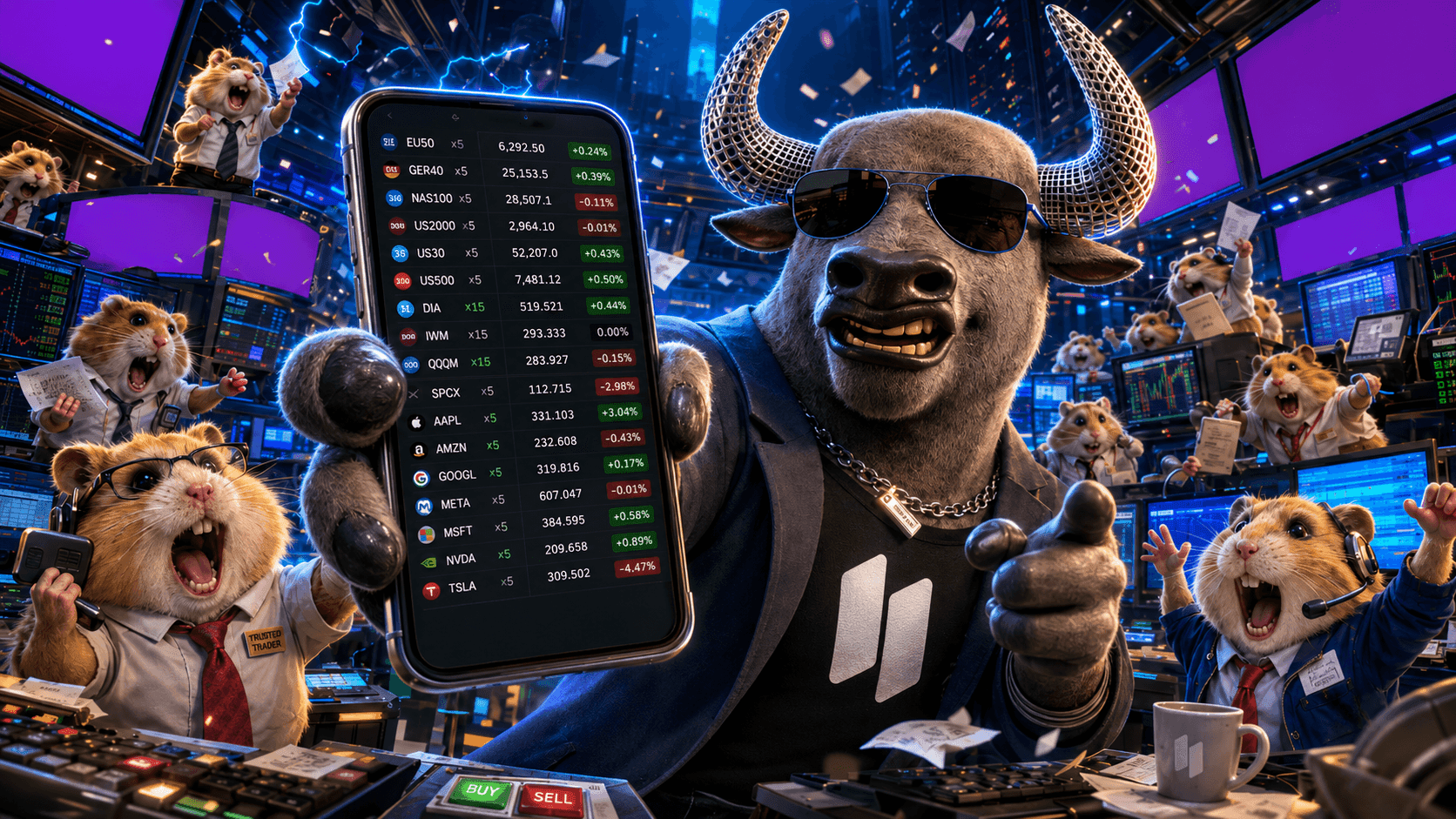
The headline event of July is Upscale's expansion beyond the crypto market in three directions at once: stocks, commodities, and indices. All new instruments run on Upscale Price Index, the platform's own price aggregator that collects data from multiple independent sources — the corresponding label now appears in the terminal.
24/7 Stocks
A new "24/7 Stocks" category has appeared in the pair selector with eight tickers: AAPL, AMZN, GOOGL, META, MSFT, NVDA, SPCX, and TSLA. The key difference from classic exchange trading is round-the-clock access to stocks, including weekends, when exchanges are closed.
Key trading parameters:
- Leverage: x1 to x5 for 1- and 2-phase challenges, up to x2 for Instant
- Commission: 0.003% for 1- and 2-phase challenges, 0.02% for Instant
- Funding: 0.025% of the full position size including leverage, charged once a day at 4:00 PM ET regardless of position direction
- Open interest limit: $100,000 per direction on each challenge, with Long and Short counted separately
The spread depends on the trading session: 0.09% during the main US market session (Monday–Friday, 9:30 AM–4:00 PM ET), 0.14% on weekdays outside the main session and on US holidays, and 0.20% on weekends. This is how the platform compensates for the lower liquidity of off-exchange hours.
One technical detail: every weekday from 9:25 to 9:35 AM ET, the stock market closes completely — volatility peaks in these 10 minutes around the exchange session open. When trading resumes, the first tick may form a price gap, so pending orders are executed at the first available market price.
Open interest data is displayed right in the trading interface: traders see the maximum limit, the amount in use, and the available remainder separately for Long and Short. If an order exceeds the available limit, the system shows the reason before the order is created.
WTI Crude Oil
The Commodities category now includes WTI Crude Oil, joining gold and silver. The instrument also trades around the clock, seven days a week.
Trading conditions mirror 24/7 stocks: leverage up to x5, funding once a day, and a session-based spread that widens on weekends. Full instrument parameters are available in the Upscale documentation.
Indices: Futures-Based Pricing and New European Instruments
The US index instruments US500 (tracking the S&P 500 market), NAS100 (Nasdaq-100), US30 (Dow Jones), and US2000 (Russell 2000) have received an updated pricing methodology. Prices for Upscale index instruments are formed from aggregated market data from the corresponding futures markets: each instrument uses a futures market linked to the corresponding stock index. The resulting price is used for charting, trade execution, and PnL calculation.
A futures index price may differ from the cash or spot index value — a normal characteristic of futures markets. The difference can depend on interest rates, expected dividends, time to contract expiration, and current market conditions.
The previous index markets SPY, QQQM, DIA, and IWM have been switched to close-only mode: opening or increasing positions on them is no longer possible, only closing existing ones. Once all positions are closed, these instruments will be removed from the terminal.
Two European instruments have been added at the same time: GER40 (tracking the German DAX 40 market) and EU50 (the EURO STOXX 50 market). Trading parameters for index instruments remain unchanged.
Market Events Calendar
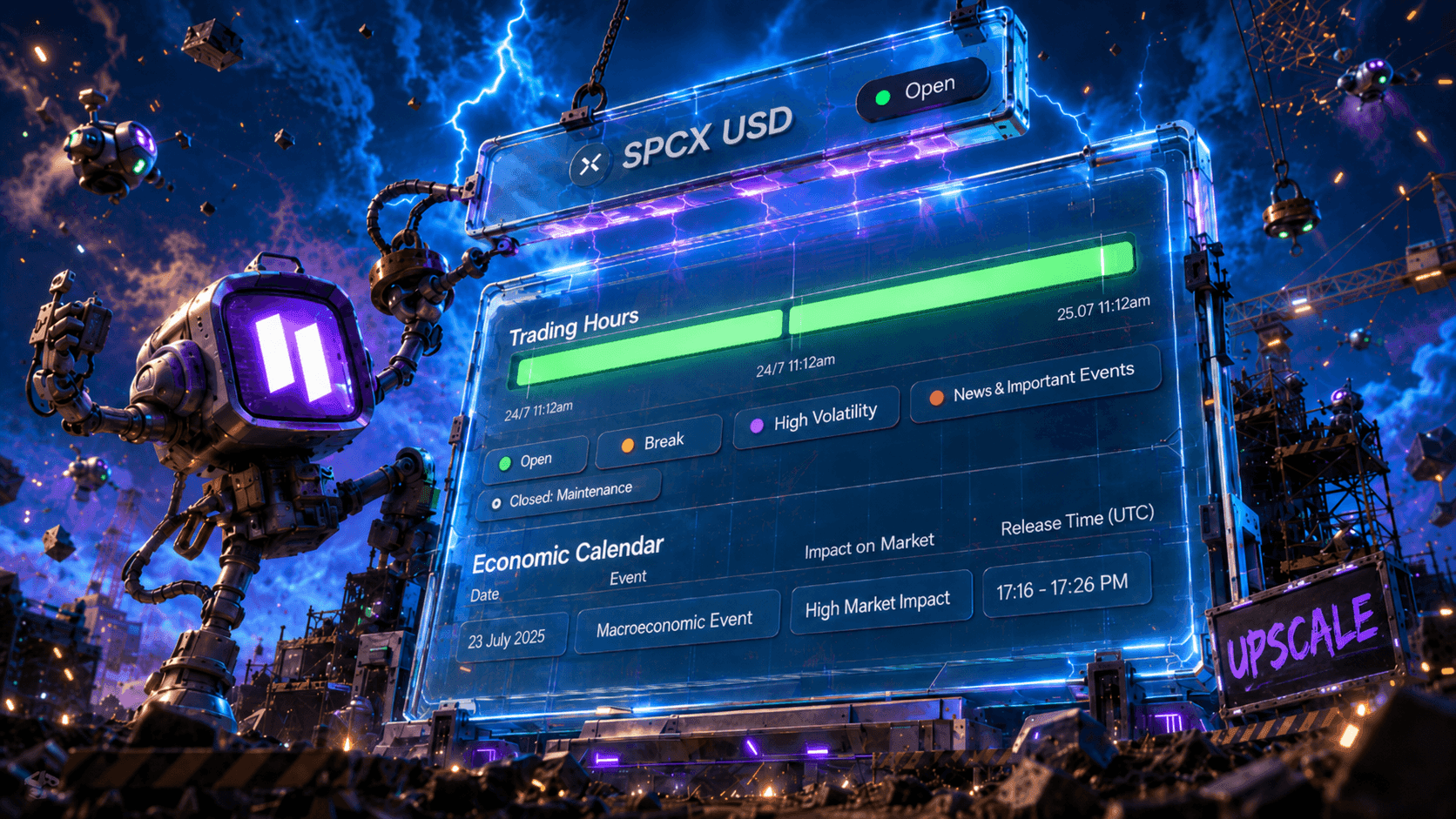
Trading stocks means keeping track of corporate and macroeconomic events — company earnings, dividends, splits, and US macro releases. The terminal now includes an events calendar for exactly that.
The trading pair window now shows market hours and a mode timeline covering ±12 hours from the current moment: normal trading, pause, close-only mode, and forced position closure. Hovering over any interval reveals the exact time and the reason — for example, an upcoming company report. All times are displayed in the user's local time zone. Below the timeline is a table of upcoming events for the instrument, with their impact on trading.
The platform automatically manages trading availability around events:
- Dividends: one hour before the event, all open positions in the stock are force-closed and the market switches to close-only mode, returning to normal trading one hour after the event
- Splits: the strictest scenario — in addition to closing positions, all active orders for the instrument are cancelled, since both the price and the sizing of the asset change after a split
- US macro events (such as inflation releases or Fed rate decisions): all US stocks switch to close-only mode for 10 minutes — 5 minutes before and after the release — with no positions closed
This mechanism protects both traders and the platform from unpredictable price gaps at the very moments when markets react to news most sharply.
Funded Account Restoration After Failure
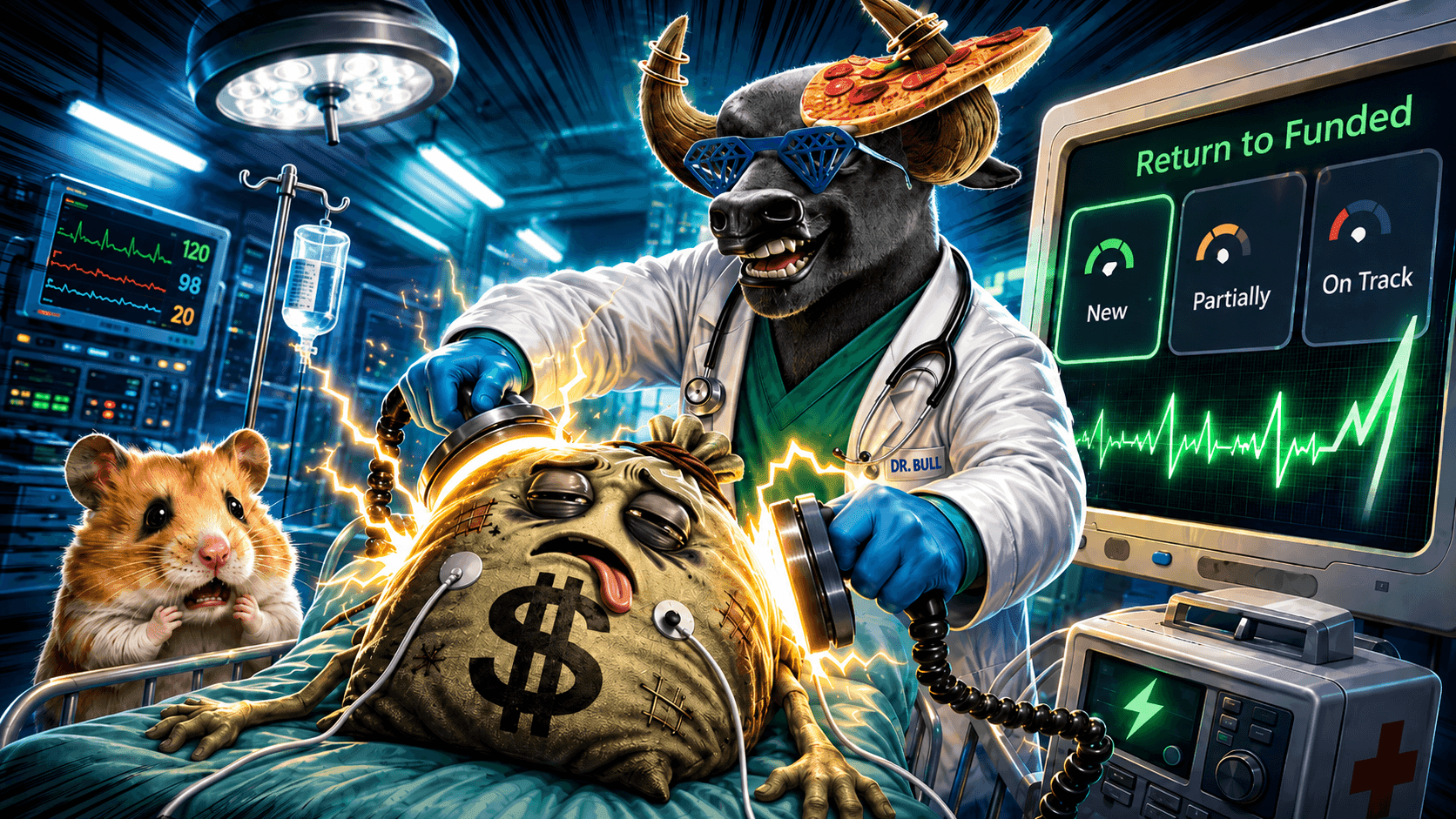
Failing a funded account no longer means going back to square one. An account failed specifically at the funded stage of a 1- or 2-phase challenge can now be restored — for a fee, within 48 hours of the failure.
Here is how it works. After a failure, a restoration offer with a timer appears on the dashboard. The trader chooses a restoration balance — from 100% of the original starting balance down to 92% for 2-phase challenges or 96% for 1-phase ones. The lower the chosen balance, the cheaper the restoration — the exact cost is shown on the restoration screen before payment.
Unlike buying a new challenge, restoration returns the account straight to the funded stage — without passing the challenge phases again, hitting their profit targets, or risking failing the evaluation once more.
After payment, restoration is instant — the same account, with its full history of trades, past payouts, and certificates preserved. Daily profit and the trading day counter start from zero, but the risk rules continue to apply from the original starting balance: the maximum drawdown is calculated from it, and if a trader restored with a balance below the original, only the amount above that original level counts as profit eligible for payout.
Example: a trader restores a $100,000 account (a 2-phase challenge with a 10% maximum drawdown) at a 95% balance — $95,000. The maximum drawdown level is calculated from the original balance and remains $90,000, leaving a $5,000 buffer before failure. For profit to become eligible for payout, the balance first needs to grow above $100,000: if the account reaches $103,000, only $3,000 counts as payable.
The same account can be restored an unlimited number of times — after every new failure, the 48-hour window opens again, and the system sends a reminder 12 hours before it expires. Payment goes through the platform's standard methods; promo codes and referral accruals do not apply to restorations. Each failure also generates a fresh AI report covering the account's entire trading history — useful for reviewing mistakes before returning to the market.
Restoration is not available for demo and Instant accounts, or for failures at challenge phases before the funded stage.
Scaling: Funded Accounts Totaling Up to $400,000

A single trader can now trade funded accounts with a combined nominal value of up to $400,000, counted by the starting balances of all active accounts. For example, two $200,000 funded accounts fully use up the limit. Importantly, balance growth from trading profits does not affect the limit — it is counted only by the accounts' starting nominal values, not their current balances. The limit applies to 1- and 2-phase challenges; Instant and demo accounts are not counted.
If another challenge reaches the funded stage and the combined nominal value exceeds the limit, the account does not burn: it receives funded status and appears on the dashboard marked "Paused". Progress, trading balance, analytics, and certificates all remain available — only trading is locked.
The account can be activated in one click as soon as the limit frees up — for example, after another funded account is closed. If several accounts are paused, the trader chooses which one to activate first. The trading day counter does not increase while paused and continues growing from the day of activation.
New Payment Methods: Solana and Bank Cards

The list of payment methods has grown noticeably — in two directions at once.
Solana network. Challenges can now be paid for with SOL, USDT, and USDC tokens on the Solana network. Popular wallets are supported: Phantom, Solflare, Trust Wallet, MetaMask, OKX Wallet, Bitget Wallet, Coinbase Wallet, Exodus, and others that support the Solana network.
Bank cards. The payment method window now includes a "Pay by card" button: payments with Visa and Mastercard, as well as Apple Pay and Google Pay, are processed on the secure page of the payment provider Stripe. The final price includes the payment provider's fee and is displayed in full before payment confirmation — no hidden charges.
For a KYC-free platform, card payments remove the last barrier for traders who do not have crypto on hand: paying for a challenge works just like in any online store.
Opening Positions by Asset Volume
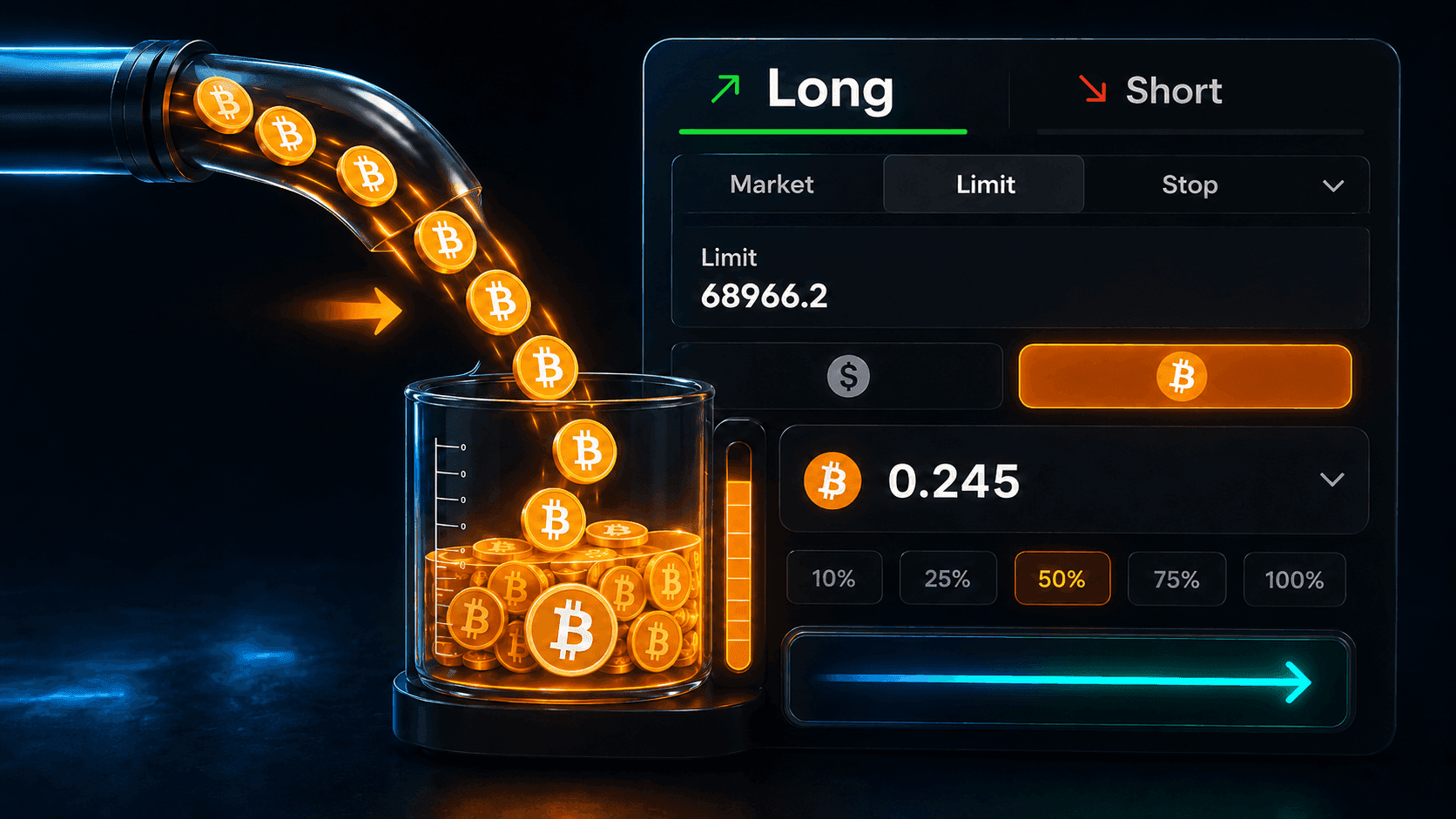
The order form now includes a toggle between two modes: by collateral amount in USD, as before, or by base asset volume — say, exactly 0.5 BTC or 100 NVDA shares.
The mode works for Market, Limit, Stop Market, and Stop Limit orders — both when opening a new position and when increasing an existing one. Another option is to set the volume as a percentage of free balance: the system calculates the maximum volume that fits within the chosen share of funds, accounting for leverage, commission, and a spread buffer.
Before an order is created, the terminal shows two amounts: the expected execution amount and the reserved amount — the latter includes a small buffer for possible spread changes. After execution, the unused remainder of the reserve is immediately returned to the balance; if the order is cancelled, the entire reserve is returned. Reserve returns do not affect daily PnL or challenge phase transitions. The minimum order volume is the equivalent of 10 USD, and the selected mode is remembered between sessions.
For strategies where position size is calculated in instrument units — such as building an order grid or averaging in with a fixed volume step — this removes the need to manually convert volume into margin every time.
Separate Telegram Notifications for Tournaments
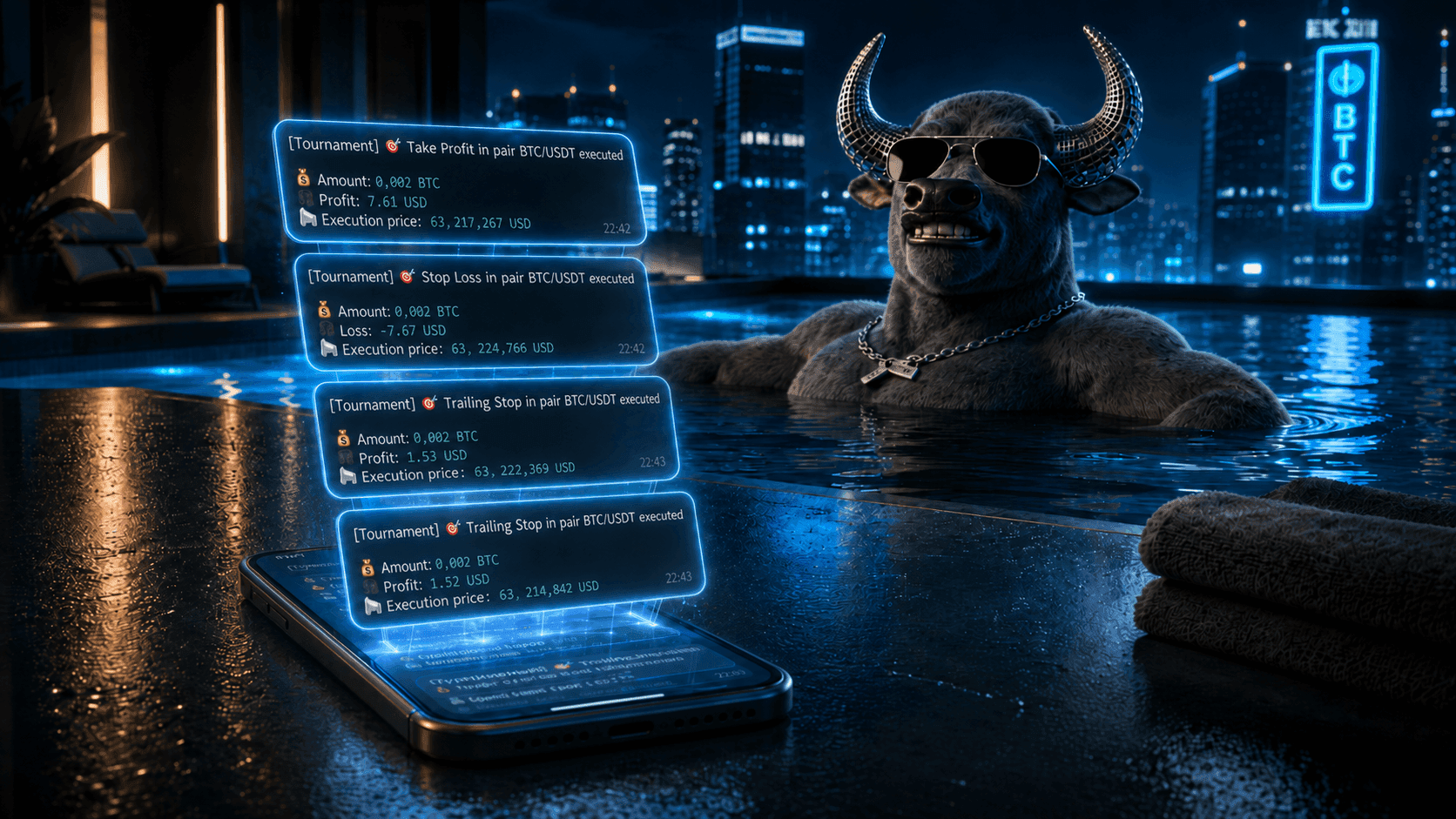
Tournament accounts no longer get mixed up with regular challenges in notifications. When a tournament account is issued, Telegram delivers a dedicated message about joining the tournament instead of the standard new-challenge push. All trading operations on a tournament account — order executions, stop triggers — are now tagged with a "Tournament" label, just as demo accounts already are. Confusing a tournament trade with an operation on a main account is no longer possible.
Updated Maximum Drawdown Parameters for the $200,000 2-Phase Challenge
Starting in July, new purchases of the $200,000 2-phase challenge come with updated risk parameters: at Phase 2 and the funded stage, the maximum drawdown is 8% instead of the previous 10%. Phase 1 is unchanged at 10%, and the daily drawdown remains 5% at all stages.
The change applies only to new purchases and new demo accounts. All existing accounts — at any challenge stage — continue to operate under the previous 5% / 10% parameters. The update does not affect 1-phase challenges or Instant Funded. Up-to-date parameters for all challenges are always available in the Upscale documentation.
Key Takeaways
- 24/7 stocks: AAPL, AMZN, GOOGL, META, MSFT, NVDA, SPCX, and TSLA trade around the clock, including weekends, with leverage up to x5 and a $100,000 open interest limit per direction.
- WTI crude oil has been added to the commodities category — also trading 24/7.
- The index instruments US500, NAS100, US30, and US2000 are now priced using aggregated data from the corresponding futures markets; the European GER40 and EU50 have been added.
- The events calendar in the terminal shows market modes for ±12 hours ahead and behind, and automatically restricts trading around dividends, splits, and US macro events.
- Funded accounts can be restored within 48 hours of failure — at the full or a reduced balance; the lower the chosen balance, the cheaper the restoration.
- Scaling: the combined nominal value of active funded accounts is capped at $400,000 per trader; accounts above the limit are paused and can be activated in one click once the limit frees up.
- Payments are now available with Visa and Mastercard via Stripe, through Apple Pay and Google Pay, and with SOL, USDT, and USDC tokens on the Solana network.
- Positions can be opened by asset volume or as a percentage of free balance — for Market, Limit, Stop Market, and Stop Limit orders.
- The maximum drawdown for new $200,000 2-phase challenges is 8% at Phase 2 and the funded stage; existing accounts keep their previous terms.
Start right now: 👉 Upscale.trade | Telegram bot
Documentation: 📖 Upscale Docs
Subscribe: 📺 YouTube | 𝕏 Twitter
Community: 💬 Telegram chat | 🎮 Discord
Frequently Asked Questions
Which stocks are available on Upscale and when do they trade?
Eight stocks are available: AAPL, AMZN, GOOGL, META, MSFT, NVDA, SPCX, and TSLA. All of them trade 24/7 — around the clock, seven days a week. The only exception is a technical pause on weekdays from 9:25 to 9:35 AM ET around the exchange session open. Outside the main exchange session and on weekends, a wider spread applies.
What happens to the old index markets SPY, QQQM, DIA, and IWM?
They have been switched to close-only mode: opening or increasing a position is not possible, while closing existing ones is. Once all positions are closed, these instruments will be removed from the terminal. They are replaced by US500, NAS100, US30, and US2000, whose prices are formed from aggregated data from the corresponding futures markets.
How much does funded account restoration cost?
The cost depends on the challenge type and the chosen restoration balance: the lower the balance, the cheaper the restoration. The exact amount is shown on the restoration screen before payment. Restoration is available within 48 hours after a funded-stage failure.
What is the $400,000 funded account limit?
It is the maximum combined starting balance of funded accounts a trader can trade simultaneously. If a new funded account exceeds the limit, it is kept in "Paused" status and can be activated in one click once the limit frees up. A paused account's progress and certificates do not burn.
Can I pay for a challenge with a bank card?
Yes. Payments with Visa and Mastercard, as well as Apple Pay and Google Pay, are processed on the page of the payment provider Stripe. The final price, including the provider's fee, is shown before payment confirmation. Payments with SOL, USDT, and USDC tokens on the Solana network have also been added.
Have the drawdown rules changed?
Only for new purchases of the $200,000 2-phase challenge: the maximum drawdown at Phase 2 and the funded stage is now 8% instead of 10%. Phase 1 (10%) and the daily drawdown (5%) are unchanged. Existing accounts continue under the previous parameters; 1-phase challenges and Instant Funded are not affected.