What Affects Trading Beyond Strategy: 7 Factors | Upscale

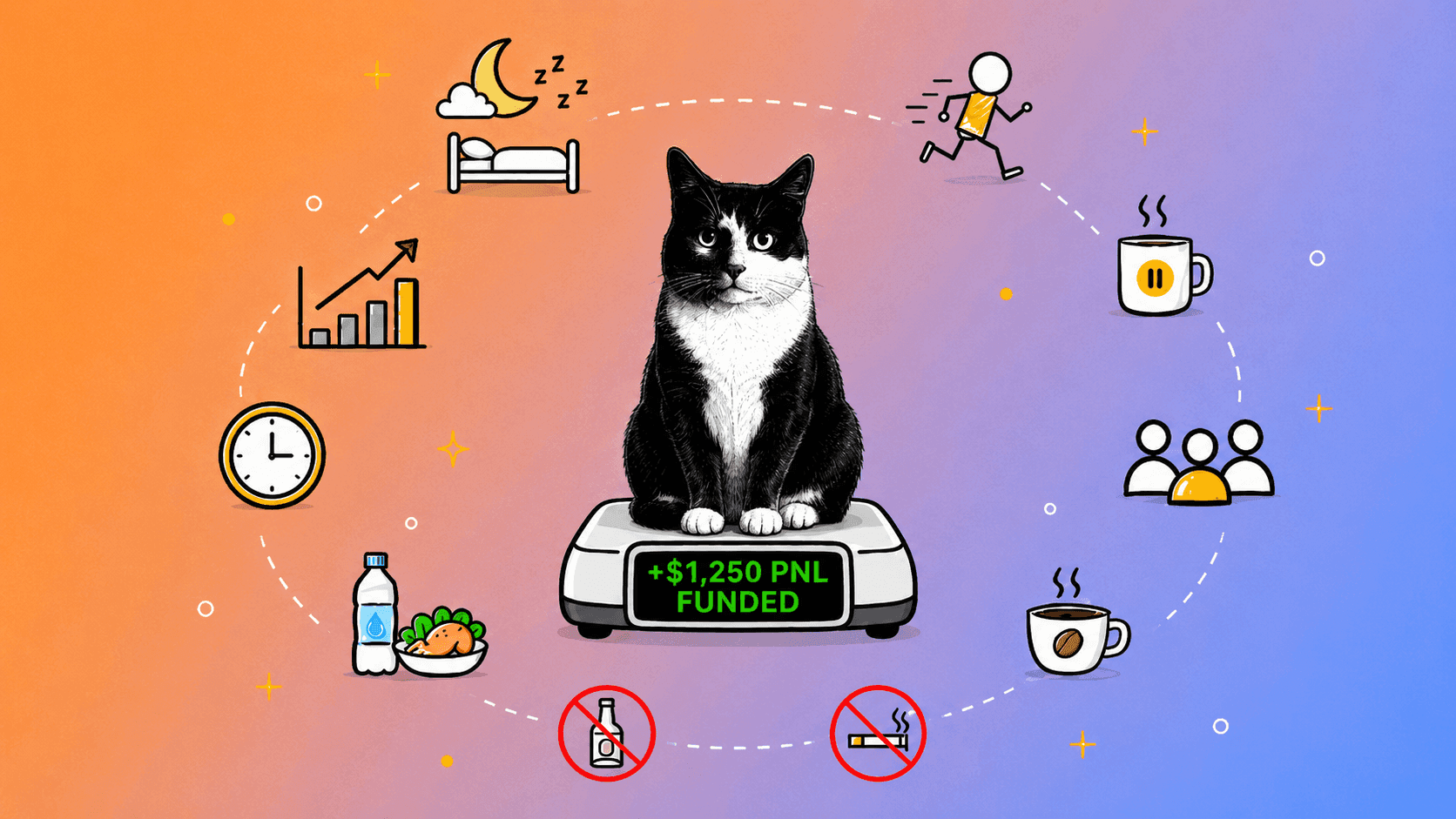
Every trading article talks about strategy and psychology. Learn the levels, control your emotions — and you'll make money. But research says something different: a sleep-deprived trader with a good strategy makes worse decisions than a well-rested trader with an average one. In 2008, neuroscientist John Coates ran a study on a London City trading floor and found that a trader's morning testosterone level predicted their daily profitability more accurately than experience or strategy. When chronic stress elevated cortisol, traders lost 44% of their risk appetite — becoming irrationally pessimistic precisely when the market offered the best opportunities. This isn't wellness advice or lifestyle content. It's data: sleep, hydration, trade frequency, time of day, and physical activity measurably affect the quality of trading decisions. And unlike strategy, which takes years to refine, these factors can be fixed in a single week. Below are seven factors that affect your trading but don't appear in any technical analysis textbook. Backed by scientific sources and examples from traders who have withdrawn over $75,000 from prop accounts.
1. Sleep: The Most Underrated Factor in Trading
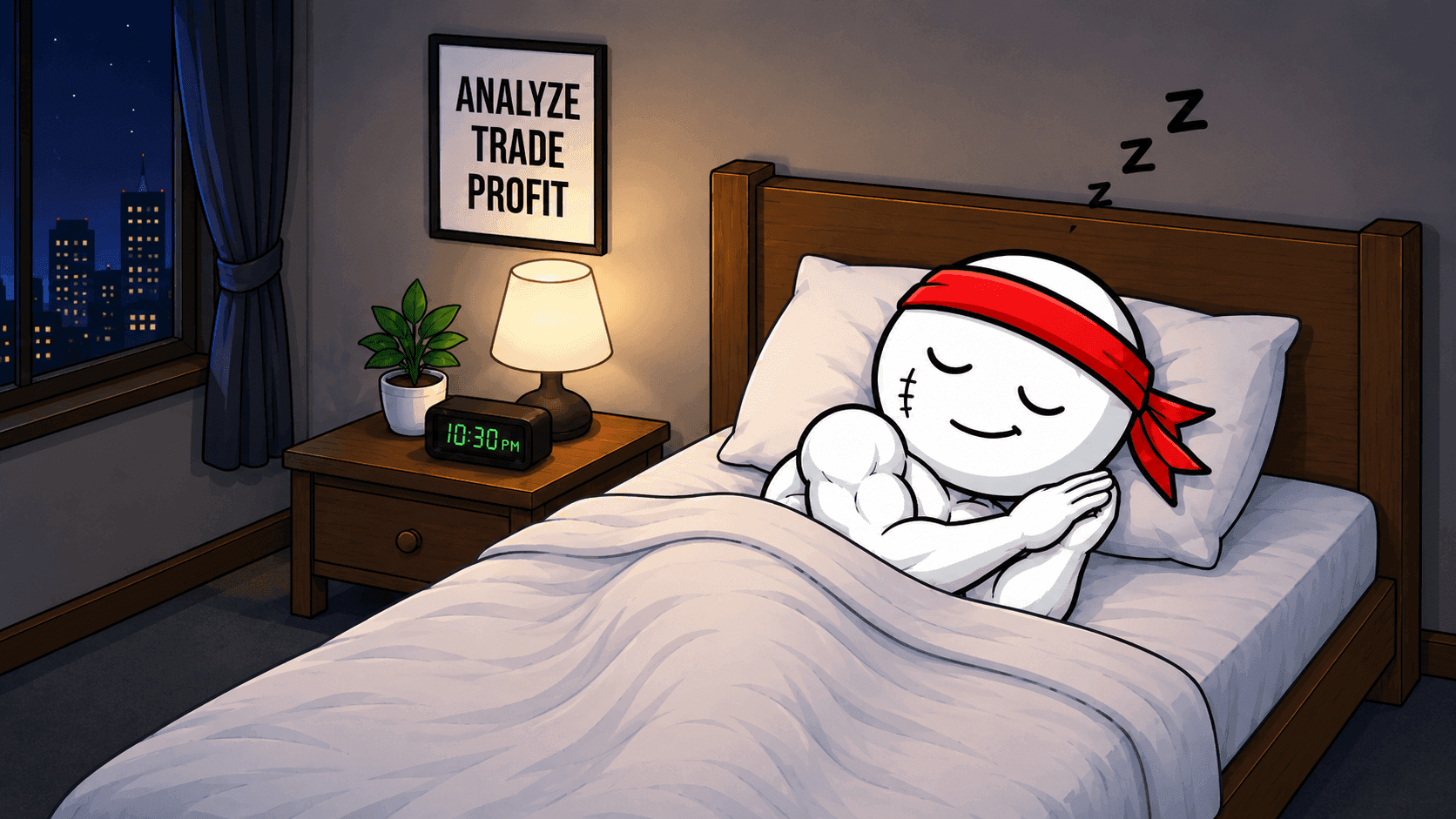
A meta-analysis of 23 studies (Nofsinger & Shank, Review of Financial Economics, 2019) found a consistent link: sleep loss increases risk-taking and amplifies optimism about gains. Neuroimaging (Duke-NUS, Journal of Neuroscience, 2011) explained the mechanism: sleep deprivation impairs the prefrontal cortex — the region responsible for deliberative risk assessment — while activating reward-seeking brain centers. You simultaneously evaluate risk worse and want to earn more. Ideal conditions for blowing an account.
The critical nuance: one sleepless night isn't the main problem. Research showed that five consecutive nights of restricted sleep reduced information-gathering before decisions and increased risk propensity. It's accumulated sleep debt — "I sleep 5–6 hours, that's enough for me" — that erodes trading quality invisibly, because the trader doesn't feel the deterioration.
An ecological study of online poker players (the closest analog to real-money trading) confirmed: sleep-deprived sessions produced more tilt, more hands played, and worse financial results.
Practical rule: 7–9 hours of sleep. If you've had multiple nights under 6 hours — reduce position size or don't trade at all. Accumulated sleep debt isn't a reason for heroics; it's a reason for a pause.
2. Trade Frequency: Less = More
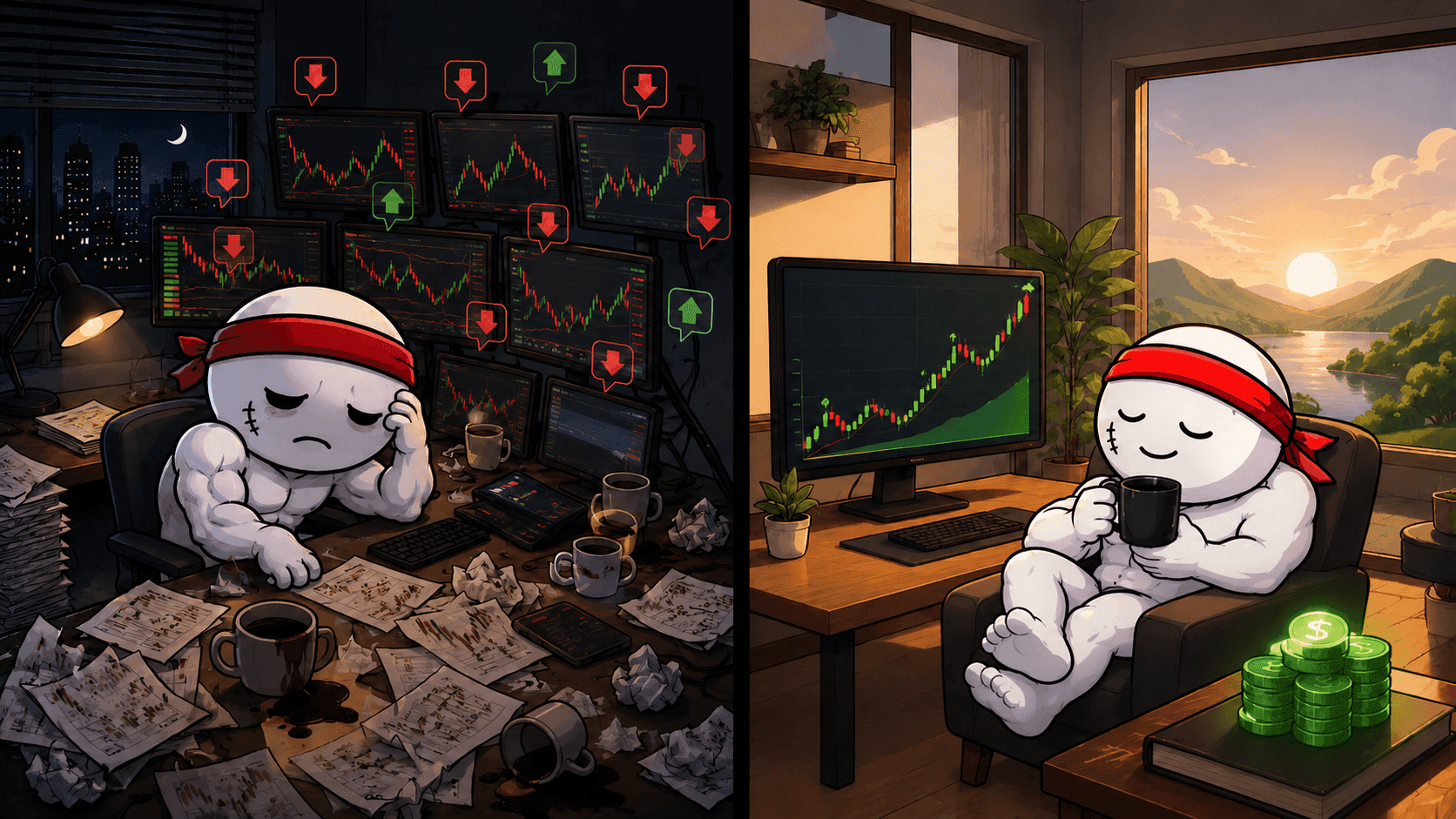
This is the best-documented money-losing factor in trading, and the most ignored.
Data from Barber & Odean across 66,465 households: a portfolio mimicking the most active traders (top quintile by frequency) returned 11.4% annually. The least active returned 18.5%. A 7-percentage-point gap — purely from trade frequency. Not from strategy, not from asset selection, not from market timing. From how often the "buy" button was pressed.
Analysis of all Taiwanese day traders over 14 years (Barber, Lee, Liu & Odean) was even harsher: less than 1% of day traders consistently earned positive returns after fees.
The reason is decision fatigue. Every trading decision depletes cognitive resources. By your tenth trade of the day, your brain physically analyzes worse than on the first. Vigilance decrement research shows that attention quality declines with every hour of continuous work — and micro-breaks every 60–90 minutes slow this decline.
What prop traders say:
Pyotr, who withdrew $2,150 from Upscale (and over $20,000 across all prop firms), formulated this as his single rule:
"One trading decision per day. That's it."
When you have one trade per day, overtrading is physically impossible. No second chance to revenge trade. No third "just one more." Pyotr doesn't fight the impulse to trade more — he removed the possibility entirely.
Alexander, who received ~$4,600 from his first prop account, lost the funded account precisely because of overtrading. His conclusion:
"Slow and steady wins the race. If you make half a percent per day consistently over a month, you can withdraw very good amounts."
Practical rule: Set a hard trade limit before the session starts. One to three trades per day for most strategies. Hit the limit — close the terminal, regardless of what the chart shows.
3. Time of Day: Your Chronotype Matters More Than the Market Schedule

A large-scale study by Bedder, Vaghi, Dolan & Rutledge (2023, Scientific Reports, 26,720 participants) found that the tendency toward risky decisions involving potential losses increases throughout the day. People assess risk more cautiously in the morning and more aggressively toward evening.
Chronotype amplifies the effect: morning types are generally more cautious and disciplined, evening types more risk-prone.
For a trader, this means something specific: if you're a morning person forcing yourself to trade the late New York session, you're trading in your worst cognitive state. If you're a night owl trying to catch the London morning session at 7 AM — same problem.
What prop traders say:
Olaide, who withdrew $1,424 from Upscale, described his approach:
"The market in London normally moves during the night. When I wake up in the morning, I check the charts — sometimes I just close and leave everything for that day."
He doesn't trade "because the market is open." He trades when he sees a setup during his alert hours. No setup — no trades for the day. This isn't laziness; it's a deliberate choice: trade at peak personal alertness, not at peak market activity.
Practical rule: Identify your chronotype (morning / evening / mixed) and trade during your peak alertness hours. Be especially cautious with decisions late in the day — research shows that's when you're most prone to unjustified risk.
4. Water and Food: Boring, but Measurable

A meta-analysis by Wittbrodt & Millard-Stafford (2018, Medicine & Science in Sports & Exercise, 33 studies, 413 subjects): dehydration beyond 2% body-mass loss impairs attention with an effect size of −0.52 — a significant effect. The functions hit hardest are exactly what traders need: sustained attention, executive function, and coordination.
A continuous glucose monitoring study (npj Digital Medicine, 200 participants) showed that both very low and very high blood glucose slow cognitive processing. A glucose crash (skipping a meal before the session) and a glucose spike (eating a candy bar) are equally harmful.
This isn't about "eating healthy." It's about a specific mechanism: your brain consumes roughly 20% of your body's total energy. When it lacks water or glucose, it runs slower. You don't feel it (the brain doesn't ache from dehydration), but your decisions get worse.
Practical rule: Glass of water before the session, bottle within reach. Eat 30–60 minutes before trading — something with stable energy release (oatmeal, eggs, nuts), not fast carbs. If the trading session runs longer than 2 hours — snack in the middle.
5. Physical Activity: Cortisol Is the Bridge Between Exercise and P&L

No direct studies linking exercise to trader profitability exist. But there's a bridge: cortisol.
Research by Kandasamy et al. (2014, PNAS) on professional traders showed that when cortisol levels rose 69% over 8 days of market volatility, risk appetite dropped 44%. Traders became irrationally pessimistic — declining profitable trades and overestimating loss probability. The effect was stronger in men.
Regular physical activity is one of the most studied methods for reducing chronic cortisol. It also increases BDNF (brain-derived neurotrophic factor), which improves cognitive function and stress resilience.
The chain: regular exercise → lower chronic cortisol → accurate risk assessment → better trading decisions during volatile periods. Each link in this chain is supported by separate studies, though the full chain hasn't been tested directly on traders.
What prop traders say:
Pyotr plays basketball — his only hobby outside trading. Saul schedules days with no trading at all. None of the successful traders in our interviews describe themselves as someone who sits at charts for 12 hours straight.
Practical rule: 20–30 minutes of physical activity per day. Doesn't have to be the gym — a walk, basketball, cycling. Consistency matters more than intensity. The goal is reducing baseline cortisol, not training for a marathon.
6. Breaks: 48 Hours Without Charts Isn't Laziness — It's an Investment

Vigilance research shows that attention quality drops continuously with every minute at the screen. A 2025 study (Frontiers in Psychology, 253 participants) found that 90-second breaks every 10 minutes preserved cognitive performance better than one long break.
On longer scales: meta-analyses show that vacations improve well-being and performance, but the effect fades within roughly one week of returning. Frequent short breaks work better than rare long ones.
What prop traders say:
Alexander, who lost his funded account after a $4,600 payout, put it this way:
"48 hours — just don't touch the charts. Step away, forget about it. Throw your phone away, go for a walk, touch some grass."
His plan for returning: slower, more careful, with mandatory breaks. For him, this is a lesson paid for with a lost funded account.
Pyotr, after a nightmarish April (every trade hitting stop-loss), took a week-long pause, then returned. He didn't try to "win back" losses immediately.
Practical rule: Micro-break every 60–90 minutes of the trading session (stand up, walk around, look away from the screen). After a streak of losing days — minimum 48 hours without charts. After losing an account — one week.
7. Social Environment: Chat Rooms Help and Hurt Simultaneously

Here, science gives two opposing results.
Isolation hurts: chronic loneliness elevates cortisol, impairs memory and decision-making, and heightens the brain's threat response. A trader working from home alone for months is in the risk zone for cognitive deterioration.
Trading chats hurt differently: research shows that social trading groups (Reddit, Discord, Telegram) amplify herding behavior, FOMO, overconfidence, and confirmation bias. When everyone in the chat is screaming "long!" — you're more likely to open a position without your own analysis. This isn't a hypothesis — it's a documented social amplification of cognitive biases.
Alexander described the mechanism:
"FOMO — you just catch it. It ruins you."
The synthesis: social connection is necessary for mental health and accountability. But real-time trade ideas from chat rooms are a bias amplifier, not an edge.
Practical rule: Be part of a community (Discord, Upscale Telegram) for experience sharing and support. But make trading decisions alone, following your own strategy, without chat influence. If you notice the chat affecting your entries — mute notifications during the session.
Caffeine, Alcohol, Nicotine: The Short Version
Caffeine (1–2 cups): improves attention and reaction time, especially when sleep-deprived. Overdose (3+ cups) impairs decision accuracy and adds anxiety. Net: moderately helpful, easy to overdo.
Alcohol: increases reward sensitivity and risk-taking without improving learning from mistakes (Iowa Gambling Task study, Cambridge Core). Trading after alcohol is a guaranteed decision impairment. No exceptions.
Nicotine: a meta-analysis of 41 studies (Heishman et al.) found small but genuine attention and working-memory improvements (effect sizes 0.16–0.44). But dependence risk and links to cognitive aging make it a bad trade for non-smokers. If you smoke, it's not an advantage — it's compensation for withdrawal.
Pre-Session Trader Checklist
Print this out and keep it by your monitor:
Physiology:
- Slept 7+ hours (if not — reduce position size)
- Ate 30–60 minutes before the session (not fasted, not after fast carbs)
- Water bottle on the desk
- Coffee — no more than 2 cups
Session rules:
- Maximum trades for the day set before start (recommended: 1–3)
- Trading session aligns with my peak alertness time
- Break scheduled every 60–90 minutes
- Three-stop rule → done for the day
Environment:
- Trading chat notifications muted during the session
- Daily plan written before opening the terminal
- After a streak of losing days — took at least 1 day off before today's session
Methodology: This article is based on peer-reviewed scientific research (Coates & Herbert 2008, Kandasamy et al. 2014, Nofsinger & Shank 2019, Barber & Odean, Bedder et al. 2023, Wittbrodt & Millard-Stafford 2018). Factors are ranked by evidence quality: "strong" — studies directly on traders; "good" — robust cognitive studies extrapolated to trading; "moderate" — reasonable assumptions with limited scientific support.
Disclosure: Upscale is referenced through examples of platform traders. Scientific data is presented independently of any connection to Upscale.
Key Takeaways
Strategy determines which trades you open. Psychology determines how you react to the outcome. But physiology and environment determine the state in which you make every decision — and that affects everything else.
Three factors with the strongest evidence: sleep (deprivation increases risk-taking and impairs loss assessment), trade frequency (the most active traders earn 7 percentage points less annually than the least active), and time of day (risk-taking tendency increases toward evening).
Three factors with good evidence: hydration and stable blood sugar (dehydration impairs attention with a measurable effect), physical activity (reduces cortisol — the hormone that, when chronically elevated, strips traders of 44% of their risk appetite), and regular breaks (attention degrades continuously without pauses).
None of this replaces strategy and discipline. But a trader with a good strategy who trades sleep-deprived, dehydrated, after five trades in a row toward the evening — loses to a trader with an average strategy who slept well, drank water, and took one trade in the morning.
As Pyotr put it: "One trading decision per day. That's it." The simplest possible rule — and it works not because Pyotr found a secret indicator, but because he removed fatigue, overtrading, and the evening risk shift from the equation.
Start now: 👉 Upscale.trade | Telegram Bot
Follow us: 📺 YouTube | 𝕏 Twitter
Community: 💬 Telegram Chat | 🎮 Discord
Frequently Asked Questions
How does sleep affect trading performance?
Sleep deprivation increases risk-taking, amplifies optimism about gains, and dulls response to losses (meta-analysis of 23 studies, Nofsinger & Shank, 2019). Accumulated sleep debt is especially dangerous: multiple nights at 5–6 hours is worse than one sleepless night. A study of online poker players confirmed: sleep-deprived sessions produced more tilt, more trades, and worse results. Recommendation: 7–9 hours of sleep; with chronic sleep debt, reduce position size or skip the day.
How many trades per day are optimal for prop trading?
The data is clear: fewer is better. Per Barber & Odean's study (66,465 households), the most active traders earned 7 percentage points less than the least active. Less than 1% of day traders consistently earn after fees (14-year analysis of all Taiwanese traders). Recommendation: 1–3 trades per day, hard limit set before the session. Pyotr, who has withdrawn $20,000+ from prop firms, trades strictly one trade per day.
Does time of day affect trading decision quality?
Yes. A study of 26,720 participants (Bedder et al., 2023) found that risk-taking tendency for potential losses increases throughout the day. People assess risk more cautiously in the morning and more aggressively toward evening. Chronotype amplifies this: morning types are more cautious, evening types more risk-prone. Trade during your peak alertness hours and be especially careful with late-day decisions.
Does dehydration really impair trading?
Yes, and it's measurable. A meta-analysis of 33 studies (Wittbrodt & Millard-Stafford, 2018) found that dehydration beyond 2% body-mass loss impairs attention with an effect size of −0.52. This is a significant effect targeting exactly the functions traders need: sustained attention and executive function. The brain doesn't signal dehydration with pain — you simply make worse decisions without realizing it.
Does exercise help you trade better?
No direct "exercise → trader profit" studies exist. But there's a proven chain: regular exercise reduces chronic cortisol → chronically elevated cortisol strips traders of 44% of their risk appetite (Kandasamy et al., 2014). High-cortisol traders become irrationally pessimistic, missing profitable opportunities. Recommendation: 20–30 minutes of physical activity per day for baseline stress reduction.
Should you trade in trading chat rooms?
Community participation (Discord, Telegram) is beneficial for mental health and experience sharing. But research shows that trading chats amplify herding behavior, FOMO, and confirmation bias. Recommendation: use the community for support and accountability, but make trading decisions alone, following your own strategy. Mute chat notifications during your session.
How often should you take breaks while trading?
Vigilance research shows cognitive performance declines continuously without pauses. Optimal: micro-break (1–2 minutes: stand, walk, look away) every 60–90 minutes. After a streak of losing days: minimum 48 hours without charts. After losing a funded account: one week. Vacation effects on performance fade within roughly one week, so frequent short breaks work better than rare long ones.