Fair Value Gap Trading: Identify and Trade FVGs | Upscale

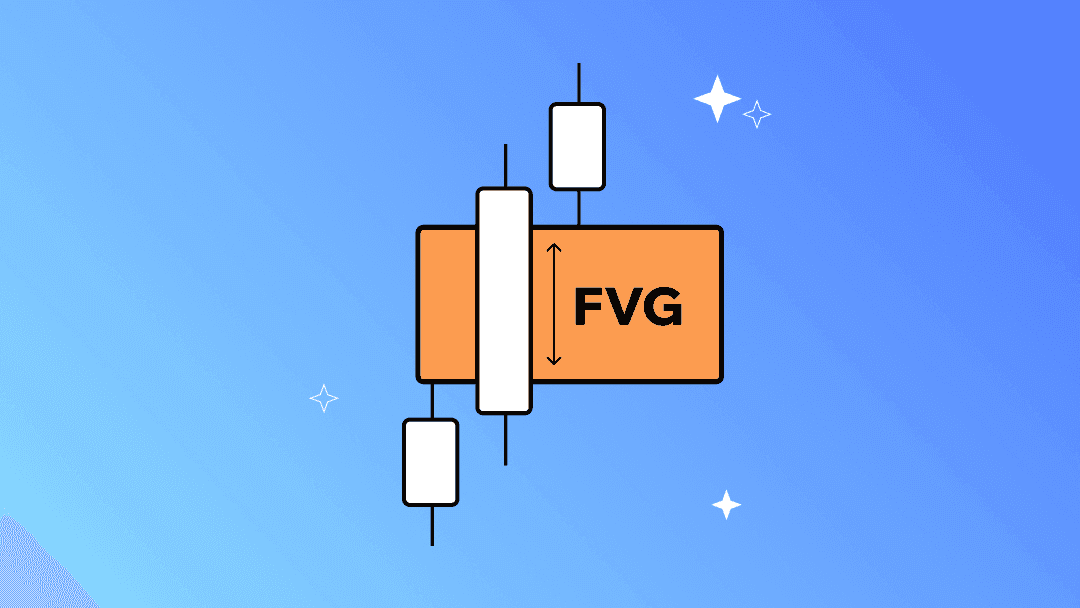
A fair value gap (FVG) is an unfilled price zone that forms when price moves so rapidly that normal two-sided trading cannot occur at certain levels. Visually, it appears as a three-candle pattern where the middle candle creates a gap whose wicks don't overlap with the wicks of the candles before or after it. FVGs are a core component of Smart Money Concept methodology — they represent the footprints left when institutional orders overwhelm available liquidity in the $7.5 trillion-per-day forex market according to the BIS Triennial Survey 2022. SMC practitioners commonly cite fill rates of 70–85% for valid FVGs, though this range comes from community observation rather than peer-reviewed research. Below is a breakdown of how FVGs form, how to identify valid setups, the complete trading strategy, and how to manage the 15–30% of setups that fail.
⚠️ About the 70–85% fill rate: This statistic is widely cited in SMC trading communities but does not originate from peer-reviewed academic research. It represents observed tendencies in trader practice, not a guaranteed probability. Actual fill rates vary by instrument, timeframe, market condition, and quality of setup selection. Use the number as a rough benchmark for setup quality comparison, not as a mathematical edge.
What Is a Fair Value Gap?
A fair value gap is an unfilled price zone on charts. It appears when price moves too rapidly for normal trading activity. The market literally skips certain price levels.
Here's how to spot one. Look for three consecutive candles. The middle candle creates a gap — its wick does not overlap with the wicks of the candles before and after it. This visual pattern appears on any chart, any market, any timeframe.
The formation cause is simple: buyer-seller imbalance. Aggressive institutional orders overwhelm available liquidity. Price jumps to the next liquidity zone. A gap remains behind.
These zones act as magnets. Price frequently returns to fill them. SMC practitioners observe that 70–85% of valid FVGs eventually get filled, though this isn't a mathematical guarantee. The market seeks efficiency, and unfilled levels represent inefficiency that often gets corrected.
FVGs connect directly to Smart Money Concept methodology. They represent institutional footprints — when banks or hedge funds move large positions, they leave traces. FVGs are those traces. For a complete breakdown of how FVGs fit into the broader SMC framework alongside order blocks and liquidity grabs, see our guide on the Smart Money Concept trading framework.
The Market Psychology Behind Fair Value Gaps
Large institutional orders create fair value gaps through aggressive execution. According to the BIS Triennial Survey 2022, daily forex turnover reached $7.5 trillion, with the vast majority handled by central banks, commercial banks, hedge funds, and multinational corporations. When institutions buy or sell urgently, they consume all available orders at certain prices. Price jumps to the next available level. The gap left behind shows where their activity was too aggressive for normal market flow.
Why does price return? Markets seek equilibrium. Unfilled price levels represent inefficiency — normal price discovery did not occur there. Later participants recognize these zones as institutionally significant, and technical traders worldwide identify the same FVGs, placing orders near these zones. This creates a partial self-fulfilling prophecy: more attention means higher probability of price returning.
The result is the commonly cited 70–85% fill rate. But it's important to understand what this number actually represents: it's the market rebalancing inefficiency created by institutional urgency, amplified by coordinated retail attention. Not all gaps are equal, and trader execution determines whether the statistical tendency translates into profit.
What Causes Fair Value Gaps
Four main catalysts create fair value gaps in trading. Understanding them helps anticipate new formations.
Institutional order flow is the primary cause. Large players execute significant orders that overwhelm available liquidity. They consume all orders at certain prices, and price skips to the next liquidity zone.
High-impact news events trigger immediate reactions. Fed decisions, employment data, and inflation reports cause rapid price movement — everyone rushes to the same side. Gaps form as price jumps through levels.
Earnings reports create information asymmetry. Institutions react immediately; retail traders process information more slowly. This one-sided pressure generates gaps during the delay.
Extreme market sentiment shifts cause herd behavior. Geopolitical events or market crashes evaporate liquidity on one side. Price gaps as it seeks available counterparties.
FVGs relate to supply and demand zones conceptually, but they differ in precision. FVGs are specific gaps between three consecutive candles — measurable to the pip. Supply and demand zones cover broader price areas and rely on subjective interpretation.
How to Identify Fair Value Gaps on Your Charts
The three consecutive candles rule defines valid FVG identification. Look for three candles where the middle one creates an unfilled gap. The gap should not overlap with surrounding candles.
Step-by-step identification:
- Scan for three consecutive candles moving in the same direction
- Check if the middle candle created a gap
- For bullish FVGs, measure from the high of the first candle to the low of the third
- For bearish FVGs, measure from the low of the first candle to the high of the third
- Verify that wicks do not overlap
- Measure the gap size against minimum thresholds — forex typically requires 10+ pips, crypto needs 0.2%+ gap size
- Assess market context including higher timeframe direction and recent structure
Not all gaps deserve attention. Significant FVGs occur on higher timeframes like 4H and above. They align with higher timeframe trends, form near key structure levels, and show substantial size relative to average candle range. Insignificant FVGs appear during choppy price action, lack directional context, and represent tiny gaps relative to normal volatility. Skip these and focus on quality setups.
Bullish vs. Bearish Fair Value Gap Examples
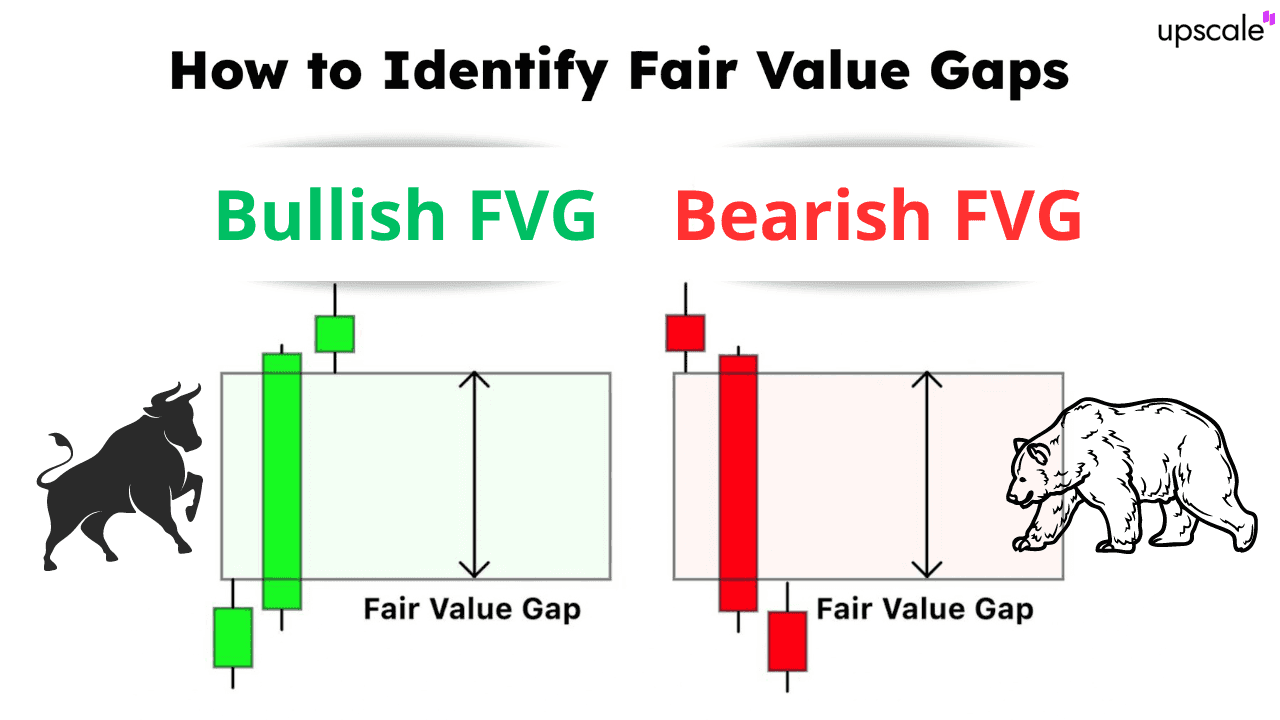
Bullish fair value gaps form during upward price movement. The pattern shows a down candle or consolidation first, followed by an aggressive up candle that gaps higher, followed by a continuation candle that maintains position above the gap. The visual result shows unfilled space below current price. This zone represents a potential long entry opportunity — price may return here before continuing higher. Target the return to the low of the first candle as minimum expectation.
Bearish fair value gaps form during downward movement. An up candle or consolidation comes first, followed by an aggressive down candle that gaps lower, followed by a continuation candle that does not fill the gap upward. The visual result shows unfilled space above current price. This zone offers a potential short entry opportunity — price may return before continuing lower. Target the high of the first candle.
Both types have comparable reliability in the SMC framework. The difference is directional bias, and your selection depends on higher timeframe market structure.
Fair Value Gaps vs. Other Market Inefficiencies
Fair value gaps differ from other market concepts. Understanding distinctions prevents misidentification.
Order blocks represent specific candles where institutions entered — the last opposing candle before significant directional moves. FVGs are the unfilled spaces created during the move itself. Order blocks are solid price zones; FVGs are empty price zones. The relationship matters for trading: order blocks frequently precede FVGs, and using both together creates higher-probability setups. Order blocks show where smart money positioned, while FVGs show the inefficiency from their execution.
Regular price gaps differ from FVGs. Regular gaps occur between trading sessions — think overnight or weekend gaps in stocks. FVGs occur during active trading from rapid intra-session movement. SMC practitioners report higher fill probability for intra-session FVGs compared to session gaps.
Supply and demand zones are broader price areas spanning multiple price levels and relying on subjective zone-drawing. FVGs are specific gaps between consecutive candles, offering precise measurable zones. Both reflect imbalances but differ in precision and identification methodology.
Inverse Fair Value Gap Explained
Inverse fair value gaps (IFVGs) signal potential reversals rather than continuation. They form at market extremes after extended moves, when price becomes overextended and then reverses immediately.
Standard FVGs suggest continuation or mitigation zones. IFVGs behave differently — they form during the final exhaustion push. Price creates a gap, then immediately reverses through it. This inverts the expected behavior and marks trend exhaustion rather than trend continuation.
Look for IFVGs at obvious extremes: multi-week highs or lows, psychological levels, major resistance or support. Volume spikes and volatility expansion indicate climactic behavior. When price immediately rejects its own gap, the previous trend has likely exhausted and reversal is underway. SMC practitioners report IFVG reliability approaching 80–85% when the formation context includes these significant turning points — though the same caveats about community-cited statistics apply.
Fair Value Gaps in Different Markets
Fair value gaps manifest across all financial markets, but market-specific characteristics affect their behavior.
Forex markets show clean FVG formation due to deep liquidity. Major pairs like EUR/USD and GBP/USD work best. Gaps tend to be smaller (5–20 pips) but precise. Best timeframes range from 15-minute to 4-hour charts. SMC practitioners report higher fill rates during London and New York sessions due to institutional concentration.
Cryptocurrency markets display highly visible FVGs due to 24/7 trading and higher volatility. Use 1-hour to daily charts — lower timeframes are noisy. Larger gaps are common (0.5–2% for BTC/USDT). Continuous trading means all gaps are true intra-session FVGs. The trader Maxim, profiled in verified prop trading success stories, uses FVG-based SMC principles on crypto markets with strict 1–2 trades per day discipline.
Stock markets require focus on liquid stocks with high daily volume. Daily to weekly charts generally prove most reliable. Distinguish true intraday FVGs from overnight gaps, which are structurally different.
Despite market differences, identification methodology remains identical: three candles with unfilled gap. Adapt expectations for volatility characteristics of each market.
Fair Value Gap Trading Strategy
A complete FVG trading strategy includes identification, confirmation, entry, stop loss, take profit, and position sizing.
Identification phase: Locate valid FVGs using the three-candle pattern. Start with 4H or daily charts for clarity. Verify the gap meets minimum size requirements. Confirm it appears in the context of higher timeframe trend direction.
Confirmation filters: Before entry, confirm additional factors. Higher timeframe alignment means FVG direction matches daily or weekly trend. Market structure support shows recent break of structure in FVG direction. Volume context confirms the initial gap formed on above-average volume. Clean price action means no major resistance or support within the FVG zone.
Entry execution offers two approaches:
- Aggressive entry places a limit order within the FVG zone immediately after formation. Captures best price if the gap fills, but may not fill if price continues away from the zone.
- Conservative entry waits for price to return and show reaction before entering. Confirmation signals include rejection candles, volume increase, or smaller timeframe break of structure. Higher probability but may miss quick fills.
Stop loss placement goes beyond the FVG zone with a volatility buffer. For bullish FVGs, place stops 5–10 pips below the gap zone. For bearish FVGs, place stops 5–10 pips above. This protects capital if the FVG fails to hold. Never place stops within the zone itself.
Take profit uses a multi-target approach. Target 1 at 50% of position goes to the opposite side of the FVG zone (the minimum expected fill). Target 2 at 30% of position goes to the next market structure level. Target 3 at 20% of position uses extended targets or trailing stops.
Position sizing risks 0.5–1% of account per trade maximum. Calculate position size based on stop distance: (account balance × risk percentage) ÷ stop loss distance = maximum position size. This is non-negotiable. The 15–30% of setups that fail will wipe out accounts that size positions by conviction rather than math.
Entry and Exit Techniques Using Fair Value Gaps
Entry timing variations affect results significantly. Choose your approach based on risk tolerance.
Immediate entry places a limit order in the FVG zone right after gap formation. Advantage: captures best price if the gap fills. Risk: may not fill if price continues without returning. Best for traders willing to miss some setups for optimal entry when filled.
Confirmation entry waits for price to return and show reaction. Look for strong rejection candles from the zone, volume increases, or smaller timeframe break of structure. Advantage: higher probability as price already shows interest. Risk: may miss quick fills. Best for traders prioritizing higher win rate over frequency.
Exit strategies determine profitability. Fixed targets use the opposite side of the FVG for minimum targets — this represents the gap fill itself. Structure-based targets extend to previous swing highs or lows. Scaling takes partial exits at multiple targets. Trailing stops let winners run based on structure.
FVGs serve as price mitigation zones. Price returns to balance the inefficiency before potentially continuing its directional move. Understanding this gives traders both an entry mechanism and an exit logic.
Risk Management When Trading Fair Value Gaps
Fill rates in the 70–85% range mean 15–30% of setups will fail. Risk management is non-negotiable.
Never risk more than 0.5–1% of total account equity per FVG trade. Calculate position size systematically: (account balance × risk percentage) ÷ stop loss distance = maximum position size. Example: $50,000 account with 1% risk equals $500 maximum loss. With a 50-pip stop, maximum position is 10 micro lots.
Always place stops beyond the FVG zone, never within it. The zone should hold as support or resistance. If it does not, the setup is invalid. Typical stop placement is 5–15 pips beyond gap boundaries depending on volatility. Never move stops further away if price approaches — accept the loss.
Minimum 1:2 risk-reward ratio is recommended. Even with the commonly cited 70–85% success rate, traders who chase tight 1:1 ratios leave mathematical edge on the table. Risk $500 to make $1,000+ creates favorable probability-based outcomes over time, assuming the setup quality selection holds up.
FVGs appear frequently, and resisting the temptation to trade every one is the core discipline. A PipFarm survey of 2,777 prop traders (2025) found that 45.1% of successful prop traders make only 1–2 trades per day, while 37.8% of failed traders cite lack of discipline as their primary problem. Quality over quantity isn't a platitude — it's what separates the profitable minority from the rest.
Multi-Timeframe Analysis for Fair Value Gaps
Multi-timeframe alignment dramatically improves FVG trading success rates.
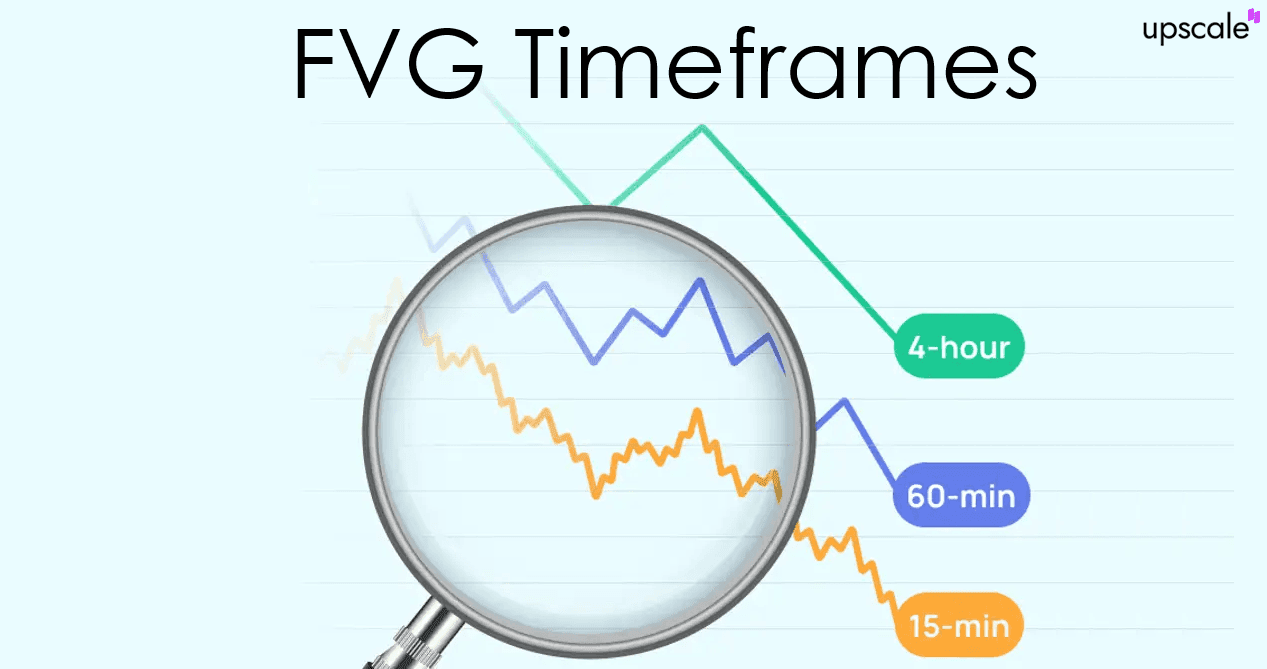
Start with higher timeframes like daily or 4H for direction and major FVGs. Identify overall market trend direction. Find significant FVG zones that institutions likely respect. Note major market structure levels. Only trade FVGs aligned with this direction.
Drop to mid timeframes like 1H or 15M for confirmation and setup refinement. Confirm higher timeframe FVG zones are still unfilled. Identify more precise entry zones within larger FVGs. Look for break of structure toward the FVG. Watch for change of character indicating momentum shift.
Use lowest timeframes like 5M or 1M for entry timing. Execute precise entries when price returns to the FVG zone. Refine stop losses with tighter placement. Spot early exit signals if price action shows rejection.
Break of Structure (BOS) confirms momentum shift on mid and lower timeframes. Look for BOS in the direction of the FVG before entering. Change of Character (ChoCH) on lower timeframes signals that price may return to the FVG zone.
Never trade an FVG on lower timeframes that conflicts with higher timeframe direction. If the daily trend is bearish, only trade bearish FVGs on lower timeframes. Ignore bullish FVGs as counter-trend trades. Timeframe alignment is the single largest factor separating high-probability setups from coin flips.
Hypothetical Trading Examples
The following examples illustrate how each strategy looks in execution. They are hypothetical scenarios for educational purposes, not records of actual trades.
Example 1: Bullish FVG in Trending Market (BTC/USDT)
Market context: Bitcoin in an established uptrend on daily chart with higher highs and higher lows. On the 4H chart, aggressive buying creates a bullish FVG between $42,800–$43,200.
Identification: Clear three-candle pattern. A down candle reaches $42,500. An aggressive up candle hits $44,000, creating the gap. A continuation candle maintains position above $43,500.
Entry decision: Conservative approach. Wait for price to retrace to the FVG zone. Entry at $43,100 when 1H chart shows a rejection candle with volume increase.
Stop placement: Below the FVG zone at $42,650 for roughly 1% position risk. First target $44,500 at recent structure high. Second target $45,000 at psychological level.
Outcome: Price reacts from the FVG zone. First target hit within 8 hours. Close 60% position at $44,500. Move stop to breakeven. Remaining 40% hits second target. Total weighted gain: ~1.4% on full position.
Example 2: Bearish FVG in Reversal Context (EUR/USD) — Losing Trade
EUR/USD approaches weekly resistance at 1.1000 after extended rally. On the 1H chart, price creates a bearish FVG after rejection at resistance.
Aggressive entry: Limit sell order at 1.0950 expecting price return. Stop placement above FVG zone at 1.0995 for a 45-pip stop. First target at 1.0850 offers approximately 1:2 R:R.
Outcome: Price returns to the gap zone within 6 hours, filling the entry at 1.0950. Then rallies through the stop at 1.0995 for full loss. The FVG did not hold.
Lesson: The daily chart was still bullish, creating conflict with the 1H bearish setup. Counter-trend setups fail more often regardless of FVG quality. This is exactly the 15–30% of setups that don't work — and why position sizing at 1% matters. The loss is absorbable; the strategy continues.
Common Mistakes to Avoid
Six main mistakes derail FVG traders.
Trading every fair value gap without context. Once traders learn FVGs, they see them everywhere. The solution: implement strict context filters. Only trade FVGs aligned with higher timeframe trend, near significant structure, during high-liquidity sessions, and meeting minimum size requirements.
Ignoring the 15–30% failure rate. Even high-probability patterns have losers, and traders who abandon strategy after a few consecutive losses blow up their accounts. Accept that roughly 1 in 4–5 setups will lose. Use 0.5–1% risk per trade maximum. Don't abandon strategy after 3–4 consecutive losses.
Entering too early before confirmation. Impatience drives most bad entries. Wait for price to return and show reaction. Conservative entry produces better results for most traders.
Poor stop loss placement. Trying to maintain tight stops within FVG zones guarantees getting stopped out by normal volatility. Always place stops beyond the FVG zone with adequate buffer. Accept the loss if the zone does not hold.
Overtrading due to FVG abundance. Set maximum daily or weekly trade limits. Focus on highest-probability setups only. The psychological pattern of trading because the market is open rather than because a setup exists is what Jared Tendler's framework categorizes as impatience tilt and entitlement tilt. For a deeper breakdown of the emotional architecture that destroys trading discipline, see the five types of trading tilt and the "Best Loser Wins" framework.
Trading FVGs in ranging markets. FVGs work best in trending markets. In choppy conditions, FVG reliability drops substantially. Identify market regime first using ADX or structure analysis before deploying the strategy.
Algorithmic Trading with Fair Value Gaps
Manual scanning across multiple instruments becomes time-intensive, and algorithmic detection offers efficiency.
Automated systems enable simultaneous monitoring of dozens of instruments, provide consistent identification without human bias, send immediate alerts when valid FVGs form, and allow systematic backtesting. Key parameters for algorithmic detection include candle count (set to 3 consecutive candles), gap size threshold as percentage of ATR (typically 0.5–1.0x), timeframe settings (1H, 4H, Daily), and overlap validation logic.
When backtesting FVG strategies algorithmically, use a minimum of 2–3 years of data history covering trending, ranging, and volatile conditions. Implement realistic execution assumptions including slippage and spread costs. Validate that fill rate statistics align with expected ranges.
Important note: algorithmic identification does not guarantee profitability. Proper strategy, risk management, and market context understanding remain essential. TradingView offers community scripts for FVG detection, MT4 and MT5 support custom indicators, and platforms like cTrader and NinjaTrader enable automated FVG strategies.
Advanced Fair Value Gap Concepts
Fair value gaps combined with other SMC concepts create higher-probability setups.
FVGs with liquidity pool analysis create common patterns: price sweeps a liquidity pool (taking out obvious stops), then aggressively moves away creating an FVG, eventually returning to fill the gap. After observing a liquidity grab, watch for FVG formation in the opposite direction.
Order block plus FVG combinations increase reliability substantially. Order blocks are the last opposing candle before significant moves. When both align at the origin of a move, setup reliability increases. This layered approach aligns with how institutions actually execute — order blocks show where they positioned, FVGs show the inefficiency their execution created.
Market structure integration adds significance. The most powerful setups occur when an FVG forms immediately after Break of Structure, confirming momentum. FVGs appearing near significant swing highs or lows add structural significance. Multiple timeframe FVGs aligning at the same price zone create institutional confluence.
Trading Psychology for Fair Value Gaps
Psychological challenges specific to FVG trading require attention.
Patience is the most difficult psychological aspect. After identifying an FVG, price often continues away for extended periods. Temptation to chase or take poor entries emerges. The solution: set limit orders and walk away. Missing some trades is better than losing capital on bad entries.
Acceptance of uncertainty matters. The 15–30% failure rate means setups will fail unpredictably. Each trade feels binary when it isn't. View FVG trading as a portfolio of bets — with proper risk management, you withstand statistical failures while allowing winners to generate overall profitability.
Discipline under pressure tests traders when price approaches the FVG zone. Fear of missing entry, temptation to move entry price, and second-guessing emerge. Establish entry criteria before price approaches. If criteria are met, take the trade. If not, let it go.
Confirmation bias prevents clear-eyed setup selection. Traders see FVGs that don't meet criteria because they want trades to exist. Use an objective checklist for every potential FVG. If any answer is "no," skip the setup.
Advantages and Limitations
Honest assessment sets realistic expectations.
Advantages: The commonly observed 70–85% fill rate provides a statistical tendency worth exploiting when properly risk-managed. Visual clarity allows even beginners to identify FVGs with practice. FVG zones provide natural stop loss placement areas, creating clear risk definition. The methodology works across forex, crypto, and stocks on multiple timeframes. Automation potential allows coding into algorithms for systematic detection. Specific entry and exit points eliminate ambiguity compared to vague concepts. Integration with order blocks, liquidity analysis, and market structure enhances effectiveness.
Limitations: The 15–30% failure rate is statistical reality — roughly 1 in 4–5 setups will not work, requiring emotional acceptance of losses. Identification subjectivity means valid FVG definitions vary between traders, with minimum size debates continuing. Market condition dependency means performance degrades in choppy, range-bound markets. Patience requirements demand discipline, and temptation to overtrade runs high. Multi-timeframe analysis is necessary for best results — single-timeframe FVG trading proves less reliable. Additionally, the 70–85% fill rate statistic, while widely cited, lacks rigorous academic verification and should be treated as community wisdom rather than proven mathematics.
Avoid FVG trading during major scheduled news events, extremely low liquidity conditions, clearly ranging markets, and when higher timeframe market structure is unclear.
Key Takeaways
Fair value gaps represent genuine price inefficiencies created when institutional order flow overwhelms available liquidity. The three-candle identification pattern is simple enough for beginners to spot after a few hours of practice, but the gap between identification and consistent profitability takes months to cross. The commonly cited 70–85% fill rate is a useful benchmark for setup quality comparison, not a mathematical guarantee — and the traders who understand this distinction are the ones who survive the 15–30% of setups that don't work.
The edge isn't in finding FVGs. FVGs are everywhere once you know what to look for. The edge is in the discipline to only take the ones that matter: those aligned with higher timeframe direction, formed in trending conditions, sized adequately, and positioned with stops beyond the zone rather than within it. Position sizing at 0.5–1% per trade isn't cautious — it's survival math. At PipFarm's reported 45.1% rate of successful prop traders making just 1–2 trades per day, selectivity consistently beats frequency across every study of retail trader performance.
Start by practicing identification on historical charts. Then paper trade for at least 50 setups to build pattern recognition. Track which FVGs filled and which didn't, and analyze why the failures failed. Only then move to live trading, and only with the smallest position sizes. The knowledge of FVGs puts you ahead of traders still using lagging indicators, but knowledge alone generates nothing. Execution, discipline, and time in the market are what convert theoretical edge into real results.
Ready to start your prop trading journey?
Start now: 👉 Upscale.trade | Telegram Bot
Follow us: 📺 YouTube | 𝕏 Twitter
Frequently Asked Questions
What is a fair value gap in trading?
A fair value gap is an unfilled price zone on charts created when price moves so rapidly that normal trading activity cannot occur at certain price levels. It appears as a gap between three consecutive candlesticks where the middle candle creates space that does not overlap with the wicks of candles before and after it. FVGs are a core component of Smart Money Concept methodology and represent the footprints of institutional order flow overwhelming available liquidity.
How do you identify a fair value gap?
Identify FVGs using the three-candle rule. Look for three consecutive candles moving in the same direction. Check if the middle candle created a gap where its wick does not overlap with the wicks of the first and third candles. Measure the gap size to ensure it meets minimum thresholds for your instrument — forex typically requires 10+ pips, crypto needs 0.2%+ gap size. Then assess market context including higher timeframe direction and proximity to key structure levels.
How do you trade fair value gaps?
Trade FVGs by waiting for price to return to the gap zone. Use aggressive entry with limit orders placed immediately after formation, or conservative entry by waiting for price reaction at the zone. Place stop losses beyond the FVG zone, never within it. Target the opposite side of the gap as minimum profit objective, with extended targets at market structure levels. Risk 0.5–1% of account per trade maximum.
What is an inverse fair value gap (IFVG)?
An inverse fair value gap forms at market extremes and signals reversal potential. Unlike standard FVGs that suggest continuation, IFVGs appear after extended moves when price creates a gap during a final exhaustion push, then immediately reverses through that gap. This inverts the expected behavior and marks trend exhaustion. SMC practitioners report higher reliability for IFVGs when they form at multi-week extremes, psychological levels, or major structural turning points with accompanying volume spikes.
Do all fair value gaps get filled?
No. The commonly cited range in SMC trading communities is 70–85% of valid FVGs eventually filling, which means 15–30% never fill. This statistic comes from community observation rather than peer-reviewed research, so treat it as a benchmark rather than a mathematical edge. Success depends on trading with proper context: higher timeframe alignment, market structure support, trending conditions, and quality setup selection. Risk management must account for setups that don't work.
Why did my FVG trade fail even though it looked perfect?
Three common reasons. First, counter-trend setup — the FVG aligned with the current 1H or 4H direction but conflicted with the daily trend. Higher timeframe conflict is the single largest cause of FVG failures. Second, market regime mismatch — FVGs work best in trending conditions and degrade in ranging markets. Third, insufficient volatility buffer on the stop — placing stops just at the edge of the zone gets swept by normal price action before the actual move begins. The 15–30% failure rate is real and unavoidable, but most failures trace back to one of these three causes rather than bad luck.
Is Fair Value Gap trading suitable for prop trading challenges?
FVG trading can work well in prop challenges when applied selectively. The strategy aligns with how successful prop traders actually behave — PipFarm data shows 45.1% of successful prop traders make only 1–2 trades per day, and high-quality FVG setups are naturally infrequent. The key constraint is daily drawdown limits: the 15–30% of setups that fail can produce clustered losses that blow through daily limits if position sizing is aggressive. Sticking to 0.5% risk per trade rather than 1%, and limiting trades to 2–3 per day, keeps the strategy compatible with prop firm risk parameters.