Smart Money Concept: Trade Like Institutions | Upscale


Smart Money Concept (SMC) is a price action methodology that focuses on reading institutional order flow rather than lagging indicators. It identifies three core elements on the chart: order blocks (the last opposing candle before a major impulse, marking where institutions accumulated positions), fair value gaps (price imbalances created when orders overwhelmed available liquidity), and liquidity grabs (engineered moves beyond obvious support or resistance to trigger retail stop-losses before the real institutional move). The methodology gained traction because it reflects how the $7.5 trillion-per-day forex market actually functions according to the BIS Triennial Survey 2022 — institutions can't simply market-buy billions without telegraphing their intent, so they accumulate, manipulate, and distribute in patterns that leave footprints on the chart. Below is a breakdown of the core components, the trading framework, and how SMC differs from traditional technical analysis.
Why SMC Exists: The Institutional Flow Problem
The core principle behind smart money concept trading centers on a structural reality of financial markets: institutional investors move markets, while retail traders react to those movements. According to the BIS Triennial Survey 2022, daily forex turnover reached $7.5 trillion, with the vast majority handled by central banks, commercial banks, hedge funds, and multinational corporations. A retail trader with a $50,000 account is invisible at this scale. An institution placing a $500 million EUR/USD order is not — and they cannot simply submit that order without devastating slippage.
This creates the foundation of SMC: institutions must accumulate positions over time, often manipulating price to gather the liquidity they need. They push price into obvious retail stop-loss zones, fill their orders against the panic-sellers, and then move price in their actual intended direction. By learning to recognize these footprints, traders position themselves alongside institutional flow rather than as the counterparty to it.
Core Smart Money Concept Components
Understanding the fundamental building blocks creates the foundation for institutional-style trading. These components work together to reveal where large market participants have placed their orders and how they intend to move price.
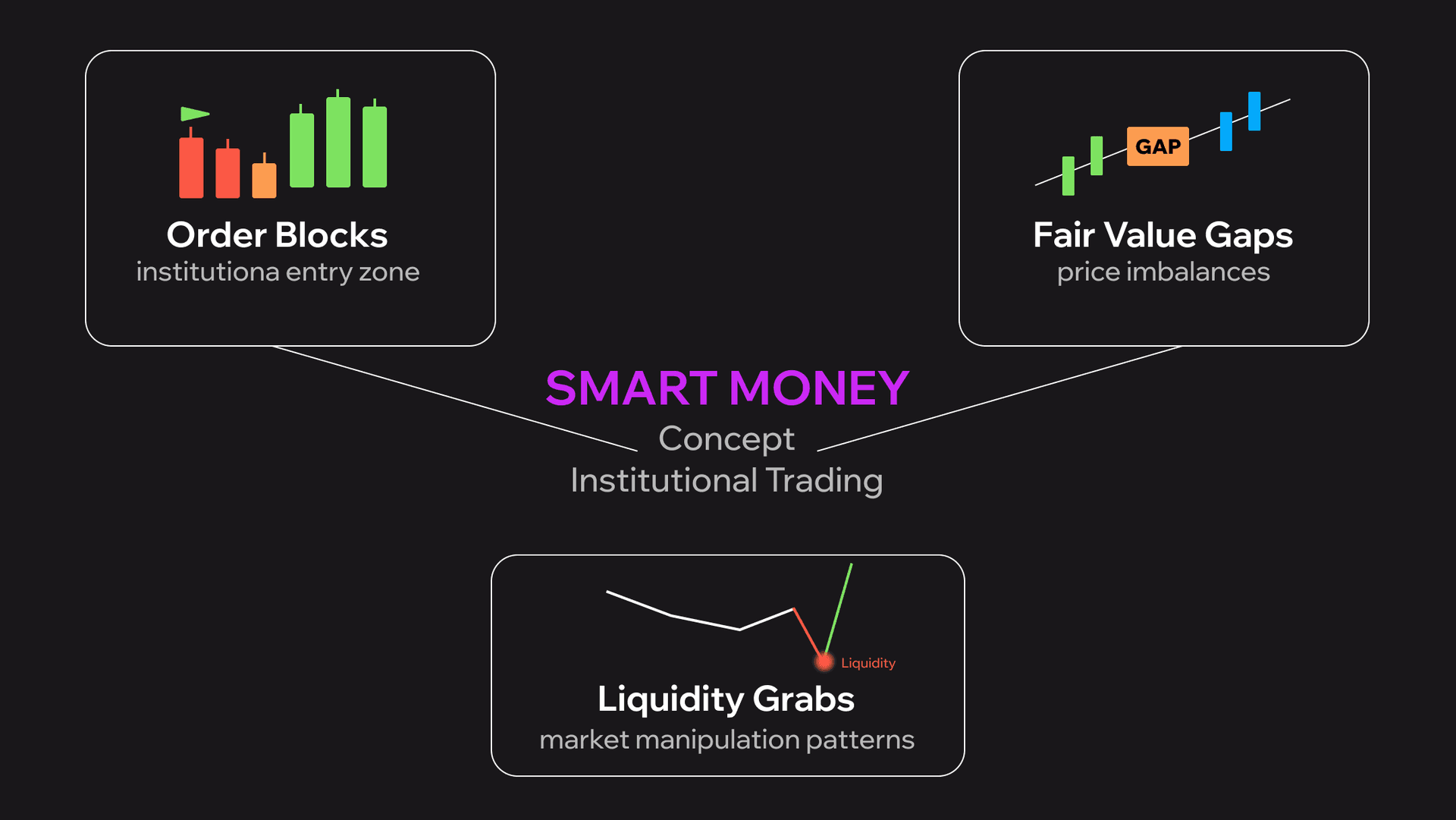
Order Blocks — Institutional Entry Zones
Order blocks represent the last opposing candle before a significant price move and identify areas where institutional orders were placed. When banks and hedge funds enter large positions, they cannot simply execute market orders without causing massive slippage. Instead, they accumulate positions over time, creating distinctive price patterns.
Bullish order blocks form when a down candle is followed by a strong upward move, indicating institutions finished selling and began aggressive buying. Bearish order blocks appear when an up candle precedes a sharp decline, showing where institutions completed their buying before initiating short positions. The key to identifying valid order blocks lies in the impulsive move away from the zone — institutional orders create explosive price action because of the sheer volume being executed.
Smart money concept order blocks function differently from traditional support and resistance. Rather than zones where price repeatedly bounces, order blocks represent unfilled institutional orders waiting to be matched. When price returns to these zones, institutions add to their positions, creating strong reactions.
Fair Value Gaps and Market Structure
Fair value gaps (FVG) emerge when price moves so rapidly that it leaves inefficiencies in the market structure. These gaps appear as spaces on the chart where no trading occurred at certain price levels, creating imbalances that the market typically seeks to fill. In smart money concept methodology, fair value gaps represent areas where institutional orders overwhelmed available liquidity, causing price to jump without normal auction process.
Market structure analysis within SMC focuses on identifying higher highs, higher lows, lower highs, and lower lows to determine trend direction and strength. Break of structure (BOS) occurs when price definitively breaks through a previous high or low, confirming trend continuation. Change of character (ChoCH) happens when price breaks counter to the established trend, signaling potential reversals. These structural breaks often coincide with fair value gaps, as institutions execute orders large enough to both break structure and create price inefficiencies simultaneously.
When price pulls back to fill a gap within a bullish market structure, it creates optimal long entry opportunities. Conversely, rallies into bearish fair value gaps during downtrends offer ideal short positions. The combination of structural analysis and gap identification separates smart money concept from basic price action trading.
Liquidity Grabs — Reading Institutional Manipulation
Liquidity grabs represent one of the most powerful concepts in SMC. Institutions need substantial liquidity to fill their large orders, and that liquidity sits just beyond obvious support and resistance levels where retail traders place their stop-losses. Before making major moves, smart money will often push price beyond these levels to trigger retail stops, creating the liquidity pool they need for their actual positions.
Classic liquidity grab patterns include stop hunts below recent lows in uptrends and raids above recent highs in downtrends. These moves appear designed to shake out retail traders before price reverses sharply in the intended direction. Confirmation signals include rapid reversals on high volume, engulfing candles that reclaim the broken level, and immediate movement back into the prior range. Traders who recognize these patterns avoid getting stopped out and can even enter positions in the direction of the true institutional move.
The psychological impact of being stopped out by a liquidity grab triggers exactly the emotional responses that destroy trader accounts — frustration, revenge trading, and rule-breaking. A PipFarm survey of 2,777 prop traders (2025) found that 73% of failed accounts violated their own stop-losses in more than 30% of cases, and that 37.5% identified emotional trading after losses as their primary problem. Understanding liquidity grabs as engineered events rather than market unfairness fundamentally changes how traders react to them.
Smart Money Concept Trading Framework
Implementing smart money concept trading requires a systematic framework that combines all core components into a coherent strategy. The process begins with multi-timeframe analysis, typically starting on daily or four-hour charts to identify overall market structure and trend direction. Traders mark key order blocks, fair value gaps, and liquidity zones on higher timeframes before drilling down to lower timeframes for precise entries.
Entry rules demand confluence between multiple factors. An ideal entry occurs when price reaches a higher timeframe order block within market structure, creates a fair value gap on the entry timeframe, after sweeping liquidity from obvious levels. This confluence significantly increases probability compared to single-factor entries. Traders wait for confirmation through candlestick patterns, typically seeking engulfing candles or strong closes back into the order block zone before executing positions.
Exit criteria focus on logical profit targets rather than arbitrary risk-reward ratios. The first target typically sits at the next opposing order block or fair value gap, while final targets aim for major liquidity pools beyond obvious highs or lows. Stop-losses are placed beyond the order block being traded, accounting for potential liquidity grabs that might occur before the main move. This approach aligns exits with where institutions are likely to take profits rather than using round numbers that lack market structure context.
Position sizing in smart money concept trading follows institutional risk management principles. Rather than risking fixed percentages on every trade, SMC practitioners scale position sizes based on confluence factors and setup quality. High-confluence setups with multiple confirming factors warrant larger positions, while lower-probability trades receive reduced capital allocation. This variable position sizing approach mirrors how institutional traders allocate capital across opportunities with varying conviction levels.
The trader Maxim, profiled in verified prop trading success stories, generated $860 from a $10,000 funded account using exactly this framework — order blocks and liquidity zones combined with strict risk discipline at 0.7–0.8% per trade and no more than 1–2 trades per day. PipFarm data confirms this pattern: 45.1% of successful prop traders make just 1–2 trades per day. Quality of setup matters more than frequency.
SMC vs Traditional Trading Methods
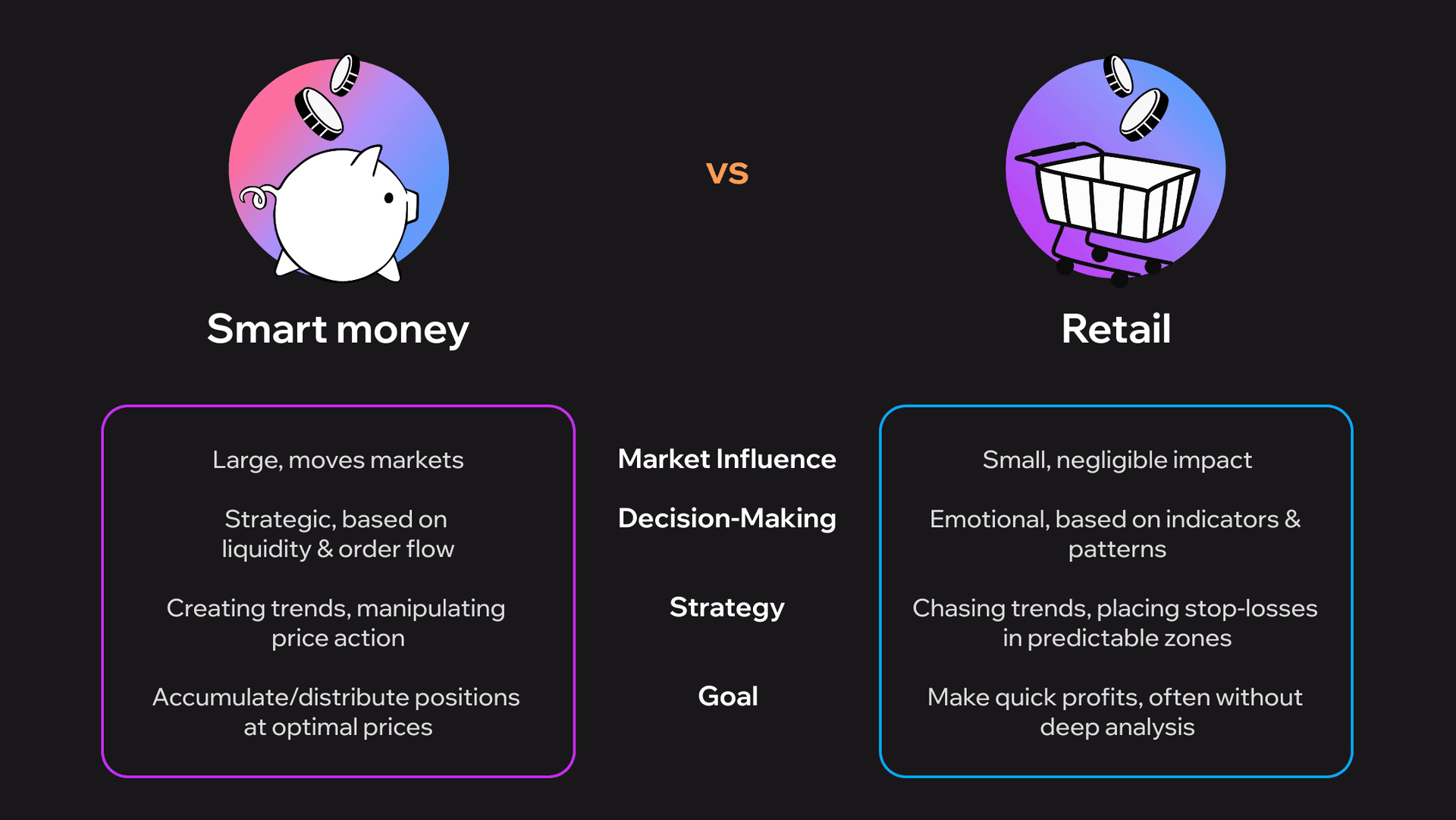
The distinction between smart money concept and traditional technical analysis extends beyond terminology. Traditional trading relies heavily on lagging indicators that calculate values from past price data. Moving averages, MACD, RSI, and similar tools all react to price movements that already occurred, creating inherent delays in signal generation. By the time these indicators trigger entries, institutions have often already positioned themselves and begun taking profits.
Smart money concept trading operates proactively rather than reactively. By identifying where institutions must go to find liquidity and fill orders, SMC traders position themselves ahead of major moves rather than chasing momentum after it develops. This fundamental difference in approach explains why SMC practitioners often enter positions that appear counterintuitive to traditional technical traders. When conventional analysis shows oversold conditions suggesting bounces, SMC traders recognize liquidity grabs preparing for further declines.
Supply and demand trading represents the closest traditional methodology to smart money concept, as both focus on identifying zones where significant orders exist. However, supply and demand typically treats these zones as static areas where price repeatedly reacts, while SMC recognizes the dynamic nature of institutional order flow. Order blocks represent unfilled orders that institutions actively manage, adjusting positions as market conditions evolve.
The effectiveness gap between methodologies becomes evident in ranging markets where traditional technical analysis struggles. Indicators generate conflicting signals in consolidation, while smart money concept clearly identifies the liquidity zones institutions are targeting and the order blocks they're building positions from. This advantage proves particularly valuable for traders seeking consistency across varying market conditions.
Market-Specific Applications
Smart Money Concept in Forex Trading
Foreign exchange markets provide ideal conditions for smart money concept application due to the massive institutional participation required for currency transactions. According to the BIS Triennial Survey 2022, daily forex turnover reached $7.5 trillion, with central banks, commercial banks, and multinational corporations executing the vast majority of volume. This concentration creates clear order blocks and liquidity patterns. Major pairs like EUR/USD, GBP/USD, and USD/JPY display particularly clean SMC setups because of the institutional flow concentration that prevents excessive manipulation.
The forex market's 24-hour nature allows traders to identify institutional order flow across different trading sessions. London and New York sessions typically show the most significant smart money activity, with clear liquidity grabs occurring during session opens as institutions position for the day ahead. Currency pairs often respect order blocks for extended periods because institutional forex positions remain active for days or weeks, creating reliable zones for multiple entry opportunities. Traders implementing smart money concept forex strategies focus on higher timeframe structure while using M15 or M30 charts for entries, aligning with the methodical pace at which institutions build currency positions.
Day Trading with Smart Money Concept
Applying smart money concept to day trading requires adjustments in timeframe focus while maintaining the same core principles of reading institutional behavior. Day traders typically work with M5 to M15 charts for entries while referencing H1 and H4 for structure and order block identification. The faster timeframes demand quicker decision-making, but the advantage comes from catching institutional moves within a single session rather than holding positions overnight.
Intraday smart money concept patterns often revolve around liquidity grabs at the beginning of major sessions. The Asian session low frequently gets swept during London open as institutions collect stops before pushing price higher, creating classic SMC entry setups. Similarly, New York open commonly sees raids of European session highs or lows before the true directional move emerges. Day traders who understand these patterns position themselves to capitalize on the reversals that follow liquidity collection.
The compressed timeframes in day trading amplify the importance of execution precision. Entries must occur at the exact edge of order blocks rather than anywhere within the zone, and stops need tight placement to maintain favorable risk-reward on shorter-term moves.
Risk Management for SMC Trading
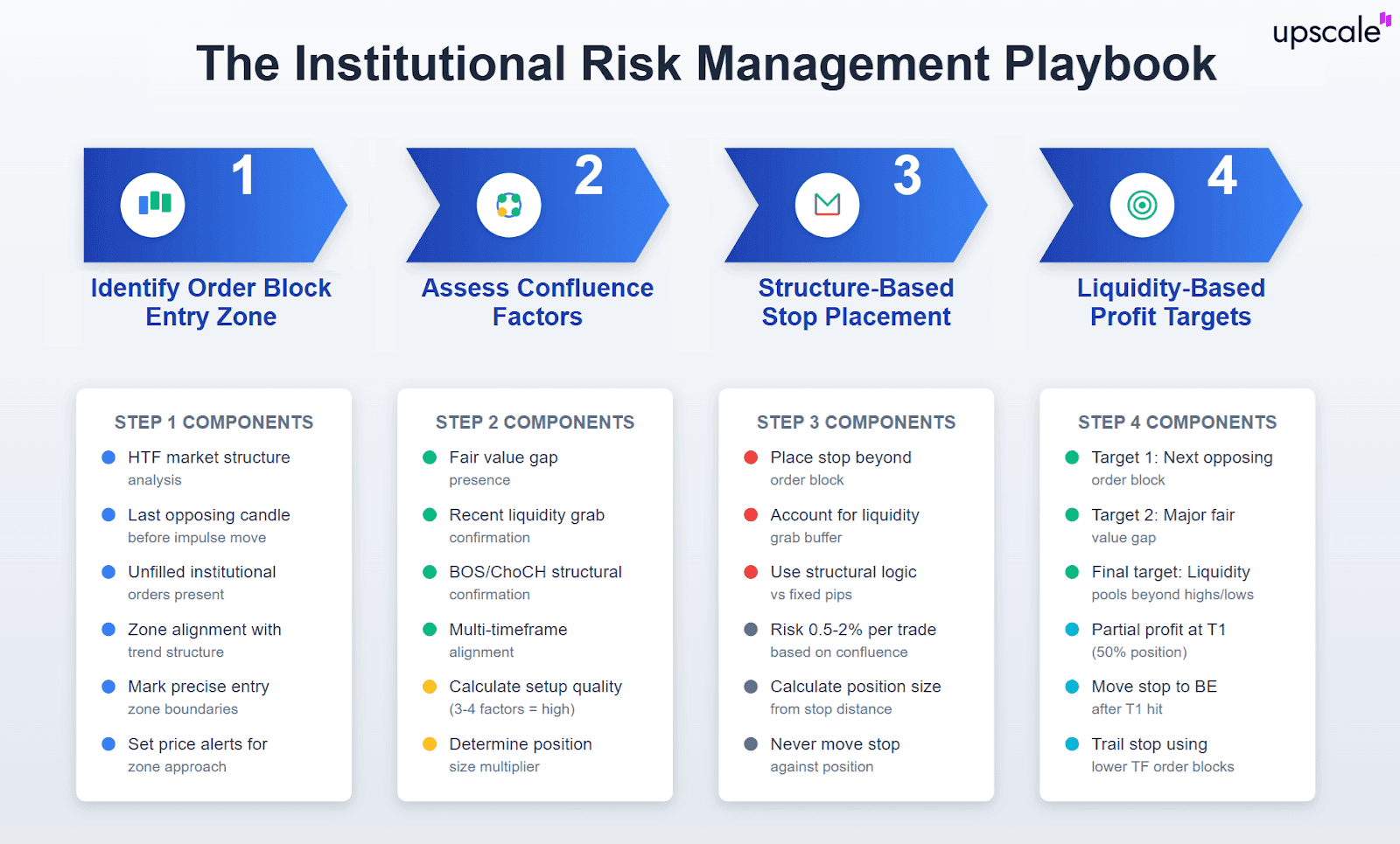
Institutional-style risk management separates consistently profitable smart money concept traders from those who struggle despite understanding the technical concepts. Unlike retail risk management that focuses primarily on percentage-based stop-losses, SMC risk management considers market structure context and institutional behavior patterns when determining position parameters.
Stop-loss placement in smart money trading always accounts for potential liquidity grabs beyond the order block being traded. Rather than placing stops at obvious levels like just below order block lows, institutional-minded traders add buffer room for wicks that might sweep stops before reversing. This approach accepts slightly wider stops in exchange for avoiding premature exits on positions that ultimately work. Research by Locke and Mann (2005), analyzing futures traders at the Chicago Mercantile Exchange, found that traders who cut losses faster earned on average 65% more per year — but this applies to losses where the trade thesis has been invalidated, not to wicks that test obvious stop zones before reversing.
Position sizing methodology within smart money concept adjusts based on setup confluence and conviction level. When multiple factors align — higher timeframe order blocks, fair value gaps, market structure confirmation, and liquidity grab evidence — traders can comfortably increase position sizes because probability dramatically improves with confluence. Conversely, trades based on single factors receive minimum position sizing. This variable approach ensures capital allocation matches opportunity quality rather than treating every setup identically.
The risk-reward framework in SMC trading differs fundamentally from traditional fixed-ratio approaches. Rather than targeting arbitrary 2:1 or 3:1 ratios, institutional-style traders identify logical profit targets based on market structure. The first target typically sits at the next opposing order block or major fair value gap, while final targets aim for liquidity pools beyond obvious structural levels. The focus remains on structural logic rather than ratio achievement.
Advanced SMC Psychology and Implementation
Mastering smart money concept extends beyond technical pattern recognition into understanding the psychological dynamics between institutional and retail participants. Institutions deliberately engineer price action to trigger emotional responses in retail traders, creating the liquidity and positioning they need for their actual trades. Recognizing this manipulation while avoiding emotional reactions separates successful SMC implementation from theoretical knowledge.
The psychological dimension is critical because liquidity grabs are designed to provoke exactly the responses that destroy retail accounts. When a stop gets swept, the natural reactions are anger, revenge trading, and rule-breaking — the same patterns that Jared Tendler, author of "The Mental Game of Trading," categorizes as injustice tilt and despair tilt. For traders learning SMC, the technical pattern recognition is only half the work. The other half is restructuring the emotional response to manipulation events. For a deeper breakdown of this psychological architecture, see the five types of trading tilt and Tom Hougaard's "Best Loser Wins" framework.
Breaker blocks represent an advanced SMC concept where previously bullish order blocks fail and become bearish zones, or vice versa. This occurs when institutional sentiment shifts significantly enough that former support becomes resistance. Traders who adapt to these breaker patterns avoid fighting against repositioned institutional flow. The psychology behind breaker blocks centers on recognizing when market narrative changes demand strategic flexibility rather than stubbornly holding bias.
Mitigation blocks function similarly to order blocks but represent areas where institutions need to mitigate existing positions before establishing new directional trades. These zones often appear as minor pullbacks within strong trends where smart money takes partial profits or adjusts positions before the next leg. Understanding mitigation versus primary order blocks prevents confusion about which zones will hold for major reversals versus brief pauses in existing trends.
Implementation framework for systematic smart money concept practice begins with paper trading or demo account work until pattern recognition becomes second nature. Traders should mark order blocks, fair value gaps, and liquidity zones in real-time daily, then review how price interacted with those levels after the fact. This deliberate practice builds the pattern recognition required for live trading success. Progressing to live markets should start with minimum position sizes, gradually scaling up as consistency develops over months rather than rushing into full-size positions immediately.
Key Takeaways
Smart Money Concept gives retail traders a framework for trading alongside institutional participants rather than as their counterparty. The methodology's effectiveness stems from its foundation in actual market mechanics — order flow, liquidity, and the structural reality that institutions handling billions of dollars cannot move quietly. The three core components (order blocks, fair value gaps, liquidity grabs) aren't arbitrary patterns; they're the visible footprints of how large orders actually get filled in markets where the BIS reports $7.5 trillion in daily forex turnover.
The path from learning SMC to applying it profitably is mostly about pattern recognition built through deliberate practice, not about discovering secret indicators. Mark order blocks, fair value gaps, and liquidity zones in real-time on instruments you plan to trade. Observe how price actually reacts. Review the chart afterwards. Start with paper trading until the patterns become automatic. Move to live trading only with minimum position sizes. Scale up only after demonstrating consistent results across at least 50–100 trades.
The psychological work matters as much as the technical work. Liquidity grabs are designed to trigger emotional responses — frustration, revenge trading, rule-breaking. Traders who recognize manipulation as a normal feature of institutional behavior rather than market unfairness keep their composure when price sweeps stops. Combined with disciplined position sizing and structural targeting, SMC becomes one of the more reliable frameworks for retail traders willing to put in the months of practice it requires.
Ready to start your prop trading journey?
Start now: 👉 Upscale.trade | Telegram Bot
Follow us: 📺 YouTube | 𝕏 Twitter
Frequently Asked Questions
How do I identify valid order blocks in smart money concept trading?
Valid order blocks show specific characteristics including an impulsive move away from the zone, clean candle structure without excessive wicks, and positioning within broader market structure context. The candle preceding the impulse should have clear rejection from one direction followed by explosive movement opposite. Higher timeframe order blocks carry more significance than lower timeframe ones, and blocks forming after liquidity grabs prove more reliable than random swing points. Confluence with fair value gaps or major structural levels strengthens order block validity considerably.
Does smart money concept actually work or is it pseudoscience?
SMC's underlying premise is verifiable: institutions handling the bulk of the $7.5 trillion daily forex market cannot execute large orders without leaving footprints in price action. Whether any specific trader profits from SMC depends entirely on execution discipline, pattern recognition skill, and risk management — the same factors that determine success or failure with any methodology. SMC isn't a guaranteed system; it's a framework for reading institutional flow that requires months of deliberate practice to apply consistently.
Can I use smart money concept with small trading accounts?
SMC works effectively with accounts of any size because the methodology focuses on percentage-based risk management rather than absolute position sizes. Small accounts benefit particularly from SMC's high-probability setups and favorable risk-reward profiles, allowing capital growth through consistent execution. The key lies in accepting position sizes appropriate to account balance rather than over-leveraging to achieve arbitrary profit targets. Starting with micro lots while learning prevents significant capital loss during the skill development phase.
How does smart money concept differ from supply and demand trading?
While both methodologies identify zones where significant orders exist, smart money concept recognizes the dynamic nature of institutional order flow versus static supply-demand zones. SMC incorporates liquidity grabs, fair value gaps, and changing market structure into analysis, while traditional supply-demand focuses primarily on reaction zones. Smart money traders understand that institutions actively manage positions and create manipulation patterns before major moves, adding layers of analysis beyond basic zone identification.
What technical indicators complement smart money concept analysis?
Smart money concept functions as a complete standalone methodology requiring no indicators, as it focuses on pure price action and order flow. Some traders incorporate volume analysis or VWAP to confirm institutional participation levels, but lagging indicators like moving averages or oscillators typically conflict with SMC principles. The methodology's strength lies in reading price structure directly rather than filtering it through mathematical transformations that introduce lag and reduce clarity.
Is smart money concept suitable for complete trading beginners?
SMC presents a steeper initial learning curve than basic technical analysis because it requires understanding market mechanics and institutional behavior rather than simply following indicator signals. However, beginners who commit to proper education often develop better trading foundations through SMC than those starting with indicator-dependent approaches. Mastery typically takes months of consistent study and practice, making structured learning programs valuable for accelerating the education process and avoiding common misconceptions.
Why do I keep getting stopped out before price moves in my direction?
Getting stopped out by sharp wicks before price reverses is the textbook definition of a liquidity grab. Institutions need liquidity to fill their positions, and that liquidity sits at obvious stop-loss zones below recent lows or above recent highs. The fix is twofold: place stops with buffer room beyond the order block being traded rather than right at obvious levels, and emotionally restructure your reaction to these events. According to a PipFarm survey of 2,777 prop traders, 73% of failed accounts violated their own stop-losses in more than 30% of cases — often after getting swept by liquidity grabs and entering revenge trades.