Put-Call Ratio Explained: Formula, Values & Use | Upscale


The put-call ratio (PCR) measures market sentiment by dividing put options volume (or open interest) by call options volume (or open interest) for a given asset or market index. Two formulas generate the headline reading: volume-based PCR = daily put volume ÷ daily call volume, and open interest PCR = total put OI ÷ total call OI. Values above 1.0 indicate more put activity than call activity (traders positioning for price declines or hedging existing longs), values below 1.0 indicate the opposite. Commonly cited neutral ranges fall between 0.7–0.8 for broad market indices, though individual sectors and asset classes produce different baselines. PCR functions primarily as a contrarian indicator at extremes: readings above ~1.3 suggest bearish positioning may be exhausting itself (potential bottom signal), and readings below ~0.5 suggest bullish positioning is overcrowded (potential top signal). Primary data sources are the CBOE's daily market statistics for US equity options and Deribit for Bitcoin and Ethereum options (which controls roughly 80–85% of crypto options volume). Academic research by Blau, Nguyen, and Whitby (2014) in the Journal of Banking & Finance finds that PCR has statistically significant predictive power for next-day stock returns, though the effect weakens at weekly and monthly horizons.
What the Put-Call Ratio Measures
A put option gives the holder the right to sell an asset at a predetermined price by a specific expiration date. A call option gives the holder the right to buy. When traders collectively buy more puts than calls, PCR rises; when call activity dominates, PCR falls. The ratio aggregates the directional bets of everyone active in the options market into a single sentiment number.
The analytical value of PCR comes from the diversity of the options market. Participants include retail speculators, institutional hedgers, market makers, and sophisticated prop trading firms. Each group has different reasons for buying puts or calls — a fund manager might buy puts to hedge a long equity position, a retail trader might buy calls to speculate on a breakout, a market maker might accumulate options as part of delta-neutral strategies. The ratio captures the net positioning of all these activities, which is why sustained extreme readings carry information that individual trade motivations cannot explain.
Professional traders monitor PCR across multiple timeframes. Daily PCR captures immediate sentiment shifts. 10-day moving average PCR smooths noise and reveals sustained directional positioning. Monthly PCR reveals structural positioning changes across cycles. Different timeframes serve different trading objectives, and signals from multiple timeframes tend to be more reliable than isolated daily readings.
Two Calculation Methods
The two standard PCR formulas measure different things and serve different analytical purposes. Professional traders often monitor both simultaneously.
Volume-Based PCR
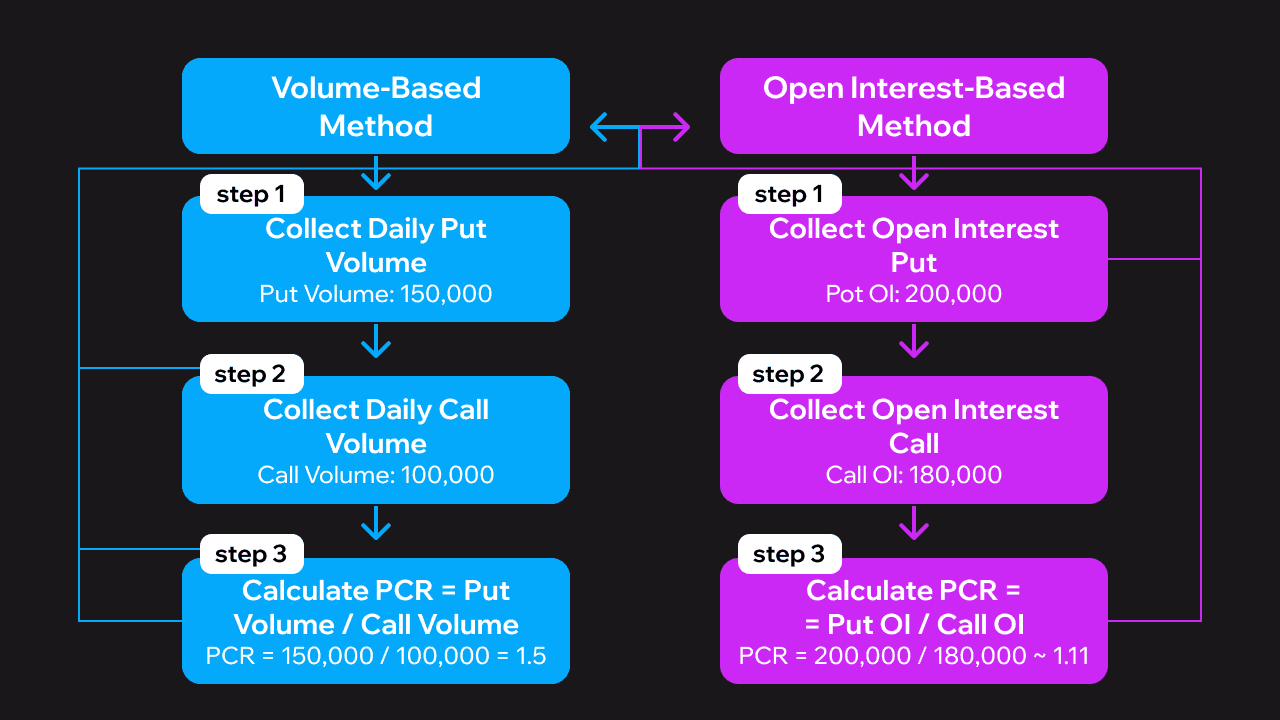
Formula: PCR (volume) = total put volume ÷ total call volume
Volume-based PCR measures trading activity during the session. It updates continuously throughout the day and reflects fresh positioning decisions. This makes it sensitive to intraday sentiment shifts, useful for short-term trading decisions.
Example: daily put volume of 2,400,000 contracts divided by daily call volume of 3,100,000 contracts = 0.77. A near-neutral reading suggesting balanced sentiment for the session.
The limitation of volume PCR is that it includes both opening and closing transactions without distinguishing between them. A large volume of put closing transactions looks identical to a large volume of new put buying, but the market implications are opposite. This is one reason volume PCR works better as a confirmation tool than as a standalone signal.
Open-Interest-Based PCR
Formula: PCR (open interest) = total put open interest ÷ total call open interest
Open interest represents outstanding options contracts — positions that have been opened but not yet closed or expired. It changes only when new positions are initiated or existing ones closed. This makes OI PCR more stable than volume PCR and better suited for identifying sustained positioning rather than intraday noise.
Example: put open interest of 850,000 contracts divided by call open interest of 1,200,000 contracts = 0.71. This reading indicates slightly bullish positioning — more call contracts remain outstanding than puts.
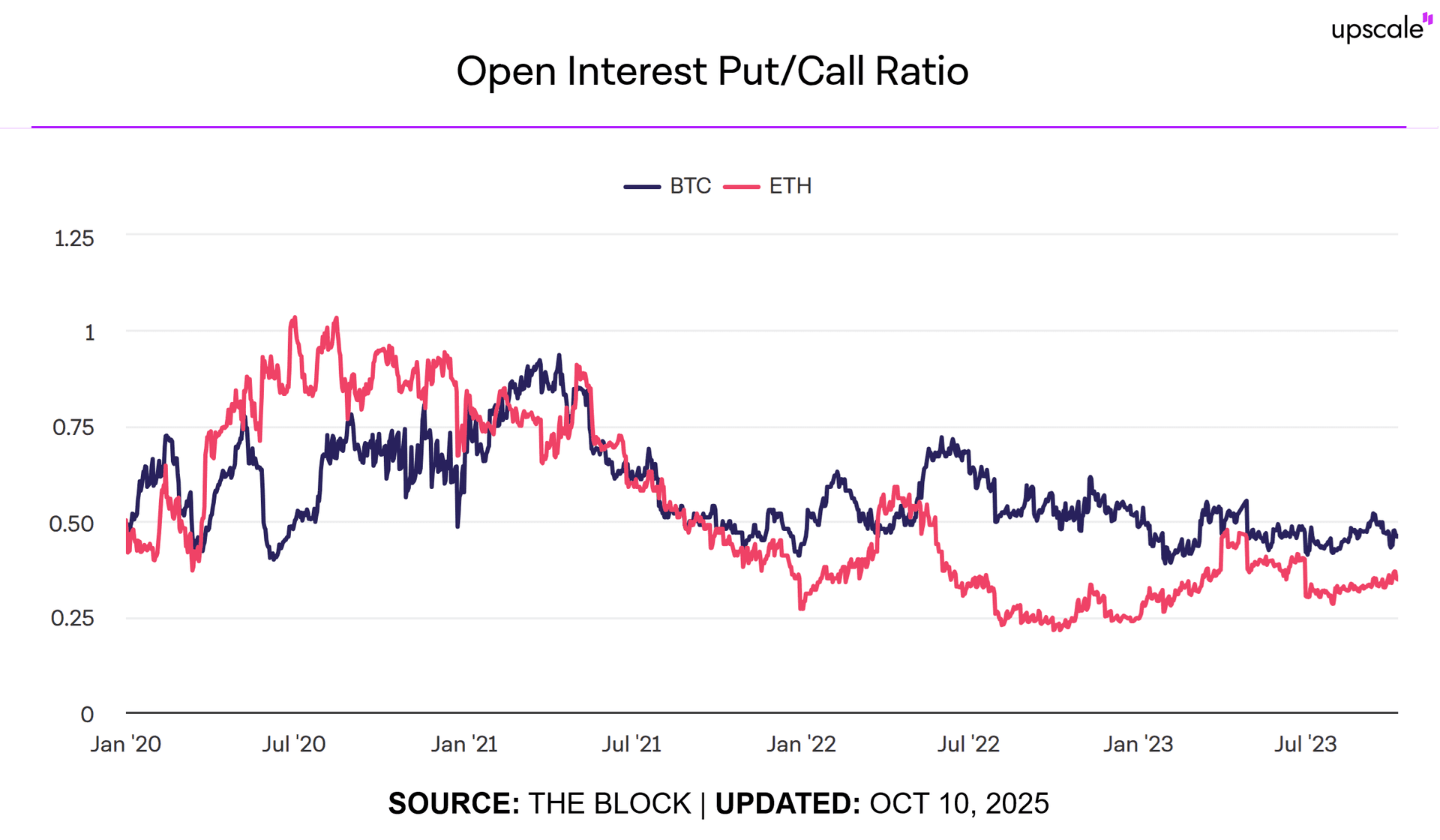
Open interest PCR is particularly useful for crypto markets. Deribit publishes Bitcoin and Ethereum open interest PCR continuously, and the ratio has oscillated between approximately 0.25 and 1.0+ since 2020, with extreme readings tending to cluster around major sentiment inflection points.
When Each Method Is Most Useful
Volume PCR is most useful for short-term trading decisions where intraday sentiment matters. Open interest PCR is better for swing and position trading where sustained positioning tells a more reliable story. The two can diverge: during options expiration weeks, volume PCR may spike due to position rolling while OI PCR barely moves, and recognizing which formula is producing the signal prevents misinterpretation.
Interpreting PCR Values
PCR thresholds vary by asset class, market regime, and timeframe. A reading that's extreme for one market may be normal for another. Correct interpretation requires knowing the baseline for the specific asset.
Normal Ranges
Commonly cited neutral ranges:
- Broad US equity indices (S&P 500, etc.): 0.7–1.0 for 10-day moving averages
- Individual stocks: 0.6–0.8 typical
- Technology sector: 0.5–0.7 (lower baseline reflects growth orientation and retail call buying)
- Defensive sectors (utilities, staples): 0.7–0.9 (higher baseline reflects hedging activity by institutional holders)
- Bitcoin/Ethereum options on Deribit: 0.6–0.9 range typically
MacroMicro notes that for the CBOE Total Put/Call Ratio, a 10-day moving average rising above 1.1 has historically suggested a potential market trough, while readings below 0.8 have suggested a potential peak. These are guidelines rather than rules — market regime matters.
Extreme Readings
The useful PCR signals occur at extremes, not within normal ranges:
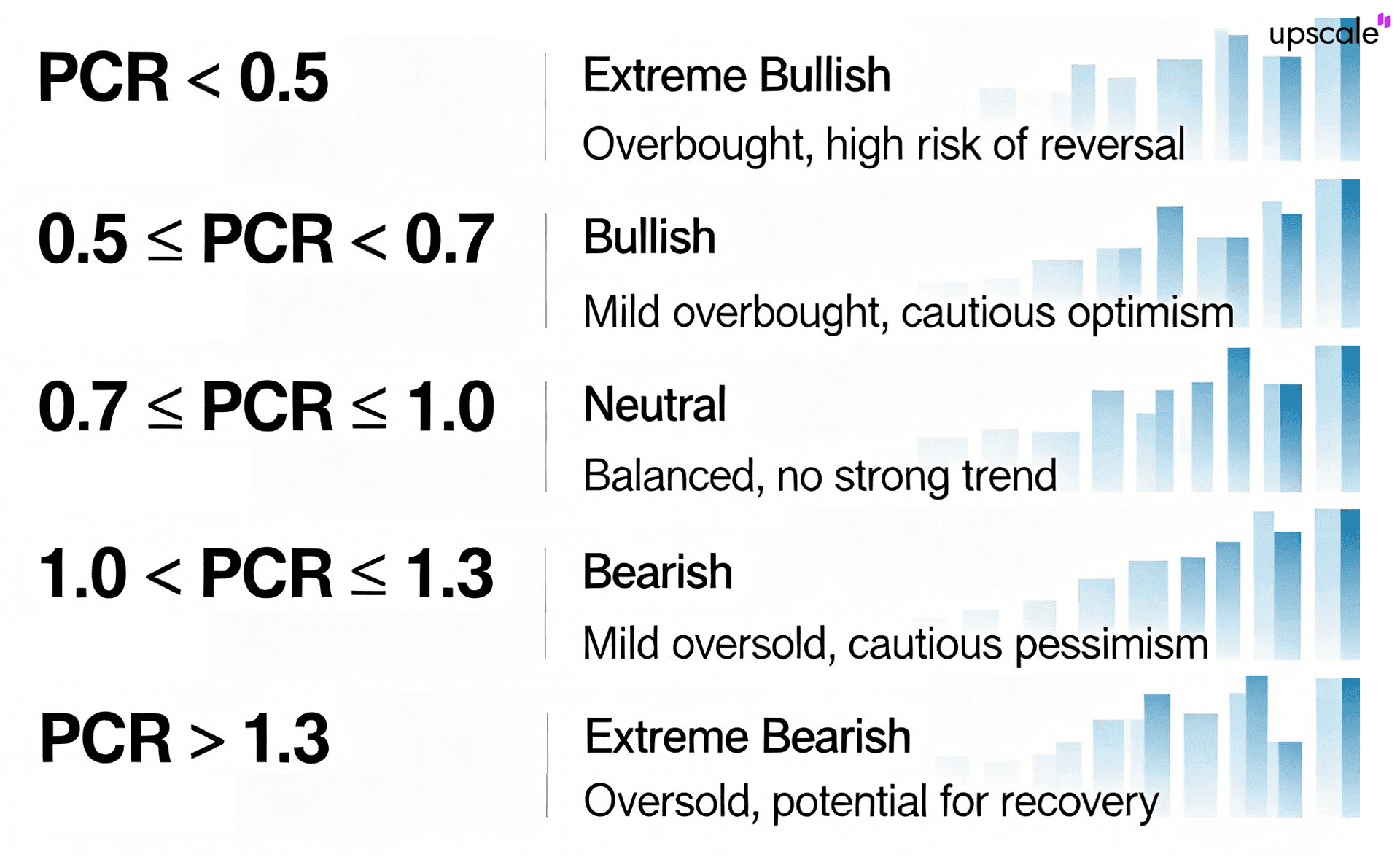
- PCR > 1.3: Heavy bearish positioning. Historically associated with potential bottoming conditions in equities when combined with other oversold indicators.
- PCR > 1.5: Extreme bearish positioning. Often coincides with panic-selling phases in major corrections.
- PCR < 0.5: Heavy bullish positioning. Often precedes corrections when combined with other overbought signals.
- PCR < 0.4: Extreme bullish positioning. Associated with market tops in historical data.
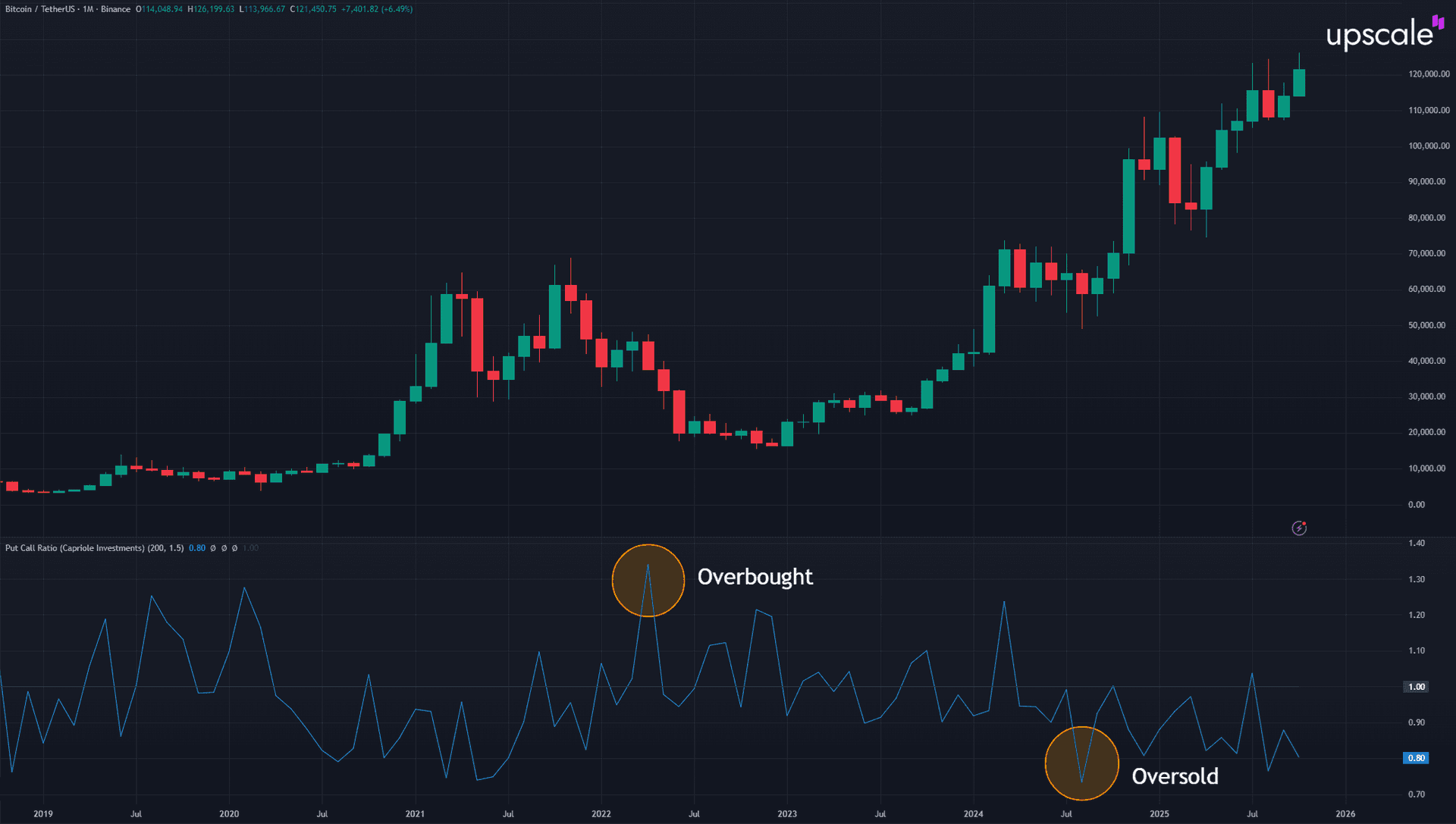
The academic research by Blau, Nguyen, and Whitby (2014) supports the informational content of PCR specifically at daily frequencies — their study finds statistically significant predictive power for next-day stock returns, with high PCR readings predicting negative future returns in the cross-section of stocks. The predictive effect diminishes at weekly and monthly frequencies, which aligns with how professional traders use PCR in practice: as a short-term sentiment filter rather than a long-term forecasting tool.
Timeframe Matching
Intraday PCR is most useful for day traders timing entries and exits. 10-day moving average PCR suits swing traders holding positions several days to weeks. Monthly PCR trends help position traders understand structural sentiment shifts. A common mistake is applying daily PCR extremes to multi-month position decisions — the signal tends to mean-revert within days, so acting on daily extremes for long horizons produces inconsistent results.
Multi-timeframe confirmation improves signal reliability. When daily PCR hits an extreme and 10-day average PCR is also elevated, the positioning is more sustained and the reversal signal stronger. When daily PCR spikes but the 10-day average remains neutral, the signal is typically weaker and more likely to be noise.
Historical Patterns at Major Market Events
Certain well-documented market events show recognizable PCR behavior, though specific peak values vary by data source (equity-only vs. total, CBOE vs. other exchanges). The pattern, not the exact number, is what matters.
March 2020 COVID Crash
During the initial Q1 2020 COVID sell-off from February 24 to April 2, equity PCR spiked multiple times and remained elevated above the long-term average for approximately 28 trading days — a pattern documented on TradingView and corroborated by CBOE historical data. The market bottom on March 23 came near the tail end of this extended elevated-PCR period, not at its first spike. This illustrates an important rule: the first extreme PCR reading in a correction rarely marks the bottom; the signal strengthens when multiple extreme readings cluster over several weeks while price action shows capitulation characteristics.
2008 Financial Crisis
The September 2008 Lehman Brothers collapse produced extended periods of elevated PCR across total and equity measures. The absolute peak values depend on which CBOE series is cited, but the qualitative pattern was clear: multi-week elevation above normal ranges, spikes during the worst selling days, and gradual mean reversion during the recovery. The October 2008 panic saw PCR levels that stood among the highest readings in the series history up to that point.
Crypto Market Bottoms
Deribit Bitcoin options PCR has shown elevated readings during major crypto drawdowns. The November 2022 FTX collapse produced sustained high PCR as institutional and retail hedging activity spiked simultaneously. The June 2022 Terra/LUNA aftermath and December 2022 approximate-bottom near $15,500 both saw elevated open interest PCR readings on Deribit. Exact peak values vary by snapshot and timeframe, but the qualitative pattern matches equity market behavior: extended elevated readings cluster around turning points rather than marking them precisely.
The practical lesson across these examples is consistent: PCR extremes are a necessary but not sufficient condition for market turns. Extreme readings identify conditions where a reversal is more probable than usual, but require confirmation from price action, volume analysis, and other sentiment indicators before generating actionable signals.
Using PCR as a Contrarian Indicator
The contrarian logic of PCR is rooted in behavioral finance. When sentiment reaches extremes, the majority of market participants have already positioned themselves according to that view. Extreme bearish positioning means most sellers have already sold and most hedgers have already hedged — there is limited marginal selling pressure remaining. Extreme bullish positioning means buyers are fully committed and marginal buying power is depleted.
This makes PCR extremes useful for identifying potential turning points, but the contrarian logic only works at genuine extremes, not within normal ranges. A PCR of 0.9 is not contrarian bullish just because it's above 0.8; it's within the normal range and reveals nothing about positioning exhaustion. The signal matters only when readings are clearly outside normal bounds.
A Framework for Contrarian Use
- Identify the extreme. Daily PCR reading significantly above or below the asset's normal range, ideally confirmed by an elevated 10-day moving average.
- Require technical confirmation. Extreme PCR readings combined with oversold or overbought readings on RSI, price action showing rejection at support or resistance, or volume climax patterns strengthen the signal.
- Define risk parameters. A failed contrarian trade can continue in the original direction for extended periods. Stop-loss placement based on price structure (not on PCR changing) prevents catastrophic losses when the signal fails.
- Scale into position. Rather than committing the full position at the first extreme reading, scaling in over multiple sessions as the extreme persists produces better average entries with lower risk.
- Exit based on price, not PCR. PCR that has normalized from an extreme reading has completed its role as a signal. Trade exits should be determined by technical levels and profit targets, not by PCR reverting to neutral.
For traders who want to understand the market structure context behind PCR signals, see our guide on the Smart Money Concept — SMC analysis of liquidity zones often aligns with the price levels where PCR extremes produce reversals. For risk management fundamentals that apply to any contrarian trading approach, see our maximum drawdown guide.
Combining PCR With Other Indicators
PCR used in isolation produces false signals frequently enough that professional traders rarely trade on PCR alone. Combining PCR with complementary indicators improves signal reliability substantially.
VIX confirmation. VIX measures forward-looking implied volatility; PCR measures actual option-flow sentiment. When both reach extreme readings simultaneously — elevated VIX combined with elevated PCR during a sell-off, or low VIX with low PCR during a rally — the sentiment extreme is more comprehensive. Divergences (elevated PCR with low VIX, or vice versa) typically produce weaker signals.
RSI divergence. When price makes a new low but RSI makes a higher low, combined with elevated PCR, the reversal probability increases. The multi-indicator agreement filters out many false signals that single-indicator trading produces.
Volume analysis. Capitulation volume (extremely high volume on down days with wide range and close near the low) combined with elevated PCR strengthens bottom-reversal signals. Without volume confirmation, PCR extremes often mark continuation rather than reversal.
Crypto-specific additions. For Bitcoin and Ethereum, combining Deribit PCR with funding rates on perpetual swaps and on-chain metrics (exchange outflows, long-term holder behavior) produces signals that options-only analysis misses. Extreme negative funding rates combined with elevated PCR has historically marked crypto bottoms more reliably than PCR alone.
Limitations of PCR
Several structural limitations affect PCR reliability. Understanding them is essential to avoid overweighting the indicator in trading decisions.
Institutional hedging distorts the signal. Large funds routinely buy puts as portfolio insurance on long equity holdings. This activity increases PCR without reflecting bearish speculation — the institutions are hedging, not betting on declines. During periods of elevated institutional hedging activity, PCR appears bearish while the underlying positioning is neutral or bullish.
Options expiration effects. Monthly and quarterly expiration weeks produce volume patterns driven by position rolling rather than new directional bets. PCR readings during expiration weeks are less reliable for sentiment analysis. Avoid using PCR extremes for trade decisions during major expiration periods.
Low-volume days produce noise. When overall options volume is low (early December, summer doldrums, holiday-shortened weeks), the denominator of the PCR formula becomes small enough that the ratio becomes volatile for structural reasons rather than sentiment reasons. Extreme readings on low-volume days are typically less meaningful.
Single-event distortions. A single large trade on an index option or a single prominent stock's options activity can move market-wide PCR measurably. Looking at sector-specific or individual-stock PCR sometimes reveals that the market-wide reading is being driven by concentrated activity rather than broad sentiment.
Market regime changes baseline. What counted as extreme PCR in the low-volatility 2017 environment was different from extreme PCR in 2022. The indicator works best when the baseline is calibrated to the current market regime rather than applied as a fixed threshold across all conditions.
Contrarian signals can precede the actual turn. Extreme PCR readings identify conditions where a reversal becomes more probable, but "more probable" is not "imminent." Markets can remain at extreme readings for weeks before turning. Position sizing and stop placement must assume the signal may fail or lead the turn by a significant margin.
Crypto-Specific Considerations
Cryptocurrency options markets have structural differences that affect how PCR should be interpreted. Understanding these differences prevents misapplication of equity-derived thresholds.
Deribit dominates the crypto options landscape with approximately 80–85% of global volume. This concentration means Deribit PCR effectively is the crypto PCR — alternative measures from smaller exchanges may diverge due to limited participation. CME Group also offers Bitcoin options with institutional participation, providing a complementary signal to Deribit's more retail-heavy flow.
Crypto markets trade 24/7 without session gaps, producing continuous data flow but also different volume patterns than equities. Equity PCR has intraday, end-of-day, and overnight dynamics driven by session structure; crypto PCR evolves continuously. This makes moving averages (10-day, 30-day) particularly useful for crypto sentiment analysis because they smooth the continuous noise.
Retail participation in crypto options is proportionally higher than in equity options. Retail traders typically buy calls for directional speculation and rarely hedge. This structural bias can keep crypto PCR readings lower than equity baselines during bull phases, and can produce sharper PCR spikes during corrections as retail hedging activity suddenly activates.
Normal ranges for Bitcoin options PCR on Deribit sit around 0.6–0.9 during balanced periods. Readings above 1.0 are less common than in equity markets and typically represent meaningful positioning shifts rather than routine hedging. This asymmetry matters: an elevated crypto PCR may be a stronger contrarian signal than the same absolute reading in equities.
Monitoring PCR in Practice
For US equity PCR, the primary source is the CBOE daily market statistics page, which publishes total, equity, and index PCR every trading day for free. Historical data is available through the CBOE historical options data download. Free charting platforms like TradingView aggregate CBOE PCR into charts with symbols USI:PCC (total) and USI:PCCE (equity-only).
For Bitcoin and Ethereum options PCR, the Deribit Statistics page offers free real-time data on volume and open interest broken down by put and call. Laevitas.ch provides more advanced crypto options analytics including PCR visualization. CME Group's Bitcoin options data provides an institutional counterweight to Deribit's retail-heavy flow.
Professional traders typically subscribe to multiple data sources to cross-reference readings. The total PCR, equity-only PCR, and index PCR from CBOE can diverge significantly, and which version to monitor depends on what's being analyzed (total market sentiment, individual stock sentiment, or index hedging specifically).
Key Takeaways
The put-call ratio is a sentiment indicator, not a forecasting tool, and treating it otherwise produces inconsistent results. At normal readings it reveals nothing actionable — it's simply a measure of current options-market positioning. The signal emerges at extremes, and even then the signal is probabilistic rather than deterministic. A PCR above 1.3 does not mean the market will bottom; it means conditions for a reversal have become more favorable than during normal periods. The practical implication is that PCR belongs in a trader's toolkit as one input among several, not as a standalone trading system.
The two calculation methods — volume and open interest — serve different purposes and should be used accordingly. Volume PCR captures intraday sentiment flow and suits short-term trading. Open interest PCR reveals sustained positioning and suits swing or position trading. Professional traders typically monitor both and pay attention to when they diverge — divergences often reveal something about market structure that either metric alone obscures.
The academic research supports PCR's usefulness specifically at daily frequencies: Blau, Nguyen, and Whitby (2014) found statistically significant predictive power for next-day stock returns, with high PCR predicting negative forward returns. But the predictive effect weakens at weekly and monthly horizons, which is consistent with how practitioners use it: as a short-term sentiment filter in combination with technical analysis, rather than as a long-term forecasting tool. For crypto traders, the same principles apply with adjusted thresholds reflecting the different structural characteristics of Deribit-dominated Bitcoin and Ethereum options markets.
The disciplined approach to PCR is to identify extremes, require multi-indicator confirmation, define risk parameters before entering, and recognize that the signal leads the turn by variable amounts. Traders who apply this framework consistently find PCR a valuable addition to their sentiment analysis. Traders who try to use PCR as a standalone reversal indicator typically find themselves on the wrong side of extended trends that defy contrarian logic.
Start now: 👉 Upscale.trade | Telegram Bot
Follow us: 📺 YouTube | 𝕏 Twitter
Frequently Asked Questions
What is the put-call ratio and how does it work?
The put-call ratio (PCR) measures market sentiment by comparing put options activity to call options activity. Two formulas produce the headline number: volume-based PCR divides daily put volume by daily call volume, while open-interest PCR divides total outstanding put contracts by total outstanding call contracts. Values above 1.0 indicate more put activity than call activity (often reflecting bearish speculation or hedging of long positions); values below 1.0 indicate the reverse. PCR functions most reliably as a contrarian indicator at extremes, where heavy positioning in one direction suggests that direction may be losing marginal buying or selling power.
How is the put-call ratio calculated?
Two standard formulas: (1) Volume PCR = daily put volume ÷ daily call volume — sensitive to intraday sentiment shifts, useful for short-term trading. (2) Open Interest PCR = total put open interest ÷ total call open interest — more stable, reflecting accumulated positioning. Volume PCR updates continuously through the session. OI PCR changes only when new positions are opened or existing ones closed. Professional traders often monitor both because they measure different things — volume captures fresh sentiment, OI captures sustained positioning.
What does a put-call ratio above 1 indicate?
A PCR above 1.0 means put activity exceeds call activity — traders collectively hold or are buying more puts than calls. This typically indicates bearish sentiment or active hedging of long positions. Readings significantly above 1.0 (1.3+) suggest extreme bearish positioning, which historically has coincided with conditions favorable for market bottoms as contrarian signals. But elevated PCR alone is not sufficient for trade decisions — institutional hedging can elevate PCR without reflecting bearish speculation, and extreme readings can persist for weeks before markets actually reverse. Technical confirmation and risk management rules matter more than the PCR reading in isolation.
How can traders use the put-call ratio in trading decisions?
PCR extremes work best as filters for contrarian trade setups, combined with technical confirmation. Practical framework: identify extreme PCR reading (outside the normal range for that asset), confirm with technical signals (oversold RSI, price rejecting support/resistance, volume climax), define risk parameters based on price structure (not on PCR changing), scale into position rather than committing fully on the first signal, and exit based on price targets rather than PCR normalization. PCR alone produces too many false signals; PCR combined with complementary indicators and disciplined risk management produces actionable setups.
What is considered a normal or neutral put-call ratio?
Normal PCR ranges vary by asset class and market regime. Broad US equity indices typically run 0.7–1.0 for 10-day moving averages. Individual stocks often 0.6–0.8. Technology sectors show lower baselines (0.5–0.7) reflecting growth orientation and retail call buying; defensive sectors higher (0.7–0.9) reflecting institutional hedging. Bitcoin and Ethereum options on Deribit typically run 0.6–0.9. MacroMicro notes that for CBOE total PCR, a 10-day moving average above 1.1 has historically suggested potential market troughs, while readings below 0.8 have suggested potential peaks. These are guidelines, not rules — market regime affects what counts as extreme.
What's the difference between volume PCR and open interest PCR?
Volume PCR measures trading activity during a session and updates continuously. It captures fresh sentiment but includes both opening and closing transactions without distinction, which introduces noise. Open interest PCR measures outstanding positions at a point in time and changes only when positions are initiated or closed. It's more stable and better suited for identifying sustained positioning rather than intraday noise. During options expiration weeks, volume PCR can spike due to position rolling while OI PCR barely moves — recognizing which formula is producing the signal prevents misinterpretation. Short-term traders emphasize volume PCR; swing and position traders emphasize OI PCR.
How does crypto PCR differ from equity PCR?
Three structural differences matter. First, Deribit dominates crypto options with approximately 80–85% of global volume, so "crypto PCR" effectively means Deribit PCR for Bitcoin and Ethereum. Second, crypto markets trade 24/7 without session gaps, producing continuous data flow and making moving averages (10-day, 30-day) particularly useful for smoothing the signal. Third, retail participation is proportionally higher than in equity options, and retail traders tend to buy calls for speculation more than they buy puts for hedging — this structural bias can keep crypto PCR baselines lower during bull phases and produce sharper spikes during corrections. Normal Deribit PCR ranges sit around 0.6–0.9, and readings above 1.0 are less routine than in equities, potentially making them stronger contrarian signals when they occur.
Is PCR reliable for day trading?
Daily and intraday PCR can be useful for day trading but with important caveats. The academic research (Blau, Nguyen, and Whitby, 2014) shows PCR has statistically significant predictive power at daily frequencies but the effect is "fleeting" — it weakens quickly at weekly and longer horizons. This matches how the signal works practically: PCR extremes often precede reversals by variable amounts ranging from hours to days, and trying to time entries on daily PCR alone produces too much slippage. The more reliable approach for day trading is to use PCR as a filter (trade long setups when PCR is extreme-high; trade short setups when PCR is extreme-low) rather than as a trigger, with entries based on shorter-timeframe price action and exits based on technical targets.