Trailing Stop Loss Orders: The Complete Guide | Upscale

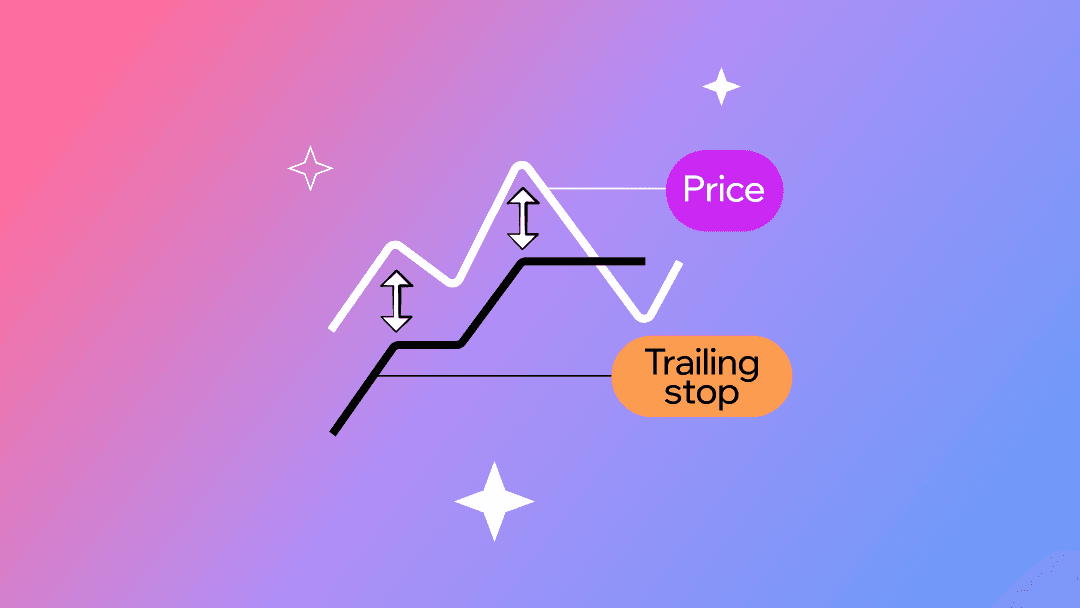
A trailing stop loss is a dynamic order type that automatically adjusts its exit price as the market moves favorably, locking in accumulated profits while still protecting against reversals. Unlike a fixed stop that sits at one price forever, a trailing stop follows the favorable direction by a set distance — a percentage, a dollar amount, a multiple of Average True Range (ATR), or a technical level — and never moves against the position. The mechanism directly addresses one of the most costly retail trading behaviors: holding winners too long and refusing to lock in gains. Research by Locke and Mann (2005), analyzing professional futures traders at the Chicago Mercantile Exchange, found that traders who cut losses faster earned on average 65% more per year — and a PipFarm survey of 2,777 prop traders (2025) found that 73% of failed accounts violated their own stop-losses in more than 30% of cases. Trailing stops remove the human element from exit decisions. Below is a breakdown of how they work, the four main types, when to use them, and how to set optimal trailing distances across different markets.
Understanding Trailing Stop Loss: Beyond Basic Risk Management
A trailing stop loss automatically adjusts the exit price as markets move favorably. Unlike regular stops that stay fixed, this dynamic order follows price upward for long positions (or downward for shorts). Think of it as a rising safety net — as the position climbs higher, protection rises with it. The stop never moves against the position. It only adjusts in the favorable direction.
Regular stops protect against losses. Trailing stops lock in accumulated gains while giving trends room to develop. The key difference: fixed stops sit at one price forever, while trailing stops move with each favorable tick. This captures extended moves without forcing premature exits.
The psychological benefit is substantial. Research by Kahneman and Tversky (1979) on loss aversion showed that humans feel losses 2.5 times more intensely than equivalent gains. This asymmetry causes traders to manually move stops further away as price approaches them, refusing to accept losses, and then hold winners through reversals because exit feels like admitting defeat. Trailing stops remove this decision entirely by automating the logic — set parameters once, and the platform handles everything without emotional interference.
How Trailing Stop Loss Orders Work
Setting a trailing stop requires two decisions: an initial trigger price and a trailing distance.
Consider a simple example. A trader buys stock at $100 with a 10% trailing stop. The initial stop sits at $90. If the stock rises to $110, the trailing stop adjusts to $99 (10% below the new high). If the price climbs to $120, the stop moves to $108, still maintaining 10% distance. When a reversal comes and price drops to $109, the stop triggers at $108, closing the position automatically.
The contrast with a fixed stop is dramatic. Without trailing, the fixed $90 stop would remain unchanged regardless of how high price climbed. A retreat from $120 back down to $90 would erase all accumulated gains and trigger the stop with zero profit captured. The trailing version locks in $8 per share; the fixed version captures nothing.
Most platforms execute these adjustments automatically. The trader monitors the position while the system handles the technical details of tracking new highs and recalculating the stop level.
Hypothetical Trailing Stop Example
The following illustrates trailing stop mechanics in a hypothetical crypto trade. It's an educational scenario, not a record of an actual trade.
A trader enters Ethereum at $1,800 with a 12% trailing stop immediately. Initial stop: $1,584. Over three days, ETH rallies to $2,000. The trailing stop adjusts to $1,760 — 12% below the peak. The uptrend continues, and price hits $2,200 by week two. The stop moves to $1,936, guaranteeing profit on the position. Momentum pushes ETH to $2,400 at peak, placing the trailing stop at $2,112. Then reversal begins. Price drops to $2,150 overnight, triggering the stop at $2,112. Position closes automatically. Final profit: $312 per ETH, capturing 52% of the total move from entry to peak.
The trailing stop achieved three things simultaneously: it protected against total reversal, it locked in a substantial portion of the move, and it removed emotional decision-making from the exit. A trader watching manually during overnight volatility might have hesitated, hoped for a bounce, or exited prematurely at the first sign of weakness. The mechanical rule handled all of it.
Types of Trailing Stops
Four main approaches exist for implementing trailing stops. Each serves different trading styles.
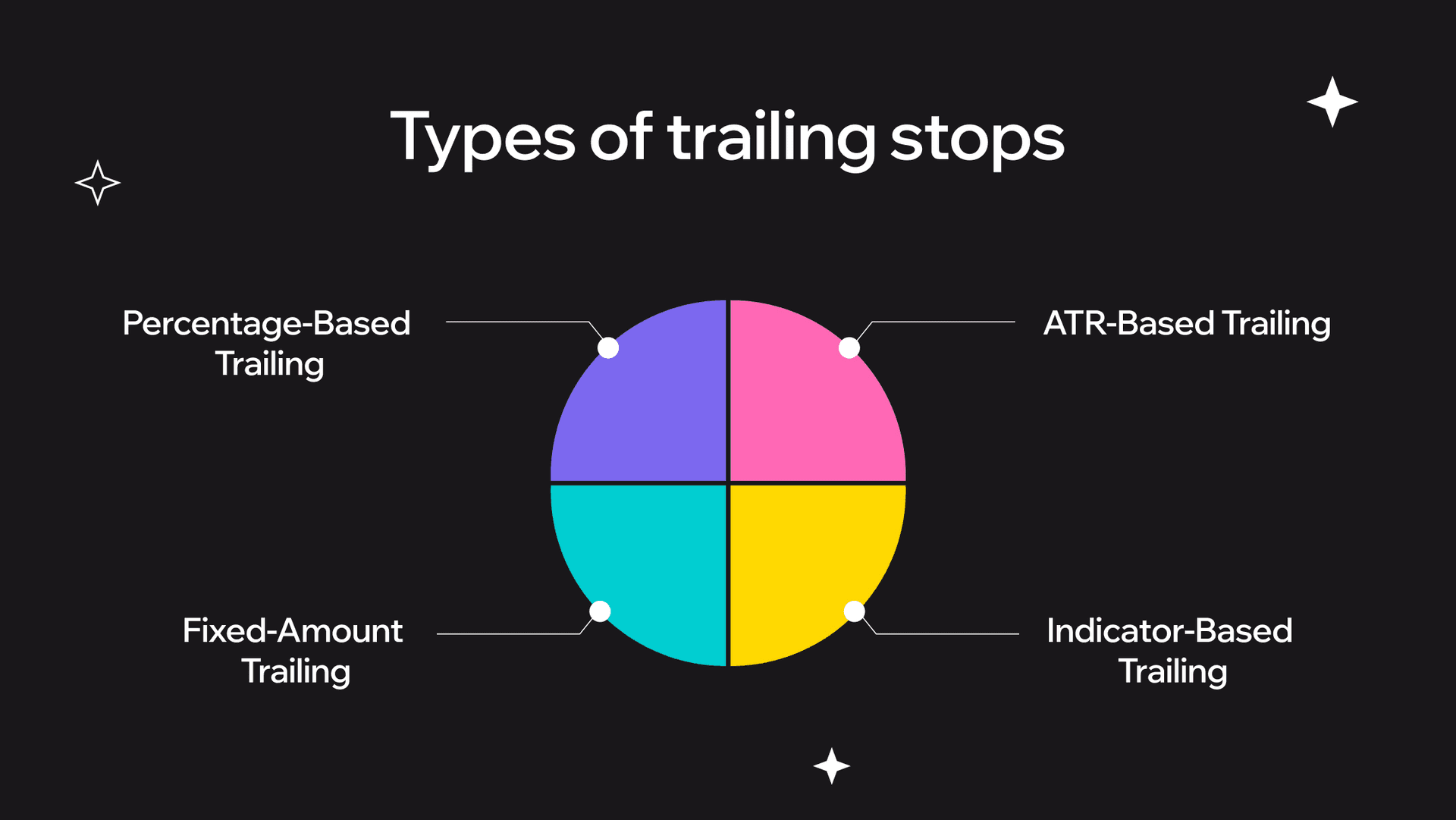
Percentage-Based Trailing
A fixed percentage below current price. Set at 8%, the stop trails by that amount consistently. Equity positions typically warrant 10–12%; crypto requires 15–18% due to higher volatility. Best for trending markets, long-term positions, and less active monitoring.
Fixed-Amount Trailing
Stop follows price by a specific dollar amount. Set $5, stop stays $5 below price always. Works well with lower-priced stocks and useful for precise risk calculations. Best for day trading, short-term trades, and specific risk targets.
ATR-Based Trailing
Uses Average True Range to measure volatility. Set trail at 2–3 times ATR value. This adapts to changing conditions automatically — high volatility gets wider stops without manual intervention. Particularly useful for swing trades because it respects market character naturally. Best for all conditions, volatility-adaptive trading, and technical traders.
Indicator-Based Trailing
Uses moving averages or support levels as dynamic stops. The 20-day EMA becomes the trail line. Price stays above the moving average, the position holds. Price crosses below, the trader exits. Best for trend followers, technical enthusiasts, and longer timeframes.
| Type | Mechanism | Volatility Response | Ideal Timeframe | Complexity |
|---|---|---|---|---|
| Percentage | Fixed % below price | Manual adjustment | Any | Low |
| Fixed Amount | Fixed $ below price | Manual adjustment | Short-term | Low |
| ATR-Based | Multiple of ATR | Automatic | Medium-term | Moderate |
| Indicator-Based | Follows MA/support | Automatic | Long-term | Moderate |
Match the trail type to the strategy. Test each individually before combining approaches.
Regular Stop Loss vs. Trailing Stop Loss
The fundamental difference shapes capital protection and profit capture.
Regular Stop Loss: A fixed price trigger. Buy at $50, place stop at $45, and that $45 never changes. Advantages: precise risk definition, no surprises, perfect for defined targets. Disadvantages: misses extended moves, requires manual adjustment to protect profits, no automatic profit protection.
Trailing Stop Loss: Adjusts automatically with favorable movement. The stop follows trends upward and never moves against the position. Advantages: captures extended moves, locks profits automatically, removes emotional decision-making, minimal monitoring required. Disadvantages: can produce premature exits in choppy markets, more complex to set up, vulnerable to volatility spikes.
Selection Criteria
Use regular stops when:
- Trading within defined ranges
- Targeting specific technical levels
- Making short-term trades with known exits
- Holding through high-impact news events
Use trailing stops when:
- Riding established trends
- Profit targets are uncertain
- Managing positions passively
- Larger positions need automatic protection
Both tools belong in any complete risk management arsenal. Regular stops limit losses; trailing stops maximize gains. Use them strategically for different scenarios rather than treating one as universally superior.
Setting Up Effective Trailing Stop Loss Orders
Implementation varies across platforms, but most brokers support trailing stops through standard interfaces.
Basic Setup Process:
- Access the order entry screen after opening a position
- Select "Trailing Stop" from the order types menu
- Enter the trailing percentage or dollar amount
- Review the initial stop price and trailing distance
- Activate the order to begin automatic tracking
Platform-specific quirks exist. Testing on small positions first verifies that execution works as expected before deploying trailing stops on larger capital.
Managing multiple trailing stops simultaneously works well because the system tracks each position independently. Weekly review during normal market conditions is usually sufficient; volatile periods may require daily monitoring.
OCO Orders
One-Cancels-the-Other combines trailing stops with profit targets. Both are set simultaneously — whichever triggers first closes the position. This hybrid approach works when trend direction remains uncertain. The trader captures either the profit target or the trail stop automatically without having to choose in advance.
Crypto exchanges like Binance offer similar functionality. Their trailing stops execute 24/7, providing continuous protection that proves especially valuable during overnight volatility and weekend moves when traditional markets are closed.
Determining the Optimal Trailing Distance
Finding the right trailing distance balances competing forces. Too tight, and normal volatility stops positions out prematurely. Too wide, and the trader surrenders too much profit during reversals.
Volatility-Based Method
Calculate current ATR for the instrument. Multiply by 2–3 for trailing distance. Example: a stock shows ATR of $4. Setting the trail at $8–$12 below price accommodates normal volatility while still protecting profits. Wider trails apply to instruments with higher ATR. Recalculating ATR weekly and adjusting distances when volatility shifts significantly keeps the system adaptive.
Percentage Approach
Fixed percentages based on volatility ranges provide a simpler starting point:
- Low volatility (blue-chips): 5–7% trailing distance
- Moderate (growth stocks): 8–12%
- High volatility (small-caps, crypto): 13–20%
Timeframe Adjustment
Trading timeframe affects optimal distance:
- Day trading: 3–5% trails
- Swing trading: 8–12%
- Position trading: 15–20%
Match trailing distance to position duration. Longer holding periods need wider stops to survive normal market noise.
Crypto-Specific Considerations
Cryptocurrency exhibits much higher volatility than traditional markets. Bitcoin routinely moves 5–8% daily; altcoins swing even wider. Crypto trails should start at 15% minimum, often 18–20% for smaller altcoins. These wider distances prevent noise-triggered exits on normal price action.
The 24/7 nature of crypto markets makes trailing stops especially valuable. They provide protection during sleep hours and weekends when manual management is impossible. Starting wider than feels comfortable, tracking results over 20–30 trades, and tightening only if leaving too much profit on the table — or widening if choppy markets trigger repeatedly — builds empirical calibration rather than guesswork.
Implementation Across Different Markets
Trailing stops function similarly across markets, but specific considerations matter for each asset class.
Equity Markets
Overnight gaps pose primary risk. Earnings announcements create sudden price jumps, and trailing stops cannot protect during closed hours. Widening stops before earnings or closing positions entirely for major announcements manages this gap risk. Market hours limitations require planning ahead. Large-cap stocks support tighter trails; small-caps need wider distances due to lower liquidity and larger normal price swings.
Cryptocurrency Markets
Crypto operates 24/7/365. Continuous protection tops the advantage list — the trailing stop watches the market during sleep hours. Higher baseline volatility demands wider trails. 15–20% trails work for most crypto positions; anything tighter gets stopped by normal movement. Weekend volatility frequently exceeds weekday movement, with traditional markets closed Friday evening while crypto continues trading. Trailing stops protect automatically during these periods without requiring constant monitoring. Maintaining different parameters for different markets — equity positions at 8–12%, crypto at 15–20% — reflects volatility differences rather than applying a single rule universally.
Strategic Applications of Trailing Stop Loss
Trailing stops shine in specific trading scenarios. Three applications dominate practical use.
Trend Following
Trailing stops align perfectly with trend-following systems. Both capture extended directional moves. Traders enter trending positions with risk-based fixed stops initially, then activate trailing stops once profit reaches 1.5x initial risk. This locks minimum gains while the mechanism lets the trend develop fully, avoiding premature exits during normal pullbacks. The stop adjusts upward with each new high, moving only in the favorable direction.
Breakout Trading
Breakouts require immediate protection because failed breakouts retrace quickly. Trailing stops provide automatic downside protection without requiring constant monitoring. Initial stops sit just below the breakout level. Once price extends 5–10% beyond the breakout, switching to trailing mode captures momentum runs while protecting against reversals. This combination produces favorable risk-reward outcomes when breakouts succeed and controlled losses when they fail.
Position Scaling
Splitting a position into components with different trailing parameters balances aggressive profit-taking with trend-riding patience. Trail half the position with tighter stops; give the other half wider parameters. The tighter stops secure base returns regardless of what happens next, while the wider stops capture extended moves if the trend continues. This approach acknowledges that the trader cannot know in advance whether a move will extend or reverse — the split position captures value in both scenarios.
Adjusting Trailing Stops for Volatile Markets
Market volatility fluctuates constantly, and a fixed trailing strategy cannot handle every market regime equally well.
Measuring volatility daily using ATR provides the basis for adjustment. When current ATR exceeds the 14-day average by 50% or more, widening trails proportionally prevents premature triggers.
Volatility Response System:
- Calculate current ATR value
- Compare to recent average
- Widen trails proportionally if elevated
- Monitor support and resistance levels
- Increase review frequency during volatility spikes
During volatile periods, reviewing positions daily instead of weekly catches shifts faster. A stock with ATR of $3 that suddenly spikes to $7 needs the trail widened from 8% to 15% or similar — a tighter trail would get stopped out by normal volatility expansion before the actual trend reverses.
Crypto Volatility Baseline
Crypto exhibits permanently higher volatility than traditional markets. Bitcoin commonly moves 5–8% daily; altcoins swing 10–20%. Starting at 15% for BTC positions and 18–22% for altcoins accommodates normal crypto movement. Applying equity parameters (8% trails) to crypto guarantees stops get hit within hours — Bitcoin's volatility routinely exceeds that stop distance. Different volatility regimes demand different approaches.
Common Trailing Stop Mistakes
Five mistakes destroy trailing stop effectiveness for most traders.
Mistake 1: Trailing distance too tight. Using 5% trails on volatile growth stocks gets triggered by normal movement. The fix is ATR-based distances calculated at 2–3x ATR value, which automatically accommodates the instrument's actual volatility.
Mistake 2: Using trails in ranging markets. Ranging markets produce whipsaw that stops trailing positions repeatedly. Identifying market regime before deploying the strategy — using ADX or structure analysis — prevents the most common source of consecutive losses.
Mistake 3: Ignoring gap risk. Holding positions through earnings with active trails exposes capital to overnight gaps that can blow through stops entirely. Widening stops before catalysts or closing positions before major announcements reduces this risk.
Mistake 4: Moving stops against position. Manually loosening a trailing stop to "give the trade room" is the single most destructive habit in trailing stop usage. It converts an automated risk management system into a manual emotional override. According to a PipFarm survey of 2,777 prop traders (2025), 73% of failed accounts violated their own stop-losses in more than 30% of cases — and loosening trails to avoid taking losses is one of the primary mechanisms. Never loosen a trailing stop once set. This is the rule that separates traders who benefit from trails and those who don't.
Mistake 5: Applying equity parameters to crypto. An 8% trail that works on blue-chip stocks will get stopped out on BTC within hours. Crypto needs its own parameter set. For a deeper breakdown of the psychological patterns that drive these mistakes — and how to restructure the emotional response to loss — see the "Best Loser Wins" framework and the five types of trading tilt.
Advanced Trailing Stop Techniques
Professional traders enhance basic trailing stops with refinements.
Volatility-Adjusted Dynamic Trails
Advanced implementation adjusts distance based on real-time volatility changes. Normal ATR produces a 10% trail; ATR increasing 50% widens it to 15%; ATR decreasing 30% tightens it to 8%. This dynamic approach reduces premature stop-outs while still protecting gains when conditions allow tighter control.
Partial Position Trailing
Splitting the position into components with different parameters consistently outperforms single-method approaches. A 50/50 split with 8% trail on one half and 15% trail on the other captures profits at two different reversal points. Position scaling acknowledges uncertainty about trend continuation without forcing a single exit decision.
Time-Based Trail Tightening
Distance can narrow as position ages, recognizing decreasing trend continuation probability over time:
- Day 1–7: 15% trail
- Day 8–21: 12% trail
- Day 22+: 9% trail
This approach assumes trends have finite lifespans and protects more aggressively as those lifespans extend.
Combining Trailing Stops with Technical Indicators
Technical analysis enhances trailing stop effectiveness when applied thoughtfully.
Moving Average Trails: Using the 20-day EMA as a dynamic stop level works well in strong trends. Price above EMA means holding the position; price crossing below means exit. This captures extended moves in trending markets while providing natural exit signals when trends actually break.
ATR-Based Distance: Setting distance at 2–3x current ATR value, recalculated weekly, adjusts to market character naturally. This respects current volatility without requiring manual intervention.
Support/Resistance Alignment: Placing trails just below key support levels exploits structure. Support holds during pullbacks; a genuine break suggests the move has ended. This technique works particularly well in combination with Smart Money Concept analysis, which identifies institutional support and resistance levels more precisely than retail chart patterns.
Trailing Stop Loss with Profit Targets
Combining trailing stops with profit targets creates powerful hybrid strategies using OCO orders.
OCO Order Implementation
One-Cancels-the-Other orders execute either the trailing stop or the profit target — whichever triggers first closes the position. Setup involves entering the position, setting a profit target at resistance or 2:1 risk-reward, activating a trailing stop at a wider distance, and linking both as an OCO order.
Example: Entry at $100 with profit target at $120 and trailing stop at 15% ($85 initially). If price rallies to $118 but reverses, the trailing stop adjusts during the move to around $100. When price drops on reversal, the trailing stop triggers and closes the position around $101 — small profit instead of loss.
The hybrid provides downside protection while chasing upside, particularly useful when trend direction is uncertain but the setup is technically strong.
Hypothetical Case Studies
The following examples illustrate trailing stop mechanics in different scenarios. They are hypothetical educational scenarios, not records of actual trades.
Case Study 1: Trending Market
Technology stock entered at $85 with an initial fixed stop at $78 (8% risk). When profit exceeds 1.5x initial risk at $95, a 10% trailing stop activates. Trail adjustments:
- Day 7: $98 → Stop $88.20
- Day 14: $106 → Stop $95.40
- Day 21: $115 → Stop $103.50
Exit triggered at $107.50 when reversal hits the trailing level. Final result: $22.50 gain (~26.5% return). Trail captured approximately 66% of total move from entry to peak.
Case Study 2: Crypto Volatile Market
Ethereum entered at $2,000 with an initial 18% trail (crypto baseline). On day 8, volatility spike doubles ATR; widening the trail to 22% prevents premature exit. Trail adjustments:
- Day 10: $2,400 → Stop $1,872
- Day 15: $2,800 → Stop $2,184
- Day 21: $3,100 → Stop $2,418
Exit triggered at $2,320. Result: $320 gain (16% return). The volatility adjustment prevented early exit that the original 18% trail would have produced.
Case Study 3: Partial Position Strategy
Growth stock at $50 with 200 shares split into two components:
- Position 1: 100 shares with 8% trail (tighter)
- Position 2: 100 shares with 15% trail (wider)
Exit results:
- Position 1: Triggered at $59 (18% gain)
- Position 2: Triggered at $58 (16% gain)
Blended return: approximately 17% overall. The split balances aggressive profit-taking with trend-riding patience, producing results that neither pure strategy would have captured alone.
Key Takeaways
Trailing stops solve a structural problem in retail trading: the emotional impossibility of manually taking profits at the right moment. Research on professional traders consistently shows that disciplined loss-cutting and profit-taking separates consistent winners from the rest — Locke and Mann's 2005 study of CME futures traders found that those who cut losses faster earned 65% more annually, and trailing stops automate exactly that discipline in the profit direction. They lock in gains as price moves favorably, give trends room to develop, and remove the moment-by-moment decision-making that exposes traders to their worst emotional instincts.
The effectiveness depends entirely on three factors: matching trail type to market regime, sizing the trailing distance to actual instrument volatility rather than gut feel, and — most critically — never loosening a trail once set. The PipFarm data is unambiguous: 73% of failed prop accounts violated their own stop-losses in more than 30% of cases. Moving a trailing stop against the position to "give the trade more room" is how automated risk management converts back into manual emotional override, and it's the single most destructive habit traders bring to trailing stop usage. Set the trail based on math, let it run, and accept the outcomes.
Start with percentage-based trails on a demo account. Test 3–5 positions at different distances. Observe how the stop adjusts, what triggers exits, and whether the distance matches the instrument's normal volatility. Progress to ATR-based trails after pattern recognition develops. Combine with profit targets using OCO orders only after basic trailing mechanics feel automatic. The path from concept to reliable execution takes weeks of deliberate practice, not hours of reading.
Ready to start your prop trading journey?
Start now: 👉 Upscale.trade | Telegram Bot
Follow us: 📺 YouTube | 𝕏 Twitter
Frequently Asked Questions
What is a trailing stop loss?
A trailing stop loss is a dynamic order type that automatically adjusts its exit price as the market moves favorably, locking in profits while still providing downside protection. Unlike regular stop losses that remain fixed at one price, trailing stops follow price movements in the favorable direction by a set distance — a percentage, a dollar amount, or a multiple of ATR — and never move against the position. When price reverses and hits the trailing level, the position closes automatically.
How does a trailing stop loss work?
A trailing stop has two parameters: an initial trigger price and a trailing distance. As price moves favorably, the stop adjusts by the trailing distance, following the new highs (for longs) or new lows (for shorts). The stop never moves backward. When price reverses enough to hit the current trailing level, the order executes automatically. Example: buy at $100 with 10% trail, stop starts at $90. Price rises to $120, stop moves to $108. Price drops to $108, position closes.
How is a trailing stop loss different from a regular stop loss?
Regular stop losses stay at a fixed price level indefinitely. Trailing stop losses adjust automatically with favorable price movement. Regular stops only limit losses; trailing stops both limit losses and protect accumulated profits. Regular stops work best for defined-target trades (sell at X resistance) and short-term positions. Trailing stops work best for trend-following, breakout trading, and any situation where the profit target is uncertain and the trader wants to let winners run while still protecting capital.
What are the advantages of trailing stop loss?
Key advantages include: automatic profit protection without manual intervention, emotion-free exits that remove psychological interference, the ability to capture extended trends that fixed targets would miss, hands-off position management for traders who cannot monitor constantly, and systematic risk control. Trailing stops work especially well in trending markets and for positions held over days or weeks where manual monitoring becomes impractical.
What are the disadvantages of trailing stop loss?
Main disadvantages: premature exits in choppy markets where price whipsaws trigger stops repeatedly, vulnerability to volatility spikes that can sweep stops before the actual reversal, more complex setup than regular stops, and poor performance in ranging conditions. Trailing stops also cannot protect against overnight gaps in equity markets — a stock that closes at $100 and opens at $90 the next day blows through any stop set between those levels.
What trailing distance should I use?
Trailing distance should match instrument volatility. Low-volatility blue-chip stocks can use 5–7% trails. Moderate-volatility growth stocks work well with 8–12%. High-volatility crypto assets need 15–20% minimum. The best method is ATR-based: calculate the Average True Range over 14 periods and set the trail at 2–3x that value. This automatically adjusts to current market conditions rather than using a one-size-fits-all percentage. Start wider than feels comfortable, track results over 20–30 trades, and tighten only if too much profit is being left on the table.
Should I ever manually move a trailing stop further away?
Never. Loosening a trailing stop to "give the trade room" is the single most destructive habit traders develop with this tool. It converts automated risk management back into manual emotional override — exactly what the trailing stop was designed to prevent. According to a PipFarm survey of 2,777 prop traders, 73% of failed accounts violated their own stop-losses in more than 30% of cases, and loosening trails is one of the primary mechanisms. The trailing stop only has value if it's followed mechanically. Accept the exit when it triggers, review the trade afterward, and adjust the distance on future trades if the pattern suggests the initial setting was too tight.