Slippage in Trading: Formula, Causes, Mitigation | Upscale


Slippage is the difference between the price at which a trader expected an order to execute and the price at which it actually executed. The formula is simple: Slippage = Execution Price − Expected Price (with sign convention depending on whether the trader is buying or selling). Slippage occurs because markets move continuously, and in the milliseconds between an order being submitted and the order being filled, prices shift. Market orders are most exposed to slippage; limit orders eliminate negative slippage but accept execution risk in return. Slippage can be positive (the trader gets a better price than expected) or negative (worse price than expected), with the latter being the statistically more common outcome over long trading histories due to how market microstructure tends to move against aggressive orders. Execution quality has been formally regulated in US equity markets since the SEC adopted Rule 605 in 2000, which requires market centers to publish monthly statistics on execution quality — including effective spread, price improvement, and execution speed. For prop traders, the stakes are different from institutional investors: slippage directly reduces profit on each trade and, critically, eats into the fixed drawdown budget that defines account survival. A trader operating with a 5% daily drawdown limit who loses 0.5% per trade to slippage across 10 trades has used 10% of their daily risk budget on execution friction alone — before any strategy-level losses.
What Slippage Measures
Slippage quantifies the friction between intent and execution. When a trader clicks "buy" at $100.00, the order arrives at the matching engine some milliseconds later. During those milliseconds, the best available ask price may have moved to $100.05 as other participants consumed the liquidity that was there before. The order fills at $100.05, and the trader has experienced $0.05 of negative slippage. If instead the ask had dropped to $99.95, the fill at that lower price would represent positive slippage.
The phenomenon exists because markets are not static. Every order book is continuously updated as participants add liquidity, remove liquidity, and execute against resting orders. The trader who sends a market order accepts whatever price is available when the order reaches the top of the queue — which, by definition, cannot be known in advance. This is the fundamental trade-off of market orders: execution certainty in exchange for price uncertainty.
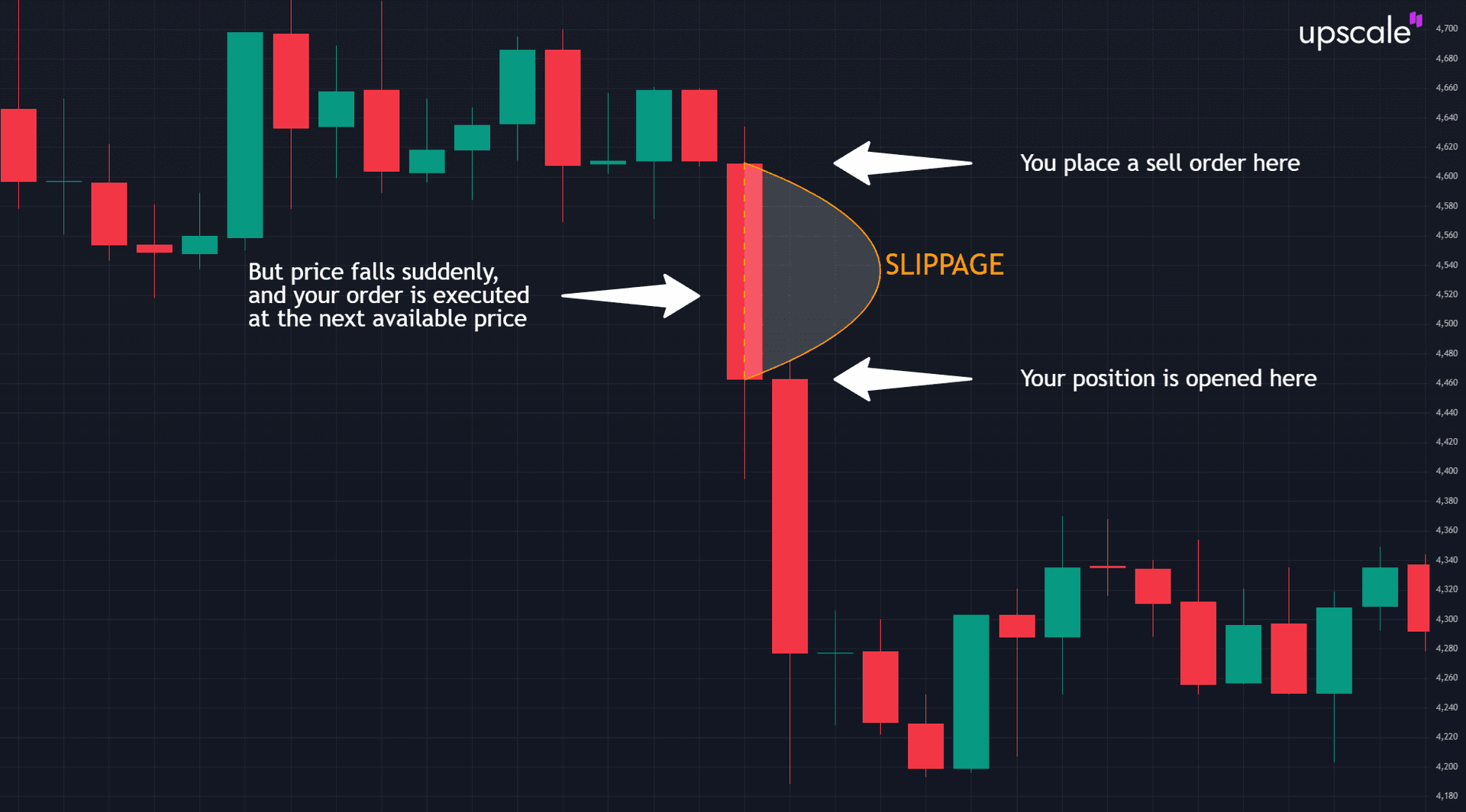
Slippage is not the same as the bid-ask spread. The spread is the static difference between the best bid and best ask at a given moment — a visible cost paid by anyone crossing the spread with a market order. Slippage is a dynamic cost caused by the order book moving between quote observation and order execution. A trader can face a tight spread (say, $0.01) but still experience $0.10 of slippage if the order is large enough to consume multiple price levels, or if the market moves aggressively in the time between quote and fill.
Positive vs. Negative Slippage
Positive slippage and negative slippage are symmetrical concepts but asymmetric in practice. Both occur, but their frequencies and magnitudes are not equal for several structural reasons.
Negative slippage — execution at a worse price than expected — tends to dominate over time because:
- Aggressive orders cross the spread in the direction of recent momentum. When a trader buys on an upward impulse, other participants are often doing the same, and prices tend to continue moving up before the order fills.
- Stop orders activate during adverse moves. A stop-loss triggers precisely when price is moving against a position, typically at the worst moment for execution quality.
- Large orders consume liquidity. An order size that exceeds the top-of-book quantity walks through multiple price levels, each progressively worse than the quoted top.
Positive slippage — execution at a better price than expected — still occurs regularly:
- Price reversals between submission and execution can deliver fills at improved prices.
- Hidden liquidity (orders not displayed in the public book but available through various routing mechanisms) sometimes fills orders at prices better than the quoted top.
- Market makers compete for retail flow and may offer price improvement as part of their business model — this is visible in SEC Rule 605 reports as "price improvement" statistics.
For a trader planning a trading system, the realistic assumption is that slippage will be net negative over a large sample. Backtests that ignore slippage typically overestimate expected returns, and live trading shows the gap. A well-designed system includes slippage as a known cost, similar to commissions or spreads.
Examples of both directions:
- Buy order placed at $100.00, executed at $99.50 = $0.50 positive slippage
- Buy order placed at $100.00, executed at $100.75 = $0.75 negative slippage
- Sell order placed at $50.00, executed at $50.25 = $0.25 positive slippage
- Sell order placed at $50.00, executed at $49.80 = $0.20 negative slippage
Calculating Slippage
The percentage formula is standard across all markets:
Slippage % = (Execution Price − Expected Price) ÷ Expected Price × 100
The sign convention depends on trade direction:
- For buy orders: positive result = negative slippage (bad); negative result = positive slippage (good)
- For sell orders: positive result = positive slippage (good); negative result = negative slippage (bad)
Worked Example
A trader submits a market buy order for BTC at an expected price of $100,000. The order fills at $100,250.
- Slippage % = ($100,250 − $100,000) ÷ $100,000 × 100 = 0.25%
On a $25,000 position, this is $62.50 in execution cost before commissions. Across 40 such trades in a month, total slippage cost would be $2,500 — equivalent to the profit on a 10% monthly return on the same position size.
Slippage Tolerance Settings
Most trading platforms allow setting a maximum slippage tolerance, beyond which the order is canceled rather than filled at a worse price. Typical settings:
- 0.1% — very tight, common for major forex pairs during active sessions
- 0.5% — common default for major crypto pairs in normal conditions
- 1.0% — reasonable for minor pairs or moderate volatility
- 2.0%+ — used for volatile assets or news periods, accepting execution but protecting against extreme deviation
These are commonly cited ranges rather than universal rules. The correct tolerance depends on the asset's typical volatility, the trader's position size relative to average market depth, and the strategy's sensitivity to execution quality. Scalping strategies tight tolerance because each pip of slippage compounds across many trades; swing strategies with wider targets can tolerate more slippage.
Why Slippage Matters More in Prop Trading
For prop traders, slippage has a compounding effect that retail traders with unlimited capital don't experience to the same degree. The drawdown limits that define prop account survival — typically 5% daily and 8–10% total across industry platforms — are measured in realized P&L, which includes slippage costs.
Practical impact:
- A trader on a $25,000 account with a 5% daily drawdown limit has a $1,250 daily risk budget.
- If average negative slippage per trade is $15 (0.06% on a $25,000 notional position), and the trader executes 10 trades per day, $150 of that budget is consumed by slippage alone — 12% of the daily limit.
- Over a month of 20 trading days, that's $3,000 in slippage costs, or 12% of account value.
The same trader on a personal account with no drawdown limit might not notice this cost — they can absorb it across extended trading history without account termination risk. For a prop trader, the daily drawdown limit makes slippage an acute concern. A single day of elevated slippage during a volatile news event can exhaust the daily budget before the trader has even placed a strategy-level losing trade.
This is one reason why scalping strategies, despite their popularity, are particularly challenging in prop trading contexts — the trade frequency multiplies the slippage impact. Traders who approach this successfully, such as those profiled in our verified prop trading success stories, typically use either fewer trades per day (Joshua's 1–3 trades on Bitcoin 15M, Albert's one-trade-per-day rule) or non-scalping approaches that reduce execution frequency while maintaining edge. For a broader discussion of why trade count matters, see our best scalping strategies guide.
Root Causes of Slippage
Slippage has specific structural causes, each of which suggests specific mitigation strategies.
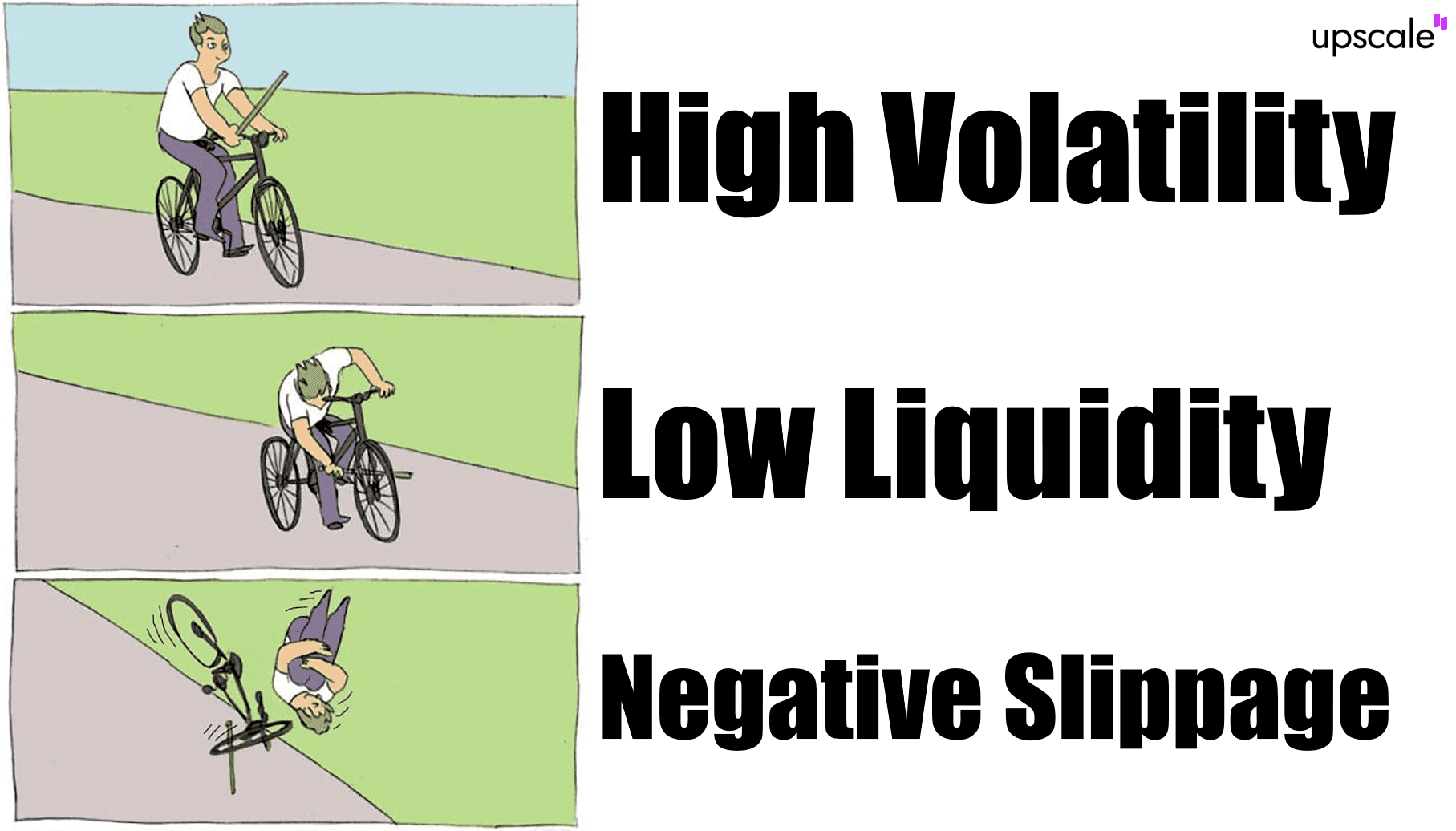
Market volatility. During periods of elevated volatility, prices move faster than they move during calm conditions. The same submission-to-execution latency produces larger price changes, hence larger slippage. VIX spikes, crypto flash crashes, news events — all increase slippage magnitude across the affected instruments.
Liquidity depth. The order book's depth at each price level determines how far an order walks before filling. A market with $10 million of liquidity at the top of book absorbs a $50,000 order with minimal impact. A market with $50,000 at the top of book absorbs the same order entirely at worsening prices. Liquidity tends to be thinner during off-hours, weekends (for 24/7 markets), and around session transitions.
Order size relative to book depth. Large orders cause larger slippage independent of overall volatility. An institutional-sized order in a retail-dominated market can produce significant price impact simply by its presence. This is why institutional traders use TWAP/VWAP execution algorithms to split orders across time rather than sending a single large market order.
News and scheduled events. Fed announcements, CPI releases, Non-Farm Payrolls, and major corporate earnings create predictable volatility spikes. Slippage during these windows is orders of magnitude larger than during normal trading. Traders who need to hold positions through such events should use limit orders and accept the possibility of non-execution.
Session transitions and gaps. Forex markets close for weekends; equities close overnight; crypto has no session breaks but still shows reduced liquidity during certain hours. Price gaps between sessions (Friday close to Monday open for equities) produce slippage on stop orders that trigger at market price.
Market structure factors:
- Fragmentation across multiple exchanges (especially in crypto)
- High-frequency trading activity that adjusts quotes in microseconds
- Order routing decisions made by broker's smart order router
- Regulatory announcements and exchange-specific technical issues
- Latency between trader's platform and the exchange matching engine
Slippage Across Asset Classes
Different markets exhibit different slippage characteristics based on their structural properties. The same trading skill applied across markets produces different execution quality results.
Cryptocurrency markets. The highest average slippage among major asset classes. Bitcoin and Ethereum on major centralized exchanges (Binance, Coinbase, Kraken) generally have deep liquidity and tight spreads during active hours, but slippage can spike dramatically during volatility events. Altcoin markets face persistent liquidity challenges — mid-cap altcoins may have only a few hundred thousand dollars of liquidity within 0.5% of the top of book. Decentralized exchanges (DEXs) have their own slippage profile driven by constant product AMM mechanics rather than order book dynamics, where slippage is a predictable function of position size relative to pool depth.
Forex. Among the most liquid markets globally, with the lowest slippage on major pairs during active sessions. EUR/USD, GBP/USD, and USD/JPY during the London/New York overlap (8 AM – 12 PM ET) typically show slippage measured in fractions of a pip on retail-sized orders. Minor pairs and exotic pairs have wider spreads and larger slippage, especially outside their most active geographic sessions. Weekend gaps create predictable slippage scenarios on positions held through Friday close.
Stocks. Liquid large-caps (S&P 500 constituents) during regular trading hours (9:30 AM – 4:00 PM ET) have low slippage and extensive execution quality data published under SEC Rule 605. The first and last 15 minutes of the session show elevated volatility and slippage — the opening cross and closing cross produce concentrated trading that moves prices rapidly. Pre-market and after-hours sessions have significantly reduced liquidity and larger slippage, often by 5–10x relative to regular hours.
Commodities and indices. Access via futures contracts or ETFs produces different execution profiles. Futures markets have well-defined trading hours and institutional liquidity; ETFs tracking commodities and indices trade on equity exchanges with the same characteristics as stocks. Upscale's RWA category uses ETFs for indices exposure (SPY, QQQM, DIA, IWM), which means NYSE trading hours apply and the ETF's own liquidity characteristics determine slippage.
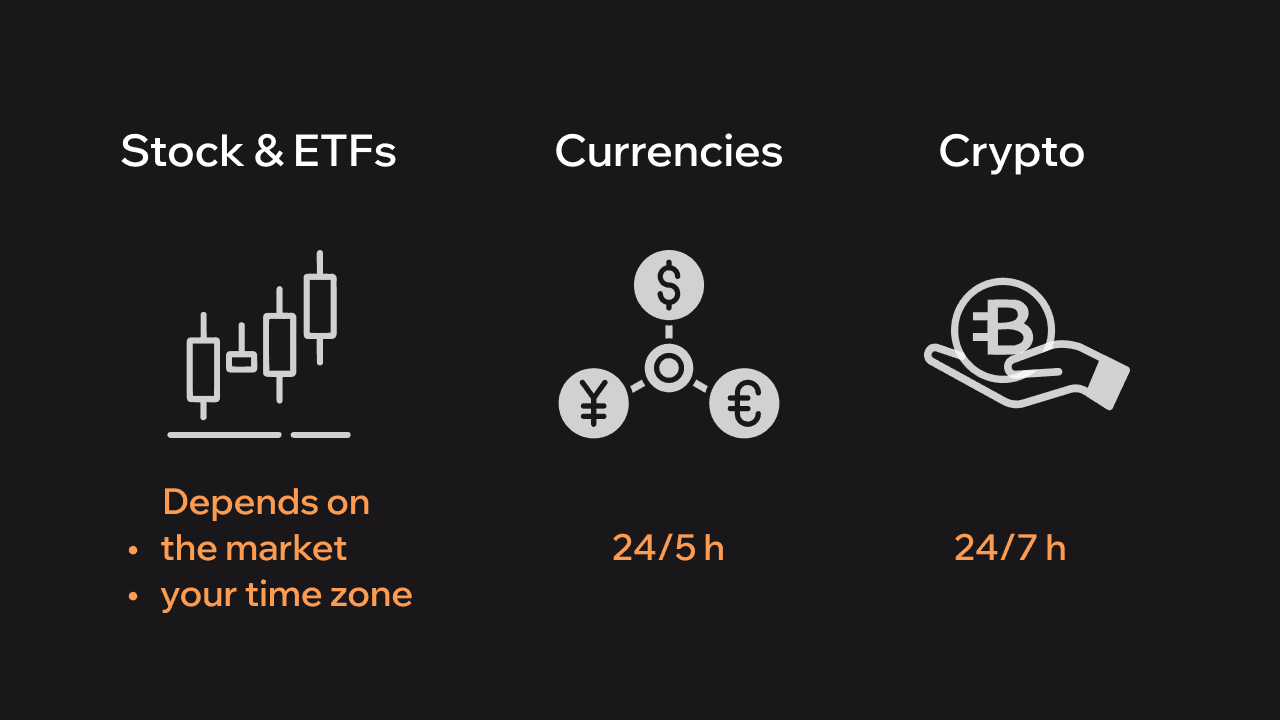
Market-specific characteristics summary:
- Crypto: 24/7 trading but highly variable liquidity; Pyth Network oracle data minimizes cross-venue price divergence
- Forex: Predictable session structure; major pairs offer best execution during session overlaps
- Stocks: Concentrated trading hours; best execution during regular session; gap risk overnight and over weekends
- Commodities: Access via futures or ETFs; seasonal volume patterns can affect execution quality
- Bonds: Generally low slippage in liquid benchmarks but sensitive to interest rate announcement volatility
Measuring Slippage Impact
Systematic measurement is the difference between managing slippage as a known cost and treating it as an unpredictable friction. Without measurement, a trader cannot know whether slippage is eroding expected returns meaningfully or trivially.
Slippage Ratio Formula:
Average Slippage = Total Slippage Cost ÷ Total Trade Value × 100
Monthly Tracking Example
A trader executes 50 trades in a month on an average position size of $10,000 (total trade value $500,000). Reconstructing expected vs. actual execution prices, total slippage cost across the 50 trades is $625.
- Slippage ratio = $625 ÷ $500,000 × 100 = 0.125%
Whether this is acceptable depends on the strategy's edge. A strategy with 1% expected return per trade can tolerate 0.125% average slippage and still be profitable; a strategy with 0.2% expected edge is destroyed by that level of execution cost.
Key Metrics to Track
- Average slippage per trade — mean execution cost across all trades
- Maximum single-trade slippage — identifies outlier events and potential platform issues
- Slippage by market conditions — separate normal vs. news/volatility periods
- Slippage by order type — market vs. stop vs. limit (limit orders should show zero slippage by definition)
- Time-of-day patterns — identify which sessions or hours produce the best and worst execution
- Slippage by instrument — different assets may require different strategies or position sizing
Tracking all trades in a journal (manual or automated) allows the monthly analysis to reveal actionable patterns. Many prop traders discover that a specific time window, specific instrument, or specific order type is responsible for a disproportionate share of slippage costs — and that eliminating that exposure improves net performance substantially.
Professional Strategies to Minimize Slippage
Four practical techniques reduce slippage without sacrificing strategy effectiveness.
Use Limit Orders Where Possible
Limit orders eliminate negative slippage by definition — they execute at the specified price or not at all. The trade-off is execution uncertainty: the order may never fill, or may fill partially. For strategies where entry precision matters more than execution certainty, limit orders are usually the correct choice.
The practical implementation is to set limit prices at or slightly beyond the current bid/offer, accepting the possibility of non-execution during fast moves. This works best in markets with sufficient liquidity and during active sessions when fills are likely.
Choose Order Types Carefully
Different order types have different slippage profiles:
- Market orders: Guaranteed execution, full slippage exposure. Use when execution certainty is required (emergency exits, for example).
- Limit orders: No negative slippage, but execution is not guaranteed.
- Stop-market orders: Trigger at the stop price, then execute as market orders — fully exposed to slippage at the worst possible moment (during adverse price movement). See our trailing stop orders guide for discussion of how stop execution works in practice.
- Stop-limit orders: Trigger at the stop price, then execute as limit orders — no negative slippage but risk of non-execution in fast-moving markets, which can be worse than slippage itself if the adverse move continues.
- Guaranteed stops (where available): Premium-priced protection against slippage on stops. The broker absorbs the slippage cost in exchange for the premium. Useful during major news events.
Setting Tolerance Levels
Platform-level slippage tolerance settings prevent execution during extreme deviations. Commonly cited reference ranges:
- Major forex pairs: 0.1–0.3% during active sessions
- Minor forex pairs: 0.3–0.8%
- Major cryptocurrencies (BTC, ETH): 0.5–2.0% depending on volatility
- Altcoins: 1.0–5.0% reflecting thinner liquidity
- Stocks during earnings or events: 1.0–3.0%
These ranges are industry-common settings rather than prescriptive rules. The right tolerance depends on the trader's strategy: scalpers need tighter settings (each pip of slippage matters), swing traders can tolerate wider settings (slippage is a smaller fraction of expected profit per trade).
Time Trades for Optimal Liquidity
The same trade placed at different times of day can face dramatically different execution quality. Optimal windows by market:
- Forex: 8 AM – 12 PM ET (London–New York overlap) for major pairs
- US Stocks: 10 AM – 3 PM ET, avoiding the first 15 minutes (volatile open) and last 15 minutes (close auction)
- Crypto: Varies by asset and session; generally avoid weekends and the hour around major news events
- Commodities: Based on underlying market hours (NYSE hours for ETFs like SPY)
Weekend considerations vary by market:
- Forex: Sunday evening gaps common when markets reopen
- Crypto: 24/7 trading but thinner weekend liquidity and higher volatility
- Stocks: Monday morning gaps possible after weekend news
- Commodities: Weather events and geopolitical news over weekends can produce Monday gaps
Slippage in Cryptocurrency Markets
Crypto markets have structural features that affect slippage in ways different from traditional markets.
24/7 trading with variable liquidity. Unlike equities, crypto has no scheduled session breaks, but liquidity still varies significantly across the week. Weekend liquidity is typically lower than weekday, and Asian session liquidity may be thinner than European or US session for non-Asian-focused assets. The 24/7 nature also means that news events in traditional markets (Fed announcements, CPI data) can affect crypto prices during hours when equity markets are closed — creating slippage windows that traditional traders don't encounter.
Centralized vs. decentralized exchange mechanics. On centralized exchanges (Binance, Coinbase, Kraken, and the institutional venues that feed prop platforms), slippage is driven by order book dynamics identical to traditional markets. On decentralized exchanges using automated market makers (Uniswap, PancakeSwap), slippage is a deterministic function of trade size relative to liquidity pool size — expressed through the constant product formula. A trader can calculate DEX slippage in advance, but cannot reduce it below the formula's output without either splitting the order or using a smaller pool.
Oracle price feeds. Prop trading platforms like Upscale use decentralized price oracles (Pyth Network in our case) to provide reference prices that are aggregated from multiple sources and updated in real time. This reduces the risk of single-venue price divergence causing artificial slippage, but does not eliminate slippage entirely since actual execution still occurs against underlying venue liquidity.
Fragmentation. Crypto liquidity is fragmented across dozens of major venues and hundreds of smaller ones. A trader on one venue may face slippage that wouldn't exist on another venue at the same moment. Smart routing across venues can reduce slippage but adds complexity and execution latency.
For an example of how slippage affects crypto scalping specifically, consider the strategy described in our Maru Joshua success story: Bitcoin-only scalping on 15-minute timeframes with 1–3 trades per day. The trader's minimum risk-reward of 1:2 provides buffer for normal slippage, but the strict limit on trade count per day caps total slippage exposure to manageable levels. Scalping strategies with 10+ trades per day face a very different slippage arithmetic, where execution friction can consume a significant portion of expected edge.
Slippage on Upscale
For traders on the Upscale platform specifically, several design decisions affect slippage:
- Pyth Network oracle pricing provides decentralized price feeds that aggregate across major venues, reducing the risk of one-venue price dislocations creating artificial slippage
- Stop Market orders execute at the current market price when triggered, which means they are subject to slippage during fast-moving markets — this is documented in the Upscale Order Types documentation
- Stop Loss and Trailing Stop orders on RWA assets execute at market price, meaning slippage applies on the RWA side as well
- Funded account drawdown limits (5% daily, 10% total for Basic; 3% daily, 6% total for Accelerated) include slippage costs in realized P&L calculations, making execution quality directly relevant to account survival
For complete documentation of how order types work on Upscale, see docs.upscale.trade.
Slippage in Algorithmic Trading
Algorithmic systems that backtest on historical data without realistic slippage assumptions produce unrealistic performance estimates. A strategy that shows 15% annual return in backtest may deliver 5% in live trading if slippage assumptions were optimistic. This gap between backtest and live performance is one of the most common reasons algorithmic strategies fail in production.
Realistic slippage modeling requires:
- Assumption based on live data, not theoretical minima. Use actual slippage measured from live or paper trading in the target market, not bid-ask midpoints.
- Dependency on market conditions. Slippage is higher during volatility spikes, news events, and low-liquidity periods. Models should adjust accordingly.
- Dependency on order size. Linear slippage scaling with size is usually wrong — actual slippage typically scales non-linearly once orders exceed top-of-book liquidity.
- Correlation with strategy signals. If a strategy's signals correlate with unusual market conditions (which is often the case), slippage during those signals may be higher than average.
Prop trading firms generally prohibit automated trading on funded accounts — this is the case on Upscale, where algorithmic execution tools and bots are not permitted. The reasoning is practical: drawdown limits and execution quality are harder to maintain when automated systems can generate cascading errors during unusual market conditions.
Key Takeaways
Slippage is a structural cost of trading, not a correctable mistake. It exists because markets move continuously and order execution takes measurable time, and no trading approach eliminates it entirely — the best traders can do is minimize it through deliberate choices about order type, timing, position size, and market selection. The realistic expectation is that slippage will be net negative over any large sample of trades, and strategies should be designed with that cost explicitly included in profitability calculations. Backtests that ignore slippage systematically overestimate expected returns, and the gap between backtest and live performance is often traceable directly to unrealistic execution assumptions.
For prop traders, the stakes are higher than for retail traders with unlimited capital. The fixed drawdown limits that define prop account survival — typically 5% daily and 8–10% total — are measured in realized P&L, which includes slippage costs. This transforms slippage from a gradual cost eroding returns into an acute constraint that affects account longevity. A trader who would ignore 0.1% slippage per trade on a personal account cannot ignore the same cost on a prop account, where ten such trades in a bad day can push the account close to the daily limit before strategy-level losses are even counted. The disciplined approach is to measure slippage systematically (average slippage, maximum single-trade slippage, slippage by market conditions), select strategies with expected edge large enough to absorb realistic execution costs, and favor order types and timing windows that minimize exposure.
Execution quality has been regulated in US equity markets since the SEC adopted Rule 605 in 2000, with amendments in 2024 expanding the scope to larger broker-dealers and modernizing reporting requirements. For crypto markets, no equivalent regulatory framework exists, but the same principles apply: deeper liquidity and more active sessions produce better execution, while thin markets and volatile periods produce worse execution. The trader who internalizes this and acts accordingly — using limit orders where possible, timing market orders for high-liquidity windows, sizing positions to available book depth, and avoiding major news events without specific preparation — captures an execution edge that compounds meaningfully across many trades. The trader who treats slippage as random noise and doesn't measure it typically discovers through account erosion that it isn't random and wasn't trivial.
Start now: 👉 Upscale.trade | Telegram Bot
Follow us: 📺 YouTube | 𝕏 Twitter
Frequently Asked Questions
What is slippage in trading?
Slippage is the difference between the price at which a trader expected an order to execute and the price at which it actually executed. The formula is Execution Price minus Expected Price, with sign convention depending on whether the trader is buying or selling. Slippage occurs because markets move continuously and execution takes measurable time — between order submission and fill, the order book changes. Market orders face full slippage exposure; limit orders eliminate negative slippage but accept execution uncertainty in return. The phenomenon has been studied formally since the SEC adopted Rule 605 in 2000 to require execution quality reporting from US equity market centers.
How can traders reduce the impact of slippage?
Four practical techniques. First, use limit orders where possible — they eliminate negative slippage by definition, at the cost of execution uncertainty. Second, trade during high-liquidity windows: London-New York overlap for forex (8 AM – 12 PM ET), mid-session for US stocks (avoiding the first and last 15 minutes), and active sessions for the specific crypto pair being traded. Third, size positions appropriately to available book depth — orders that exceed top-of-book quantity walk through multiple price levels. Fourth, avoid trading during scheduled news events (Fed announcements, CPI, earnings) unless specifically preparing for event volatility with appropriate order types and risk controls.
What's the relationship between spread and slippage?
The bid-ask spread is the static difference between the best bid and best ask at a given moment — a visible cost paid when crossing the spread with a market order. Slippage is a dynamic cost caused by the order book moving between quote observation and order execution. Both increase trading costs, but they are distinct phenomena. A trader can face a tight spread (say, $0.01) but still experience $0.10 of slippage if the order is large enough to consume multiple price levels, or if the market moves aggressively during the submission-to-execution window. Tight spreads reduce slippage risk but don't eliminate it.
Why does slippage happen?
Slippage happens because markets are not static. Between the moment a trader submits an order and the moment it reaches the exchange matching engine, prices change as other participants add and remove liquidity. Contributing factors include: market volatility (higher volatility means more price movement during the execution window), liquidity depth (thin order books produce more slippage on the same order size), order size relative to available top-of-book quantity, news events that produce volatility spikes, and session transitions (weekend gaps, market opens, market closes). High-frequency trading activity in modern markets means order books can update in microseconds, and any latency between trader and exchange contributes to slippage risk.
Is positive slippage good?
Positive slippage — execution at a better price than expected — is favorable when it occurs, but relying on it produces unrealistic expectations. Over a large sample of trades, net slippage tends to be negative for several structural reasons: aggressive orders tend to move with momentum rather than against it, stop orders activate during adverse price movements (worst execution moments), and large orders consume liquidity progressively at worse prices. A realistic trading plan assumes slippage is a net cost and builds strategies with edge large enough to absorb that cost profitably. Treating occasional positive slippage as a bonus rather than a baseline expectation is the more disciplined approach.
How much slippage is normal?
Normal slippage varies significantly by asset class and conditions. Typical ranges: major forex pairs during active sessions 0.1–0.3 pip; major cryptocurrencies in normal conditions 0.05–0.2%; liquid US stocks during regular hours under 0.1%. These ranges can multiply by 5–10x during volatility events, news releases, or illiquid periods. What matters is measuring slippage against expected strategy edge: a strategy with 1% expected return per trade can tolerate 0.2% slippage and remain profitable, while a strategy with 0.3% edge is destroyed by the same slippage level. The diagnostic question isn't "is slippage high or low in absolute terms" but "is slippage small relative to the strategy's expected edge."
Why does slippage matter more in prop trading?
For prop traders, drawdown limits transform slippage from a gradual cost into an acute constraint. A $25,000 account with a 5% daily drawdown limit has a $1,250 daily risk budget. If average negative slippage is $15 per trade (0.06% on a $25,000 notional position) and the trader executes 10 trades per day, $150 of that budget is consumed by slippage alone — 12% of the daily limit before any strategy-level losses. Retail traders with unlimited capital can absorb this cost across extended trading history; prop traders cannot. The same execution quality that's "good enough" on a personal account may be insufficient for prop account survival, making deliberate slippage management a requirement rather than an optimization.
Does slippage affect algorithmic trading?
Yes — slippage is often the primary reason algorithmic strategies underperform their backtests in live trading. Backtests that use midpoint prices or bid-ask spreads without realistic slippage modeling systematically overestimate expected returns. Strategies showing 15% annual return in backtest may deliver 5% live if slippage assumptions were optimistic. Realistic slippage modeling requires using actual measured slippage from live or paper trading in the target market, adjusting for market conditions (higher slippage during volatility), accounting for order size relative to book depth (non-linear scaling), and recognizing that signals often correlate with unusual market conditions where slippage is worse than average. Note that most prop trading firms, including Upscale, prohibit automated trading on funded accounts for this reason among others — execution quality and drawdown limits are harder to maintain with automated systems that can generate cascading errors during unusual market conditions.