5 Years in the Red, $4,380 on Prop: Vlad's Story | Upscale

For five years, Vlad traded at a loss: he would grow small deposits on an exchange and blow them as soon as things started to "get to his head." In spring 2026, he spent his last money on a $5,000 prop challenge, a paid evaluation that leads to a funded account, meaning an account with a defined notional whose profit the trader shares with the platform. By mid-September, Vlad had three payouts totaling $4,380, second place in an Upscale tournament and a paid-off credit card.
By his own account, he has no strategy. What he has is range trading on bitcoin, mandatory stop-losses and, for the first time, an account he can't afford to blow. This is the story of why prop trading changed his attitude to risk, how his friends chipped in for a tournament entry and why he was glad to be knocked off first place.
Five years in the red

Vlad is 24, a university student, and has been trading "with mixed success" for about five years. To be honest, at a loss.
It all started back in school, with betting. On a bookmaker's website, Vlad came across binary options: candles jumping on a chart, and he got curious. Something even seemed to work, or at least it felt that way. But he sensed the catch right away:
"I understood that there was probably something unfair going on there, so I didn't mess around with it. But it got me interested."
His instinct was right: US regulators the SEC and the CFTC warn about binary options fraud, especially on unregistered online platforms.
A couple of years later, Vlad watched a streamer trade Dogecoin futures with leverage, a tool that lets you open a position many times larger than your own deposit. He put 500 rubles on an exchange, grew it to $100 and blew it right away. Then came another streamer who marked support levels on the chart, and over time that became the basis of how Vlad trades today.
Throughout those years, the main problem wasn't the market but the size of the deposit:
"You can't really make anything with 50–100 dollars, even if you grow the balance. One way or another, your head starts spinning, and then the balance gets blown."
On top of that, fees quickly ate into the small account: with a tiny balance, every mistake is expensive. And money that can't change your life isn't money you feel like protecting. Again and again, Vlad tried to win his losses back. This state is called tilt, and we break down its signs in 5 Types of Trading Tilt.
Why prop trading
Vlad first heard about prop trading three or four years ago, but never really looked into it. It seemed expensive, and he thought it required verification and some kind of trader exam.
He started taking it seriously in May 2026. In the chat of a trading community on Telegram, reviews from Upscale traders kept popping up, and in one of them Vlad recognized himself: someone had spent their last money on an account and, in a short time, withdrew a first profit that covered the cost.
"I believed people, the stories in those reviews. Of course I was careful, but in one of them I saw almost exactly my own situation."
Soon after, he did the same and bought a $5,000 challenge with his last money. We don't recommend repeating that step: the US Securities and Exchange Commission (SEC) advises risking only money you can afford to lose. But for Vlad, something else mattered most:
"For a symbolic amount, I get an account that's significant for me, and I can potentially withdraw significant money from it."
Responsibility, for the first time
On the exchange, Vlad lost money that didn't really matter to him. With prop trading, it was different:
"I treated and still treat the prop account more responsibly than the money I had on the exchange. There it was insignificant for me, it couldn't change my life. But here, for less than I sometimes spent a month on gambling, I get an account. I feel a responsibility."
"Even a $5,000 account would be, let's say, a great salary for me if I could do it regularly."
So he handled the account with extreme care. Every challenge stage started in the red, and every time Vlad steadily worked his way out of it.
He received his first payout of $480 on August 24. He could have done it earlier, but he didn't want to withdraw $150–200 and kept growing the balance for another month and a half.
The tournament: friends chipped in, and second place beat first

By then, the $5,000 account was already funded. Vlad saw that Upscale regularly runs tournaments and wanted to take part. In challenge-based tournaments, anyone who buys a challenge during the tournament period becomes a participant; in his case, it was a $10,000 account. He had no spare money and didn't want to withdraw profit from his funded account to pay for it.
The solution was very much a student one: his friends chipped in, and Vlad split the shares, giving himself 10% more than the others. Later, he admitted that the amount was small and splitting it into shares wasn't really necessary. The interview host added an important caveat: you shouldn't trade with borrowed money, because it almost never ends well.
Three trades
Vlad opened his first position over the weekend, and instead of a profit he got −$900. In the evening, he saw that the tournament leaders were already up $4,000. A top-three spot didn't interest him; he wanted first place. He closed the losing position and reopened a long, a trade betting on a rise, on a pump, a sharp price surge.
"Whether it works or not, I went for it. If it dropped, no big deal: I'd lose the tournament."
In the morning, his take-profit triggered. That's an order that automatically closes a trade when the price reaches a set profit level. Vlad climbed to about sixth place. Next, he opened a short, a trade betting on a fall, at the pump's new high, and that position took him to first place. He locked in the profit and waited to see whether anyone would start catching up.
Only one participant overtook him, apparently with a single lucky position. And Vlad was genuinely glad:
"I got knocked off first place, and I was incredibly happy about it. In that tournament, second place gave a $100,000 account, and first didn't."
For second place, Vlad received $500 and a $100,000 challenge. He took it to the funded stage and withdrew $3,542 from it, his largest payout.
That was tournament logic: the worst outcome was losing the tournament. Vlad approached his main account in a completely different way.
No strategy, just risk management

Asked about his strategy, Vlad answers honestly:
"This will probably be the most boring part. My trading strategy: I've basically never had one."
Ranges and news
His trading is built on ranges: price moves between a lower and an upper boundary, and inside them you can buy near support and sell near resistance, repeating this several times. On top of that, Vlad reads macroeconomic analysts who make the case for a near-term rise or drop, and draws his own conclusions. Sometimes, as in poker, which he has also played, he enters earlier than the analysts or with a wider range.
90% of trades are bitcoin
According to his account data, about 90% of Vlad's trades are in bitcoin:
"It's the least volatile compared to any altcoin. All the news is reflected on bitcoin first."
He has never really looked at the stock market.
Stop-loss, take-profit and room for error
Vlad's real strategy is risk management. Every trade has a stop-loss, an order that automatically closes the position at a set loss, and a take-profit. Even so, he more often closes the position before the price reaches the take-profit: he takes what the market gives.
"I give myself a big margin for error. I often took what was given to me, and even if the price went further afterward, I tried not to get carried away, because that was a frequent mistake of mine in the past."
He names his weak spot himself: greed and the urge to win losses back. In the past, that ended in a blown account every time:
"I used the deposit carefully up to a certain point, until I lost my head and wanted to win it back in the moment: volatility is high, you want to make a quick winning trade. That always led to blowing the account."
We explain how to review a breakdown like this using your trade history and avoid repeating it on the next attempt in Failed a Prop Challenge? How to Review Your Mistakes in 7 Steps, and how to choose your risk per trade to fit the account's limits in How Much to Risk per Trade in Prop Trading.
Where the payouts went
From mid-August to mid-September, Vlad received three payouts totaling $4,380:
- $480 (August 24), the first payout from the $5,000 account, went to everyday expenses: "it was significant for me, I lived on it";
- $3,542 (September 11), from the $100,000 account won in the tournament, partly went to paying off an old credit card;
- $358 (September 14), the second payout from the $5,000 account.
Vlad split the $500 tournament prize among the friends who had chipped in for his entry.
He talks about the credit card calmly:
"I can't say I was really worried, because I understood that one way or another I'd pay it off, pay it off with trading. That was my goal. It got easier to breathe."
That was Vlad's decision, not a recipe: no one guarantees payouts in trading, so relying on them to pay off debt is risky.
Being honest: "I'm survivorship bias too"
Vlad brought several friends to Upscale and urged them to start with a demo tournament. Some got interested, some didn't. Most of them traded aggressively, on altcoins and with their full balance, even though he asked them to manage risk. Some even reached payouts and then blew everything.
Survivorship bias is when conclusions are drawn from those who succeeded, while those who dropped out stay out of sight. Vlad applies the concept not only to his friends but to himself:
"I consider myself survivorship bias too at the moment. For now, until I make my next payout, because that's really difficult for me right now."
The host objected: three payouts and a prize spot in a tournament already look like a system. But Vlad is in no hurry to call himself a professional, and that may be the healthiest part of his story.
Vlad's advice
Start simple
"I'd advise being bolder about making your first purchase with the simplest account and trying the demo."
The demo account on Upscale is free and mirrors the structure of a paid challenge: the same stages, targets and drawdown limits. And some tournaments run on demo accounts, so you can compete for prizes without paying anything.
Be smart about risk
The advice is basic, Vlad says himself, but it works: risk a small percentage of the balance per trade, not as much as you don't mind losing.
Rethink your attitude to money
"You need to reconsider your attitude to money. My life was a closed loop: sometimes I'd mess around, sometimes I wouldn't, I'd gain some experience, and it led nowhere. But prop trading is a great chance to find something that's truly yours, especially if you enjoy it, like I do."
Roman went through a similar path from blown accounts to payouts: he blew 4 accounts before coming out ahead.
Payout certificates
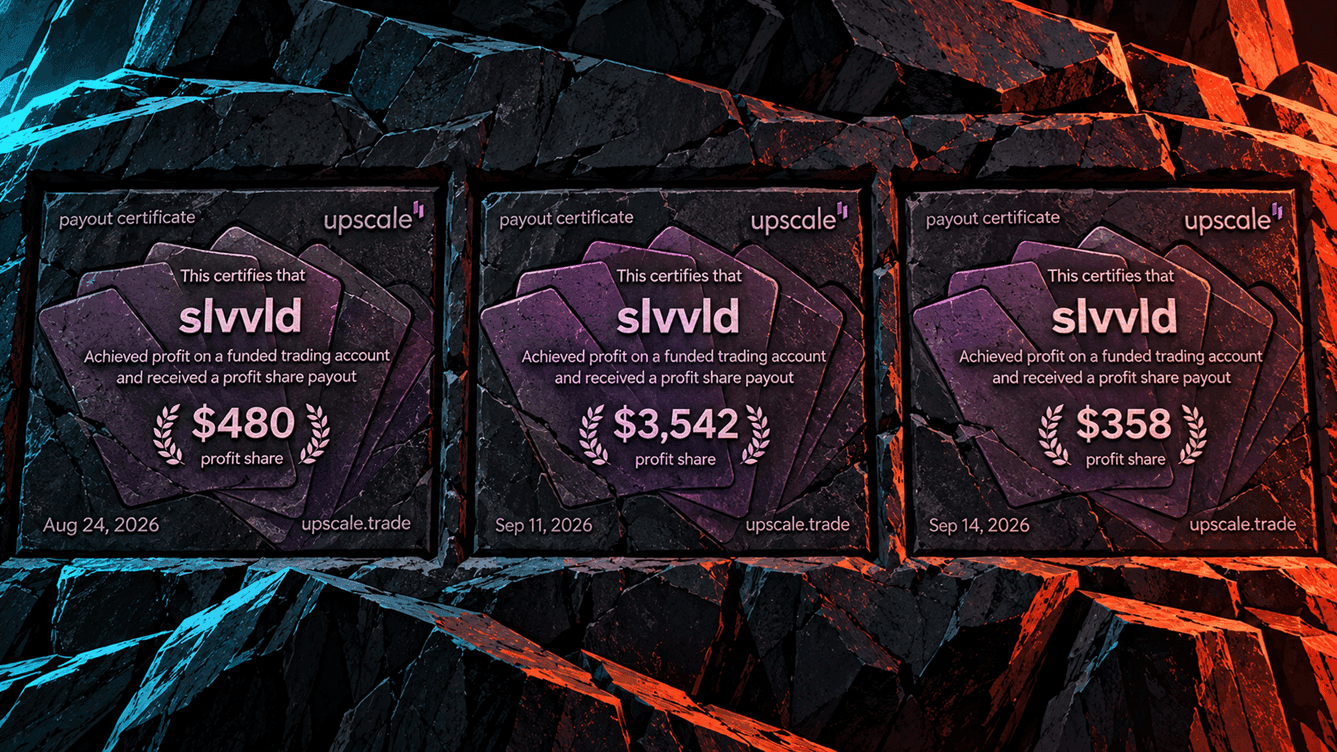
Vlad's payouts: $480 (August 24, 2026) and $358 (September 14, 2026) from the $5,000 account, and $3,542 (September 11, 2026) from the $100,000 account won in the tournament. Total: $4,380.
Verification
Vlad's results are verified by:
- An interview on the Upscale YouTube channel
- 3 Upscale payout certificates
All Upscale payouts are made on-chain and can be independently verified on the blockchain.
Key takeaways
Vlad's story is about how behavior changes when the stakes change. For five years, he traded small deposits that didn't matter and blew them again and again trying to win his losses back. The $5,000 account was the first money he couldn't bear to lose: every challenge stage started in the red, but he steadily worked his way out and ended up with three payouts totaling $4,380 between mid-August and mid-September 2026.
The second takeaway is about risk management instead of strategy. Vlad has no formal system: he trades ranges, mostly on bitcoin, and leans on the views of macroeconomic analysts. But every trade has a stop-loss and a take-profit, and he more often takes profit before the target so as not to give in to greed. Even his tournament success, second place with $500 and a $100,000 account from which he withdrew $3,542, came from being willing to take a risk only where the worst outcome was clear in advance.
The third takeaway is about being honest with yourself. Vlad calls himself survivorship bias until he gets his next payout and admits that it's difficult right now. His advice is simple: start with the simplest account and the demo, risk a small percentage of the balance per trade and rethink your attitude to money. His other steps, buying a challenge with your last money or trading with other people's money, are not worth repeating: only risk what you can afford to lose.
Start now: 👉 Upscale.trade | Telegram Bot
Follow us: 📺 YouTube | 𝕏 Twitter
Community: 💬 Telegram chat | 🎮 Discord
Frequently Asked Questions
How much has Vlad earned on Upscale?
$4,380 across three payouts: $480 (August 24, 2026) and $358 (September 14) from the $5,000 account, and $3,542 (September 11) from the $100,000 account he won in a tournament. On top of that, he received $500 in prize money for second place in the tournament.
How did Vlad win a $100,000 account?
He took second place in an Upscale tournament. Under that tournament's terms, second place came with $500 and a $100,000 challenge, while first place didn't, so Vlad was glad to be overtaken. He took the $100,000 challenge to the funded stage and withdrew $3,542 from it.
What strategy does Vlad trade?
By his own account, he has no formal strategy. He trades ranges, buying near the lower boundary and selling near the upper one, takes into account the views of macroeconomic analysts and opens about 90% of his trades on bitcoin. The core of his trading is risk management: a stop-loss and a take-profit on every trade and the habit of taking profit before the target.
Why does Vlad mostly trade bitcoin?
In his words, bitcoin is the least volatile compared to altcoins, and all major news is reflected on it first. That makes bitcoin's moves easier for him to understand and the risk lower.
Why did prop trading work for Vlad when the exchange didn't?
On the exchange, he traded small amounts that didn't matter, and after a series of mistakes he would try to win his losses back, which ended in a blown account every time. The $5,000 account was the first money he couldn't bear to lose, and he started handling it with extreme care.
What does Vlad advise beginners?
Start with the simplest account and try the demo, where some tournaments are free to enter. Risk a small percentage of the balance per trade. And rethink your attitude to money: prop trading, in his words, is a chance to turn a passion for trading into something real.
Should you buy a challenge with your last money, like Vlad did?
No. Vlad himself calls himself survivorship bias until he gets his next payout, and most traders fail their challenge. Only risk money you can afford to lose, and don't trade with borrowed money.