Intraday Trading: Strategies, Risk Rules, Examples | Upscale

Intraday trading means opening and closing all positions within the same trading session — nothing stays open overnight. This distinguishes it from swing trading (days to weeks), position trading (weeks to months), and investing (months to years). The core appeal is speed of feedback: an intraday trader knows within hours whether a decision was correct. Research by Locke and Mann (2005) at the Chicago Mercantile Exchange found that traders who cut losses faster earned on average 65% more per year — and intraday trading, by its nature, forces faster decisions on every position. A study of Brazilian day traders (Chague, De-Losso, Giovannetti, 2020) found that 97% of those who persisted for more than 300 days lost money, with the primary causes being psychological rather than strategic — revenge trading, overtrading, and failure to respect stop-losses. For prop traders, intraday trading aligns naturally with funded account structures: the daily drawdown limits that define account survival (typically 5% on Basic accounts) enforce the exact discipline that Locke and Mann's research associates with higher earnings. According to a PipFarm survey of 2,777 prop traders (2025), 45.1% of successful traders make only 1–2 trades per day — fewer trades with proper risk management consistently outperforms higher volume with loose controls.
Intraday Trading vs Other Styles
The trade-offs between intraday trading and other approaches are structural, not preferential — each demands a different skill set applied to a different time horizon.
| Aspect | Intraday Trading | Swing Trading | Investing |
|---|---|---|---|
| Holding period | Minutes to hours | Days to weeks | Months to years |
| Analysis type | Technical, price action | Technical + macro | Fundamental |
| Decision speed | Seconds | Hours to days | Weeks |
| Profit target per trade | 0.5–3% (commonly cited range) | 5–15% | 10–30% annually |
| Risk management | Stop-loss essential | Stop-loss + time stops | Portfolio diversification |
| Overnight risk | None | Present | Present |
Intraday trading demands more screen time, faster execution, and stronger emotional control than longer-term approaches. It eliminates overnight gap risk entirely — a significant advantage on cryptocurrency markets that trade 24/7, where weekend liquidity drops and unexpected news events can produce 5–10% overnight moves that swing traders and position holders absorb but intraday traders avoid completely.
On the other hand, the compressed time horizon means that slippage and execution quality have disproportionate impact on results. A 0.1% slippage per trade that a swing trader barely notices compounds into a meaningful cost for an intraday trader executing 5–10 trades per session.
Proven Intraday Strategies
No single strategy works in all market conditions. Successful intraday traders typically master one approach before adding others.
Momentum Trading
Momentum trading captures strong directional moves. Price breaks a key level, volume surges, and the trader enters in the direction of the breakout.
Key confirmation signals: volume exceeding the 20-day average, price closing above (not just wicking through) resistance, and the ADX reading above 25 indicating trend strength. Without these confirmations, most breakouts fail — a PipFarm survey of 2,777 prop traders (2025) found that 37.8% cite lack of discipline as their primary cause of failure, often from entering momentum trades without proper confirmation.
For a detailed breakdown of eight momentum and scalping setups with specific entry criteria and prop-trading context, see the best scalping strategies guide.
Reversal Trading
Reversal trading captures rebounds from overextended moves. The market pushes too far, too fast, and snaps back. This is higher-risk than momentum trading because the trader enters against the prevailing direction.
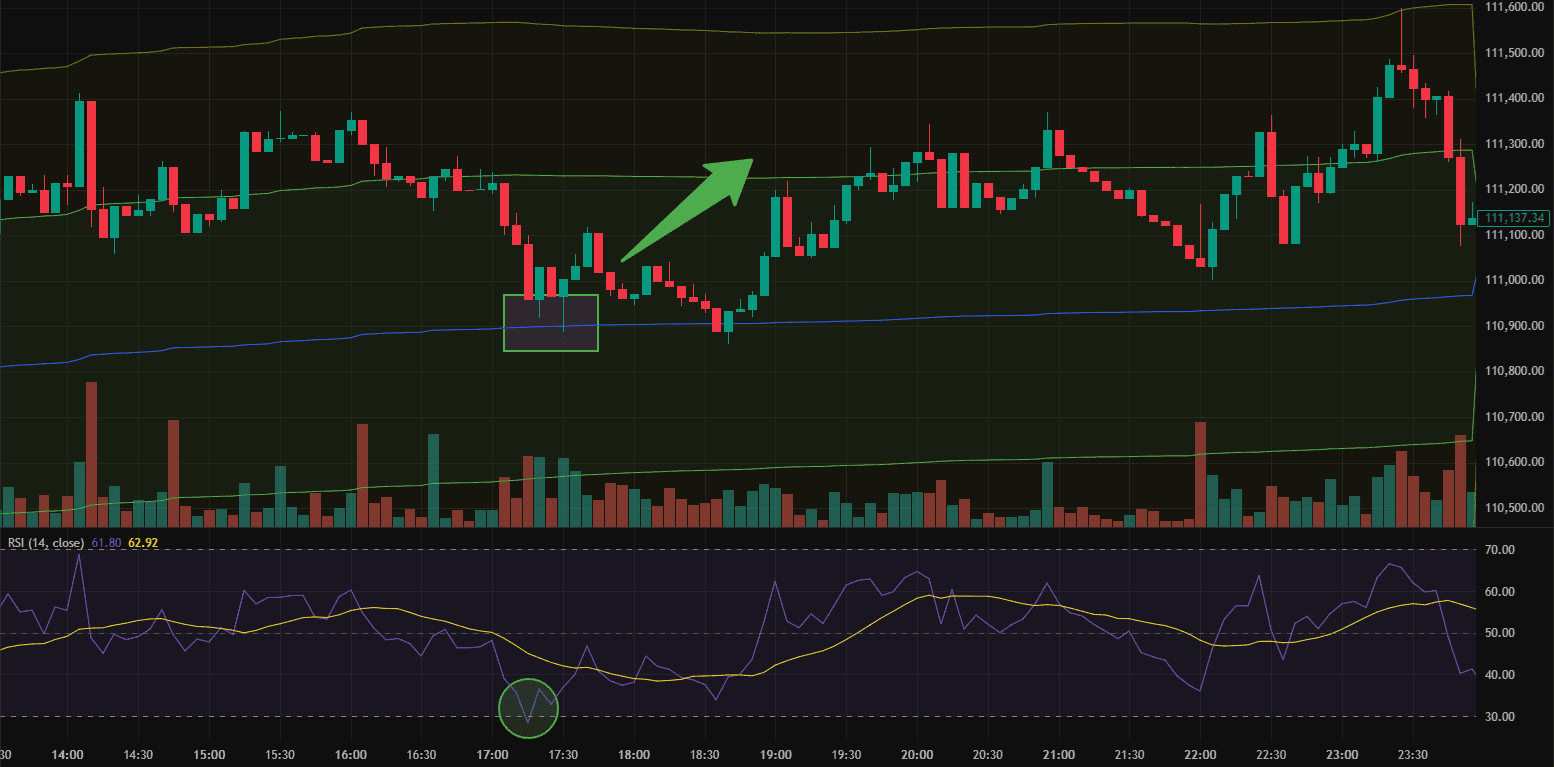
The process: identify oversold RSI readings (below 30), confirm with bullish divergence on at least one indicator, wait for a reversal candlestick pattern (pin bar, engulfing), and enter with a tight stop below the recent low. Position sizes should be 50–75% of standard because the trade is against momentum. Traders using Smart Money Concept frameworks identify institutional order blocks at reversal zones, adding confluence to the setup.
Breakout Trading
Breakout trading profits from the explosive moves that follow consolidation periods. Price compresses in a range (triangle, rectangle, wedge), energy builds, and eventually price breaks out.
The critical filter: volume. Genuine breakouts show volume spikes of 50% or more above the 20-day average. Without volume confirmation, the probability of a false breakout increases dramatically. Waiting for the retest of the broken level before entering filters out roughly half of false signals. Fair Value Gaps often form during genuine breakouts as aggressive order flow creates price imbalances — their presence confirms institutional participation in the move.
Scalping
Scalping means taking small profits repeatedly on trades lasting seconds to minutes. Targets are 5–10 pips or $0.10–0.20 per share. The edge comes from volume of trades, not size of individual wins.
Requirements: direct market access, sub-second execution, and a platform that supports hot keys for instant orders. Scalping on a mobile phone or slow platform is not viable — execution speed is the strategy itself. Slippage is the primary cost concern: as detailed in the slippage guide, a prop trader on a $25,000 account executing 10 scalps per day at $15 average slippage burns 12% of the daily drawdown budget on execution friction alone.
Among Upscale's funded traders, Maru Joshua uses a scalping approach on Bitcoin 15-minute timeframes with 1–3 trades per day — the strict trade count limit is specifically designed to cap slippage exposure while maintaining edge.
Range Trading
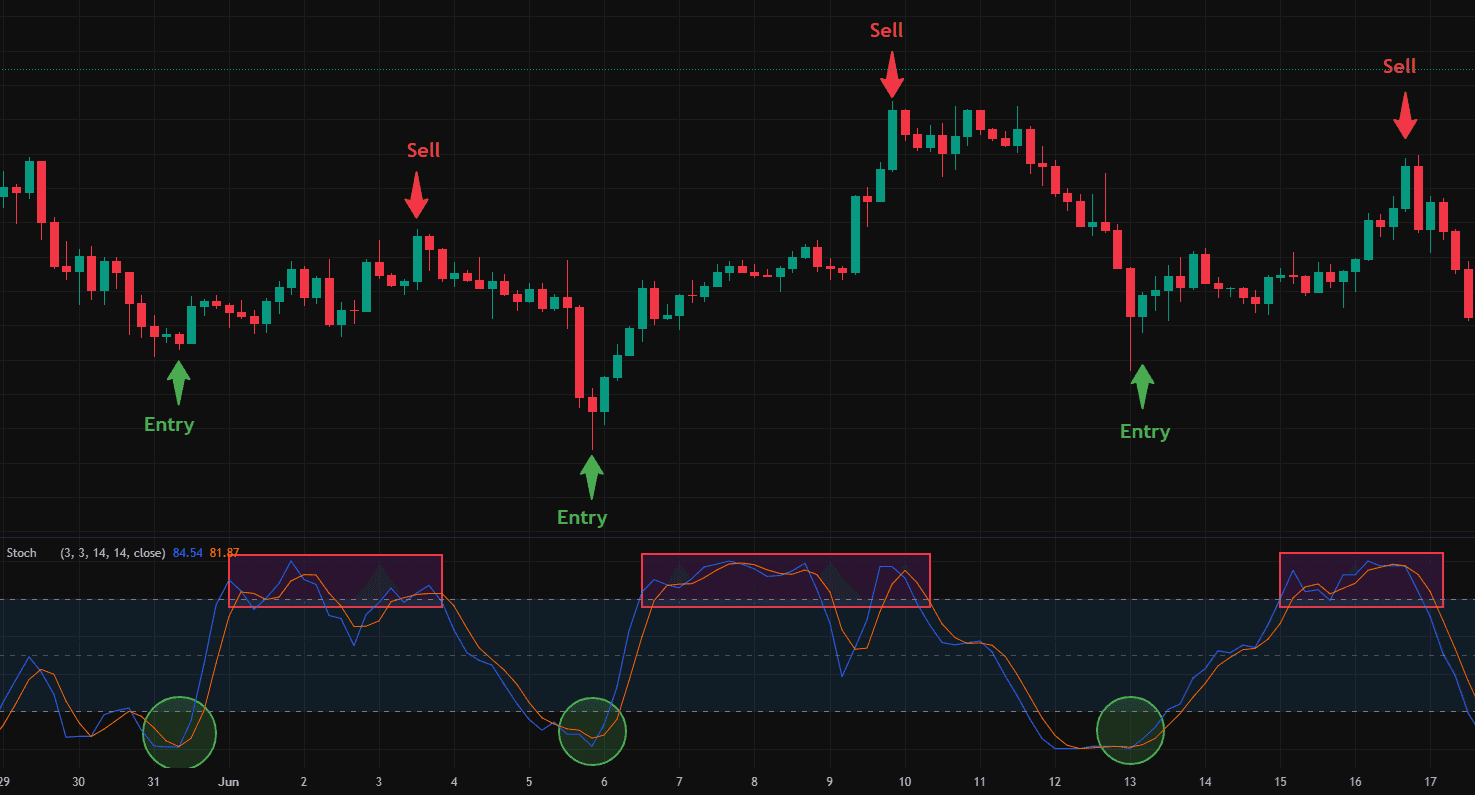
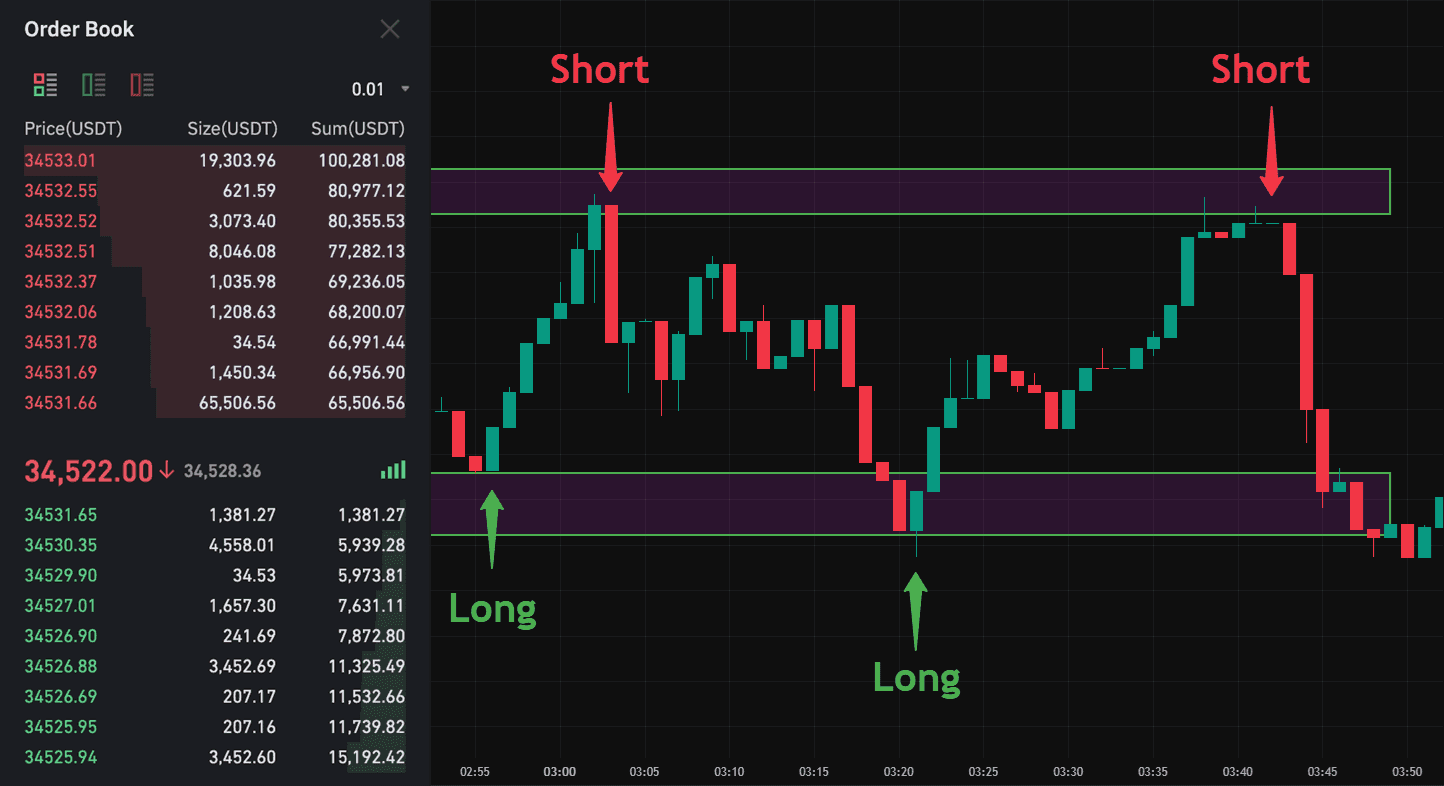
Range trading works when markets move sideways between defined support and resistance levels. Buy at support, sell at resistance, repeat until the range breaks.
Stochastic oscillator and RSI work well here: readings below 20–30 signal buys near support, above 70–80 signal sells near resistance. The key risk: the range eventually breaks, and if the trader is positioned for a bounce when the breakout happens, losses can be sudden.
Asset Selection for Intraday Trading
The instrument traded matters as much as the strategy used.
Liquidity is non-negotiable. Easy entries and exits without significant slippage require adequate market depth. For stocks, this means average daily volume above 1–2 million shares. For crypto, this means sticking to majors: BTC, ETH, SOL, and top-20 altcoins by market cap.
Volatility creates opportunity but also risk. The sweet spot is instruments with 2–4% average daily range (ATR). Below 2%, there's not enough movement to profit after fees. Above 4%, the risk of sudden adverse moves increases disproportionately. Bitcoin typically offers an ATR well within this productive range during active sessions, while many altcoins exceed it — making them suitable for experienced traders but dangerous for beginners.
Spread directly impacts profitability. For scalpers especially, tight spreads are essential. Bitcoin typically offers the tightest spreads in crypto; forex majors (EUR/USD, GBP/USD) offer the tightest in currencies. Platforms using oracle-based pricing like Pyth Network — including Upscale's TradingView terminal — reduce the cross-venue price divergence that can create artificial slippage.
Session structure varies by market. Traditional equities have defined sessions (NYSE 9:30 AM – 4:00 PM ET) with predictable volume patterns — maximum volatility at open and close, reduced liquidity midday. Cryptocurrency markets trade 24/7, but liquidity still varies: Asian, European, and US session overlaps produce different volume characteristics. Understanding these patterns is essential for timing entries — a concept explored in depth in the VWAP trading guide, where session-based vs. anchored VWAP application depends on exactly this session structure awareness.
Risk Management: The 2% Rule and Beyond
Research consistently shows that risk management — not strategy selection — is the primary determinant of long-term trading survival. According to Barber and Odean (2000), the average individual investor underperforms the market by 2–5% annually, largely due to poor risk control and emotional decision-making. For a deeper exploration of how drawdown arithmetic works and why recovery from losses is nonlinear, see the maximum drawdown guide.
The 2% Rule
The standard risk management framework: never risk more than 2% of account equity on a single trade. For a $10,000 account, maximum risk per trade is $200.
Position sizing calculation:
- Account: $10,000
- Risk per trade: $200 (2%)
- Stop-loss distance: $0.50
- Position size: 400 shares ($200 ÷ $0.50)
This math should be automatic before every entry. Most professional prop traders use 1% rather than 2%, giving themselves a wider margin for consecutive losses before approaching daily drawdown limits.
Layered Risk Limits
Professional traders use multiple layers of protection:
- Per-trade risk: maximum 1–2%
- Daily loss limit: maximum 4–6% (2–3 losing trades, then stop)
- Weekly loss limit: maximum 8–10%
- Correlation risk: avoid multiple positions in the same direction on correlated instruments
A PipFarm survey of 2,777 prop traders found that 45.1% of successful traders make only 1–2 trades per day. Fewer trades with proper risk management consistently outperforms higher volume with loose controls. Albert, one of Upscale's funded traders profiled in the success stories collection, enforces a strict one-trade-per-day rule — a self-imposed constraint that functions as an additional risk layer beyond the platform's built-in limits.
Stop-Loss Discipline
According to FPFX Tech data, 73% of failed prop accounts violated their own stop-losses in more than 30% of cases. This single metric explains more account failures than any strategy flaw.
Rules: set the stop-loss before entering. Never move it further from entry. If stopped out, the trade is over — no re-entering the same idea without a new setup. For a detailed discussion of how stop-market orders execute and the slippage implications during adverse moves, see the trailing stop orders guide.
Technical Analysis Essentials
The most effective intraday traders use fewer indicators, not more. Three maximum: one for trend direction, one for momentum/overbought-oversold conditions, and volume for confirmation.
VWAP (Volume Weighted Average Price) dominates institutional intraday trading. Price above VWAP is bullish; below is bearish. Most intraday reversals happen at VWAP. It's the single most useful indicator for day trading — covered in depth with formula, worked example, and strategy frameworks in the VWAP trading guide.
Moving averages (20 EMA for intraday, 50 EMA for context) show trend direction. Trading in the direction of the moving average slope — rather than against it — reduces the frequency of false signals significantly.
RSI on the 14-period setting identifies overbought (above 70) and oversold (below 30) conditions. Most useful in range-bound markets; less reliable in strong trends where overbought conditions can persist for extended periods.
Price action — candlestick patterns, support/resistance levels, and market structure — remains the foundation. Indicators confirm what price action suggests, not the other way around. Traders who base entries on indicator readings alone without price action context typically experience higher false signal rates.
The Daily Framework: Before, During, and After
Pre-Market (30–60 minutes before session)
Review the economic calendar for scheduled events (Fed announcements, CPI releases, earnings). Identify overnight market movements and gap levels. Mark key support and resistance on primary instruments. Set alerts at zones of interest. Define maximum trades for the day — 2–3 for most traders, consistent with the PipFarm data showing that 1–2 trades per day is the most common frequency among profitable prop traders.
For crypto markets, there is no formal "pre-market" — but the equivalent routine applies before each active session (European open, US open). Check overnight funding rates, liquidation cascades, and any major news.
During the Session
The first 30–60 minutes of any major session offer maximum volatility — and maximum risk. Many professionals wait 15–30 minutes after the session open for the initial noise to settle before taking their first trade.
Midday in US equities (roughly 11:00 AM – 1:00 PM ET) typically sees reduced volume and choppy price action. Experienced traders often avoid this window entirely. In crypto markets, the equivalent is the transition period between Asian and European sessions where liquidity may thin temporarily.
The final hour of equity sessions sees institutional position squaring and renewed volume. Setups tend to be cleaner, but time pressure increases. Crypto has no equivalent "close," but the US session close often triggers a brief consolidation in BTC and ETH as equity-correlated institutional flow subsides.
Post-Market (15–30 minutes after session)
Review every trade taken. Screenshot setups for the trading journal. Rate each decision on a 1–5 quality scale independent of outcome. Track plan adherence percentage — this metric matters more than daily P&L for long-term improvement.
The distinction between outcome quality and decision quality is critical. A trade that followed the plan perfectly but lost money was a good decision; a trade that violated the plan but happened to profit was a bad decision. Journaling both reveals whether the trading edge is real and whether discipline is improving.
Psychology: Why Most Day Traders Fail
The failure rate in day trading is well-documented. The Brazilian day traders study (Chague, De-Losso, Giovannetti, 2020) found that 97% of those who persisted for more than 300 days lost money. The primary causes are psychological, not strategic.
Revenge trading — attempting to recover losses immediately after a losing trade — is the single most destructive behavioral pattern. Jared Tendler, author of "The Mental Game of Trading," classifies this as "desperation tilt" and recommends a hard rule: after 2–3 consecutive losses, take a mandatory 30-minute break from the screen. For a comprehensive framework on managing tilt and its variants, see the trading tilt guide.
Overtrading destroys accounts through accumulated fees and poor-quality entries. The PipFarm data is clear: 45.1% of successful prop traders make just 1–2 trades per day. Quality over quantity.
FOMO (Fear of Missing Out) causes entries without proper setups. The market offers hundreds of opportunities daily — missing one is irrelevant. Entering one bad trade costs real money.
Post-win overconfidence is equally dangerous. Barber and Odean (2000) found that traders who traded most actively earned 6.5 percentage points less annually than the market average — often because winning streaks created false confidence leading to oversized positions. The psychology of loss acceptance and the counterintuitive advantage of embracing losses quickly is explored in the Best Loser Wins mindset guide.
Intraday Trading in Prop Firms
Prop trading addresses two of the biggest barriers to successful day trading: insufficient capital and lack of external discipline.
A trader with a proven intraday strategy on a $1,000 personal account can apply the same edge to a $50,000–$200,000 funded account. The same 2% daily return yields $20 on personal capital versus $1,000–$4,000 on a prop account — with risk limited to the challenge fee rather than the entire balance.
Built-in drawdown limits (5% daily, 10% total on Basic accounts) enforce the exact discipline that most traders fail to maintain on their own. According to Locke and Mann (2005), this kind of structural constraint directly correlates with higher earnings — traders who are forced to cut losses quickly outperform those who have unlimited latitude to hold losing positions.
Among Upscale's funded traders, intraday approaches dominate: Joshua's 1–3 trades per day on Bitcoin 15M, Albert's one-trade-per-day rule on crypto, and Anton's price action entries with fast loss-cutting. The common thread is not the specific strategy but the discipline of controlled trade frequency and rigorous stop-loss adherence — the two factors that the academic literature most consistently associates with survival and profitability in short-term trading.
For intraday traders evaluating prop platforms specifically, key features to compare: execution speed, available instruments and their spreads, drawdown protection mechanics, and whether the platform imposes restrictions on scalping or news trading (some prop firms do; Upscale's participation requirements allow both).
Getting Started: A Realistic Timeline
Month 1–3: Education. Read at minimum "Trading in the Zone" (Mark Douglas) and "The Mental Game of Trading" (Jared Tendler). Study one strategy in depth. Watch markets daily without trading.
Month 4–6: Demo trading. Apply the chosen strategy on a demo account. Track every trade in a journal. Aim for 100+ demo trades before risking real money.
Month 7–9: Small live trading. Start with minimum position sizes. Focus on execution quality, not P&L. The goal is plan adherence above 70%.
Month 10–12: Gradual scaling. If demo results are consistently positive and plan adherence is stable, begin increasing position sizes or consider a prop challenge to access larger capital without risking personal savings.
This timeline is optimistic. Most consistently profitable traders took 1–3 years to reach that point. Rushing the process is itself a form of poor risk management — and the prop trading model is specifically designed for traders who have already completed this learning curve and need capital, not education.
Key Takeaways
Intraday trading is a specific skill set applied to a specific time horizon — not inherently superior to swing trading or investing, but structurally different in ways that matter for execution. The elimination of overnight risk, the speed of feedback, and the forced decision-making on every position within hours rather than days create a trading environment where discipline compounds faster than in any other style: disciplined traders improve rapidly, and undisciplined traders blow accounts rapidly. The academic evidence is consistent on what separates the two groups — Locke and Mann (2005) at the CME found faster loss-cutters earned 65% more annually, and FPFX Tech data shows that 73% of failed prop accounts violated their own stop-losses in more than 30% of cases. The strategy matters far less than the discipline of executing it.
The failure rate is real and should not be minimized. The Brazilian day traders study found 97% of persistent day traders lost money, and the primary causes were psychological — revenge trading, overtrading, FOMO, and post-win overconfidence — not strategic. The traders who survive and profit are those who treat risk management as the strategy itself: 1–2% maximum risk per trade, daily loss limits enforced without exception, and trade frequency controlled deliberately. According to the PipFarm survey of 2,777 prop traders, 45.1% of successful traders make just 1–2 trades per day. The implication is clear: fewer, higher-quality trades with strict risk controls consistently outperforms high-frequency execution with loose discipline.
For traders who have developed a proven intraday edge through the months or years of practice the timeline demands, prop trading provides the capital and structural discipline to scale that edge without proportional personal risk. The daily drawdown limits built into funded accounts (5% on Basic, 3% on Accelerated) replicate exactly the kind of structural constraint that the academic literature associates with higher earnings — and the funded capital ($25,000–$200,000 on Upscale) transforms the same 2% daily return from $20 on personal capital to $500–$4,000 on a funded account. The path is not fast, not easy, and not guaranteed — but for traders who have done the work, the infrastructure exists.
Start now: 👉 Upscale.trade | Telegram Bot
Follow us: 📺 YouTube | 𝕏 Twitter
Frequently Asked Questions
What is intraday trading?
Intraday trading means opening and closing all positions within the same trading session — nothing is held overnight. This eliminates overnight gap risk but requires faster decision-making, more screen time, and stronger emotional control than longer-term approaches. The time horizon ranges from minutes to hours, and the analysis is primarily technical (price action, indicators, volume) rather than fundamental. Research by Locke and Mann (2005) at the Chicago Mercantile Exchange found that traders who cut losses faster earned on average 65% more per year, which makes intraday trading — with its forced decision speed — a natural fit for disciplined risk managers.
How does intraday trading differ from swing trading?
Holding period is the primary distinction: intraday positions last minutes to hours, swing positions last days to weeks. This creates downstream differences in risk profile (no overnight risk for intraday, overnight gap risk for swing), analysis type (intraday is purely technical, swing incorporates macro context), and the impact of execution costs (slippage and spreads compound more at higher trade frequency). Neither is inherently better — intraday suits traders who want immediate feedback and can dedicate active screen time, while swing trading suits those who prefer fewer decisions with larger profit targets per trade.
What are the most common intraday trading strategies?
Five core approaches: momentum trading (capturing strong directional moves on volume breakouts), reversal trading (entering against overextended moves at extreme RSI or divergence signals), breakout trading (profiting from explosive moves following consolidation), scalping (repeated small profits on trades lasting seconds to minutes), and range trading (buying at support, selling at resistance in sideways markets). Most successful intraday traders master one strategy before adding others — attempting multiple strategies simultaneously without expertise in any is a documented cause of failure. A PipFarm survey of 2,777 prop traders found that 37.8% cite lack of discipline as their primary failure cause, often from applying strategies without proper confirmation filters.
How much capital is needed for intraday trading?
On a personal account, the minimum depends on the market: US equities require $25,000 to avoid Pattern Day Trader restrictions, crypto has no regulatory minimum, and forex can be started with as little as $100–500 on leverage. However, small accounts face a mathematical challenge — the same percentage gain yields trivially small absolute returns. Prop trading addresses this directly: a challenge fee of $59–500 can unlock $5,000–$200,000 in funded capital, allowing the same strategy to produce meaningfully larger returns. The trade-off is that funded accounts impose drawdown limits that enforce discipline but restrict risk tolerance.
What is the 2% rule in intraday trading?
The 2% rule means never risking more than 2% of account equity on a single trade. For a $10,000 account, maximum risk per trade is $200 regardless of conviction level. Position sizing follows from this: if the stop-loss is $0.50 from entry, the maximum position is 400 shares ($200 ÷ $0.50). Most professional prop traders use 1% rather than 2% to give themselves wider margin for consecutive losses. This single rule, applied without exception, prevents the catastrophic drawdowns that eliminate accounts — Barber and Odean (2000) documented that poor risk control is the primary reason individual investors underperform by 2–5% annually.
Why do most day traders lose money?
The failure rate is documented: a study of Brazilian day traders (Chague, De-Losso, Giovannetti, 2020) found that 97% of those who persisted for more than 300 days lost money. The primary causes are psychological: revenge trading after losses (attempting to recover immediately, usually with oversized positions), overtrading (PipFarm data shows successful traders make just 1–2 trades per day while unsuccessful ones trade far more frequently), FOMO-driven entries without proper setups, and post-win overconfidence leading to oversized positions. According to FPFX Tech, 73% of failed prop accounts violated their own stop-losses in more than 30% of cases — the strategy was not the problem, the discipline was.
How does intraday trading work in prop firms?
Prop firms provide funded capital ($10,000–$200,000+) to traders who pass an evaluation challenge. The trader applies their intraday strategy to the funded account and keeps 70–90% of profits (80–90% on Upscale depending on tier). Built-in drawdown limits (typically 5% daily, 10% total) enforce the risk discipline that most traders fail to maintain independently. For intraday traders specifically, the key advantages are: capital scaling (the same 2% daily return yields $20 on a $1,000 personal account vs. $1,000 on a $50,000 funded account), structural discipline (external drawdown limits replicate the constraints that academic research associates with higher earnings), and reduced personal financial risk (the trader risks the challenge fee, not the trading capital).
What technical indicators are most useful for intraday trading?
Three indicators cover the essential dimensions: VWAP (Volume Weighted Average Price) for intraday fair value and institutional reference — price above VWAP is bullish, below is bearish, and most intraday reversals occur at VWAP. Moving averages (20 EMA for intraday trend, 50 EMA for context) show trend direction — trading with the moving average slope rather than against it reduces false signals. RSI (14-period) identifies overbought/oversold conditions in range-bound markets, though it's less reliable in strong trends. The foundational layer is price action itself — candlestick patterns, support/resistance levels, and market structure. Indicators confirm what price action suggests, not the other way around. Using more than three indicators simultaneously typically increases confusion rather than accuracy.