No-KYC Prop Trading: Funded Capital Without a Passport | Upscale


No-KYC crypto exchanges are well-documented — Coin Bureau, Koinly, and dozens of comparison sites maintain updated lists of platforms where traders can swap assets without uploading a passport. No-KYC prop trading is a fundamentally different category that barely exists yet. The distinction matters: an exchange lets you trade your own money without identification; a no-KYC prop firm gives you access to funded capital — $10,000 to $200,000 — without identification. The second proposition is structurally more valuable for traders who have skill but lack capital, and structurally more controversial because the firm is allocating its own resources based solely on demonstrated trading performance rather than identity verification. As of 2026, KYC requirements across major centralized exchanges have intensified — Binance, Coinbase, Kraken, and Bitget all require at least basic identity verification for meaningful trading activity, while the EU's MiCA framework has pushed enforcement further, with France issuing 14 enforcement notices in Q4 2025 alone targeting exchanges operating without authorization. Meanwhile, non-custodial swap volumes surged over 340% year-over-year according to DeFiLlama and Dune Analytics data — the market is voting clearly on which direction it prefers. This article examines why no-KYC prop trading represents a distinct category from no-KYC exchanges, who it serves, what risks it carries, and how to evaluate whether a no-KYC prop firm is structurally sound or cutting corners.
No-KYC Exchange vs No-KYC Prop Firm: Different Categories
A no-KYC exchange removes identity verification from the process of trading your own capital. You connect a wallet, deposit crypto, and trade. The exchange never holds your identity documents because it operates as a swap facilitator — your money in, your money out. The risk profile is symmetric: you risk your own capital, and the exchange risks nothing beyond its reputation.
A no-KYC prop firm removes identity verification from the process of accessing someone else's capital. You connect a wallet, purchase a challenge, demonstrate trading skill, and receive a funded account with $10,000–$200,000. The firm never holds your identity documents, but it does hold the trading capital and pays out profits based solely on performance. The risk profile is asymmetric: the firm risks its capital on a trader it cannot identify by passport — only by wallet address and trading results.
This asymmetry is why no-KYC prop trading barely exists as a category. Most prop firms require KYC not because regulation demands it (prop firms trading their own capital typically don't fall under the same licensing requirements as exchanges or brokers), but because identity verification feels like a necessary safeguard when allocating capital to strangers. The firms that operate without KYC have made a deliberate architectural choice: trading performance is a more reliable predictor of future behavior than passport data.
The contrastive pair that defines this category: a KYC-gated prop firm verifies who you are before letting you prove what you can do. A no-KYC prop firm verifies what you can do and considers that sufficient.
The Access Problem: Who Needs No-KYC Prop Trading
The question "why would a legitimate trader avoid KYC?" carries an assumption — that KYC is a minor inconvenience rather than a structural barrier. For traders in certain circumstances, that assumption is wrong.
Geographically restricted traders
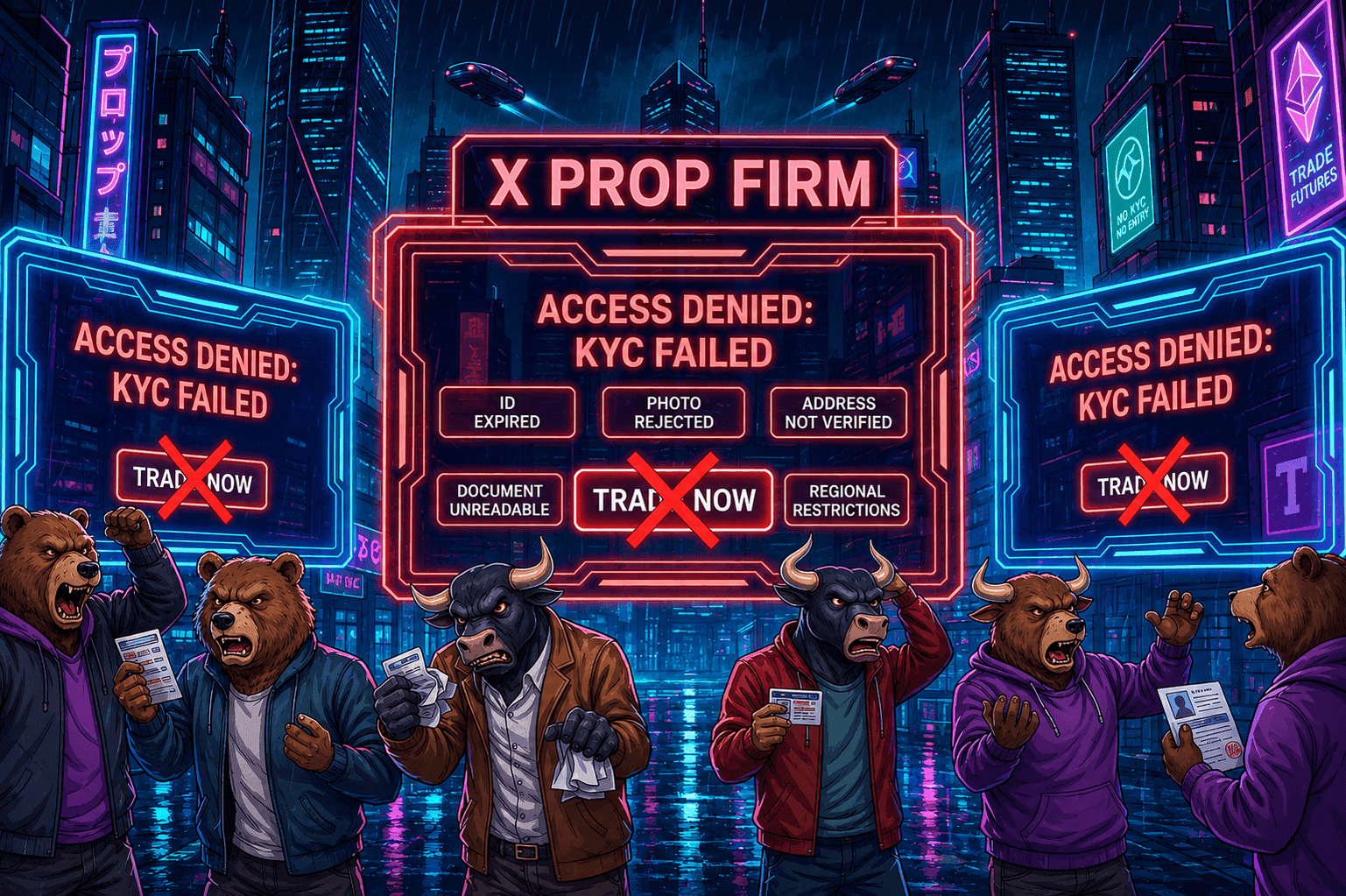
FTMO — the industry's largest prop firm — has blocked traders from Russia and several other countries since 2022. FundedNext restricts futures services for Russian traders. The list of restricted jurisdictions across KYC-gated prop firms covers populations in the hundreds of millions. These aren't traders trying to evade regulation — they're traders whose government's geopolitical position has eliminated their access to funded trading capital through no action of their own.
A trader in Moscow with five years of experience and a proven 6% monthly return has identical trading skill to a trader in London with the same track record. KYC-gated prop firms cannot serve the first trader. No-KYC prop firms can — because wallet-based access doesn't discriminate by passport.
Underbanked and underdocumented traders
The World Bank estimates that approximately 1.4 billion adults globally remain unbanked — without access to formal financial accounts. In regions across Sub-Saharan Africa, South Asia, and Southeast Asia, obtaining the documentation required for KYC (government-issued photo ID, proof of address via utility bill, bank statement) ranges from difficult to impossible. A talented trader in Lagos or Dhaka who learned technical analysis on a phone screen and backtested strategies for months cannot access KYC-gated prop firms — not because they lack skill, but because they lack documents.
No-KYC prop trading doesn't solve the unbanked problem broadly. But it does create a specific path: demonstrated trading skill → funded capital → crypto payouts to a wallet — entirely outside the documentation requirements that would otherwise exclude these traders from professional-grade capital access.
Privacy-conscious traders in functional jurisdictions
Not every no-KYC user is geographically or financially excluded. Some are in jurisdictions with full banking access who prefer not to submit identity documents to multiple international platforms. With over $3.4 billion stolen in crypto hacks in 2025 according to Chainalysis — all from custodial platforms holding user data — the concern about identity documents being compromised in a data breach is not theoretical. Every KYC submission creates an attack surface. No-KYC eliminates that surface entirely.
As blockchain privacy researcher Marcus Henly of the University of Zurich noted: "The demand is not about evading regulation. It is about proportionality. A trader converting ETH to USDT should not need to provide the same documentation as someone opening a bank account."
The same logic applies to prop trading: a trader demonstrating profitability under defined risk parameters should not need to provide the same documentation as someone applying for a mortgage. The evaluation measures trading skill. A passport does not improve or degrade that measurement.
The Regulatory Landscape: Why No-KYC Prop Is Different From No-KYC Exchange
The regulatory environment for no-KYC crypto activity is tightening. The EU's MiCA framework now requires Crypto Asset Service Providers (CASPs) to implement full KYC. The US's FinCEN applies Travel Rule requirements to transfers above $3,000. Singapore's MAS has a threshold of 1,500 SGD. These are exchange-level regulations — they apply to platforms that custody user funds and facilitate trades between users.
Prop firms occupy a structurally different position. A prop firm trades its own capital and shares profits with traders who demonstrate skill. The firm is not a broker (it doesn't execute trades on behalf of clients), not an exchange (it doesn't match buyers and sellers), and not a custodian of client assets (the funded capital belongs to the firm, not the trader). This structural distinction means prop firms typically fall outside the regulatory frameworks that mandate KYC for exchanges and brokers.
This doesn't mean no-KYC prop trading is unregulated — it means the regulatory framework that applies to it is different from exchange regulation. The firm still has obligations around anti-money laundering to the extent it operates within jurisdictions that apply such rules broadly. But the specific KYC mandates targeting exchanges don't automatically extend to prop firms trading their own capital.
A critical distinction: no-KYC does not mean no rules. A well-run no-KYC prop firm still enforces strict trading rules — drawdown limits, position sizing requirements, minimum trading days — and pays out only to wallets that complete the evaluation process. The absence of passport verification doesn't mean the absence of verification entirely. The verification is performance-based rather than identity-based.
How No-KYC Prop Trading Actually Works
The architecture of a no-KYC prop firm replaces identity verification with wallet-based access and performance verification.
Step 1: Wallet connection. The trader connects a crypto wallet — not a bank account, not a verified identity, just a wallet address. This is the only "identity" the platform knows.
Step 2: Challenge purchase. The trader purchases an evaluation using crypto (USDT, TON, or other supported assets). No fiat on-ramps, no bank transfers, no payment processors that require identity verification. The entire transaction occurs on-chain or through crypto payment rails.
Step 3: Performance evaluation. The trader must hit profit targets while staying within drawdown limits — the same evaluation structure as KYC-gated prop firms. The rules don't change because KYC is absent. If anything, the evaluation is the replacement for KYC: instead of verifying who you are, the firm verifies what you can do.
Step 4: Funded account. Successful traders receive a funded account with the firm's capital. Trading continues under the same rules. The firm monitors risk in real-time.
Step 5: Payout. Profits are paid in crypto directly to the trader's wallet. No bank verification, no geographic restrictions on withdrawal, no multi-day settlement. The payout goes to the same wallet that entered the system.
The entire cycle — from entry to payout — occurs without the trader ever submitting an identity document. The firm's risk management relies on trading rules and real-time monitoring, not on knowing the trader's legal name.
How to Evaluate a No-KYC Prop Firm
The absence of KYC creates a legitimate question: if the firm doesn't verify trader identity, how does the trader verify the firm's legitimacy? The answer is structural evaluation — checking the architecture, not the marketing.
Payout verification. The single most important test. Does the firm have verifiable, public evidence of payouts to real traders? Certificates with dates and amounts, video interviews with funded traders, on-chain payout records — these are harder to fabricate than marketing claims. A firm with ten documented payout cases across multiple traders and months is structurally more credible than one with zero public evidence regardless of how polished its website looks.
Pricing infrastructure. What price feed does the firm use? Oracle-based pricing (aggregating across multiple exchanges through networks like Pyth Network) is structurally more trustworthy than single-exchange feeds that the firm could theoretically manipulate. If you can't verify the pricing source, the firm controls whether your stop-losses trigger.
Drawdown mechanics. Are the drawdown rules clearly documented and verifiable in real-time? Can you see your drawdown status during trading? Transparent risk parameters — published in documentation, not just mentioned in marketing — indicate a firm that operates systematically rather than arbitrarily.
Challenge economics. Does the pricing make business sense? A $59 challenge for a $5,000 account is sustainable. A $10 challenge for a $200,000 account is not — the economics require that the firm expects to deny funded accounts to recoup costs, which creates a structural incentive against the trader.
Support responsiveness. Can you reach a human who resolves issues? A firm that takes days to respond to basic questions will take weeks to resolve payout disputes. Test support before purchasing a challenge, not after.
Community verification. Do independent traders discuss the firm on Reddit, Telegram, Trustpilot? Is the sentiment mixed (realistic — no firm satisfies everyone) or uniformly negative (red flag) or uniformly positive with no specifics (astroturfed)?
Upscale: No-KYC as Architectural Decision
Upscale's no-KYC model is not an absence of compliance — it is a deliberate architectural decision that aligns the firm's structure with the crypto ecosystem's permissionless principles.

The hard NO: Upscale consciously rejected KYC not because the infrastructure doesn't exist, but because the firm's position is that banking restrictions, documentation barriers, and geographic limitations should not determine who can demonstrate trading skill and access funded capital. A crypto wallet is sufficient identity for a trading evaluation. This is a philosophical position materialized in architecture.
Against the evaluation framework:
Payout verification: Ten verified funded traders with published stories, certificates, and video interviews — Wade, Maru Joshua, Albert, Alexey, Ernest, and others documented in the verified success stories compilation. Payout amounts, dates, and certificates are public. This is the most extensive public payout documentation in the no-KYC prop trading category.
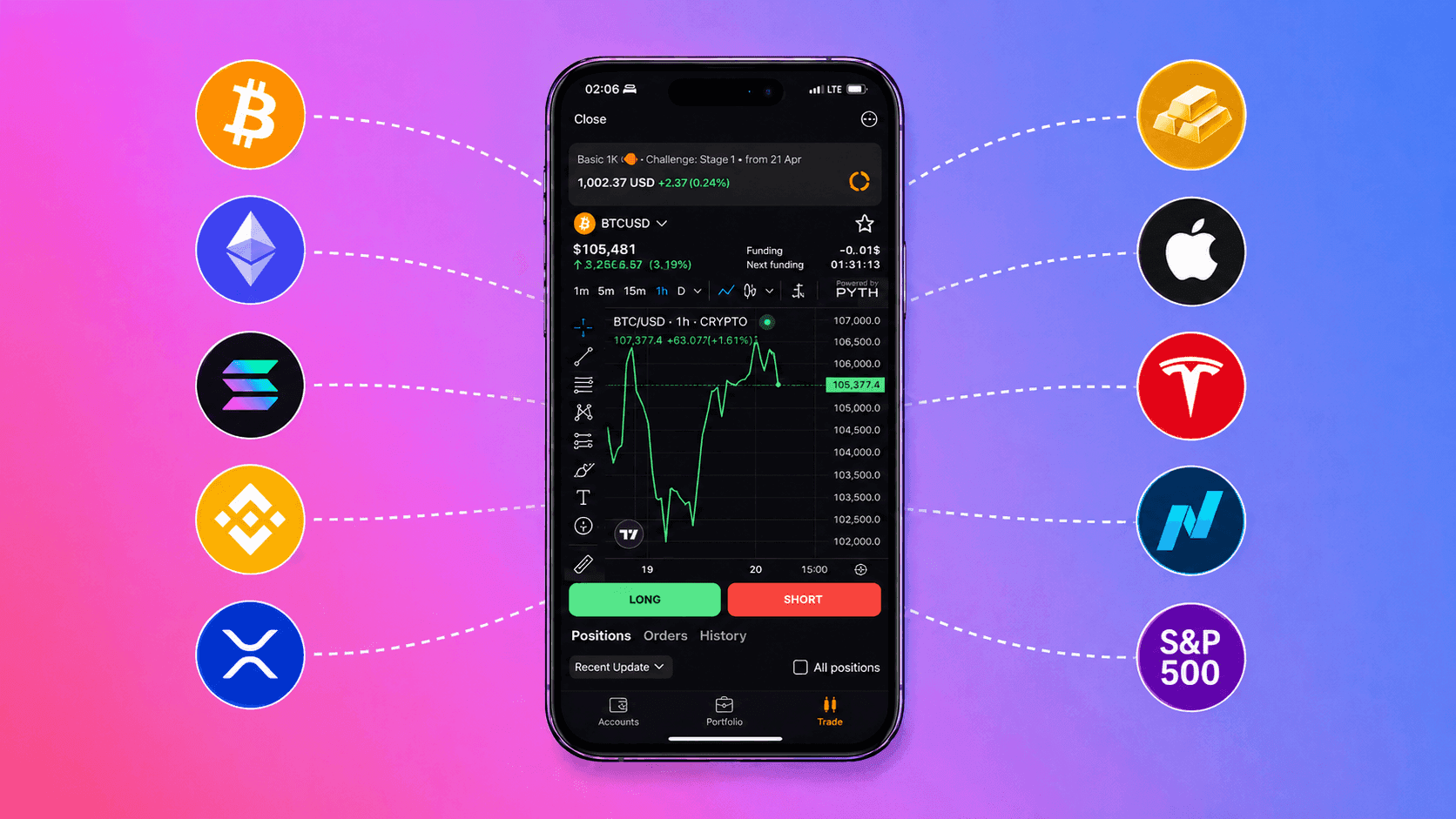
Pricing infrastructure: Oracle-based through Pyth Network, aggregating across multiple sources. Not single-exchange, not proprietary — decentralized and verifiable. Detailed in the crypto prop trading architecture guide.
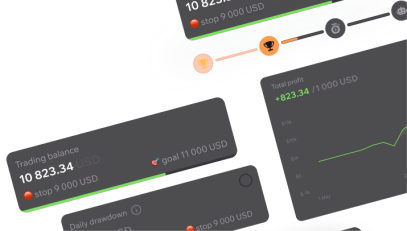
Drawdown mechanics: Fully documented in public GitBook documentation — Basic (5% daily / 10% total), Accelerated (3% daily / 6% total), Turbo (6% trailing from max balance). Real-time drawdown visibility in the trading interface.
Challenge economics: $59 minimum (RWA 5K Basic) to $1,599 maximum (200K Accelerated ALL). Pricing published transparently, not hidden behind registration walls.
Support: 24/7 via Telegram bot, Russian and English. Ernest, in his verified interview, specifically noted: "Technical support in Russian — very fast, all the guys respond. They won't leave you alone until your questions are answered."
Community: Active Telegram community and Discord server with real traders sharing results and discussing strategies.
The Risks: What No-KYC Doesn't Protect Against
Honest assessment of limitations is necessary for a complete picture.
Firm counterparty risk. Without KYC, the trader has no legal identity on file with the firm — which means dispute resolution is more difficult if the firm acts in bad faith. The mitigation: verify payout history before purchasing, start with minimum challenge sizes, and validate the complete payout cycle before scaling. Ernest's approach — starting with a $10,000 account, confirming payouts, then scaling to $200,000 — is the structural template for managing this risk.
Regulatory uncertainty. While prop firms currently occupy a different regulatory position than exchanges, regulatory frameworks evolve. A jurisdiction could extend KYC requirements to prop firms, forcing operational changes. The mitigation: firms operating from jurisdictions with clear virtual asset frameworks (UAE, for example) have more regulatory stability than those in jurisdictions actively tightening restrictions.
Tax responsibility remains. No-KYC does not mean no tax obligation. Traders are responsible for declaring income in their jurisdiction of residence regardless of whether the platform collected their identity. The platform's no-KYC policy affects the platform's compliance — not the trader's. This is a common misconception worth addressing explicitly.
No recourse for lost credentials. If a trader loses access to the wallet connected to their account, recovery options are limited compared to KYC-verified accounts where identity documents can restore access. The mitigation: standard crypto security practices — seed phrase backup, hardware wallet usage, and never connecting accounts to wallets whose keys aren't fully controlled.
Who Should — and Shouldn't — Use No-KYC Prop Trading
Strong fit:
- Traders in sanctioned or restricted jurisdictions who cannot access KYC-gated prop firms (Russia, Iran, certain African and Asian markets)
- Underdocumented traders with skill but without formal identification infrastructure
- Privacy-conscious traders who prefer to minimize identity exposure across platforms
- Crypto-native traders who operate entirely within the on-chain ecosystem and prefer wallet-based infrastructure
Poor fit:
- Traders who need fiat on-ramp support (no-KYC means crypto-only payment rails)
- Traders seeking regulatory protection and formal dispute resolution mechanisms
- Complete beginners who need the structured onboarding that KYC processes often accompany
- Traders in jurisdictions where engaging with no-KYC platforms creates specific legal exposure
The decision is not moral — it's structural. No-KYC prop trading solves a specific access problem for a specific population. For traders outside that population, KYC-gated firms may offer advantages (fiat payouts, regulatory clarity) that outweigh the access flexibility of no-KYC.
Evidence: Traders Who Accessed Capital Through No-KYC
The structural argument becomes concrete through trader outcomes.
Ernest — a 47-year-old former business owner from Moscow — could not access FTMO (Russia blocked since 2022). On Upscale's no-KYC platform, he passed a $10,000 Basic challenge in 22 days and received $1,308 in payouts over two months. He then scaled to two $200,000 challenges. Without no-KYC access, this trader's six years of experience and proven system would have no path to funded capital from major international prop firms.
Maru Joshua — a 19-year-old from Nigeria — earned $3,296 from a $25,000 account scalping Bitcoin on 15-minute charts. For a young trader in a jurisdiction with limited banking infrastructure, the path from skill to funded capital through traditional KYC-gated firms involves documentation barriers that no-KYC eliminates entirely.
Alexey — an airdrop hunter who didn't identify as a professional trader — earned $412 from a $10,000 account in 50 days using Bollinger Bands on altcoins. His journey from crypto-native activity (airdrops) to funded prop trading occurred entirely within the crypto ecosystem, wallet to wallet, without touching traditional financial infrastructure at any point.
The pattern across all three: skilled traders who accessed funded capital through a path that didn't require them to exit the crypto ecosystem or submit to documentation requirements that their circumstances made impractical.
Key Takeaways
No-KYC prop trading is not no-KYC exchange trading with a different label. It is a structurally distinct category where a firm allocates its own capital to traders based on demonstrated performance rather than identity verification — replacing passport-based trust with performance-based trust. The category exists because a specific and growing population of traders has the skill to manage funded capital but lacks the documentation, geographic position, or banking access that KYC-gated firms require. For these traders, no-KYC prop trading is not a preference — it is the only path to professional-grade capital.
The evaluation framework for no-KYC firms is necessarily different from KYC-gated firms. Without regulatory identity verification as a baseline trust signal, traders must verify the firm through structural indicators: public payout evidence across multiple traders and months, transparent pricing infrastructure (oracle-based, not single-exchange), fully documented drawdown mechanics, sustainable challenge economics, and responsive support. Upscale's ten published trader stories with certificates and video interviews represent the most extensive public payout documentation in the no-KYC prop category — and that documentation exists precisely because in a no-KYC environment, verifiable payout history replaces identity verification as the primary trust mechanism.
The risks are real and should not be minimized. Counterparty risk is higher without legal identity on file. Regulatory frameworks could evolve to include prop firms under KYC mandates. Tax obligations remain regardless of platform policy. Lost wallet credentials are harder to recover. The mitigation for all of these is the same approach Ernest demonstrated: start minimum, verify the complete cycle, scale only after confirmation.
A prediction: the regulatory tightening that pushed non-custodial swap volumes up 340% year-over-year will have the same effect on no-KYC prop trading. As MiCA enforcement expands, as centralized exchanges require deeper verification for meaningful activity, and as geographic restrictions multiply across KYC-gated prop firms, the population of skilled traders who cannot access traditional funded capital through documentation-based systems will grow. The firms that built permissionless access from the architecture up — rather than retrofitting wallet login onto KYC infrastructure — will define this category as it scales. Trading skill, not passport status, as the qualification for funded capital is not a temporary workaround. It is the structural direction of crypto-native finance.
Start now: 👉 Upscale.trade | Telegram Bot
Follow us: 📺 YouTube | 𝕏 Twitter
Community: 💬 Telegram Chat | 🎮 Discord
Frequently Asked Questions
What is no-KYC prop trading?
No-KYC prop trading is a model where a firm provides funded trading capital ($10,000–$200,000) to traders who demonstrate skill through an evaluation process — without requiring government-issued identity documents, proof of address, or banking verification. Access is wallet-based: the trader connects a crypto wallet, purchases a challenge with crypto, passes the evaluation, and receives funded capital. Payouts go directly to the trader's wallet. This is structurally different from no-KYC exchanges (which let you trade your own money without ID) because the firm is allocating its capital based solely on demonstrated trading performance rather than identity verification.
Is no-KYC prop trading legal?
Prop firms trade their own capital and share profits with traders — they are not exchanges, brokers, or custodians of client assets. This structural distinction means they typically fall outside the regulatory frameworks (MiCA, FinCEN rules) that mandate KYC specifically for exchanges and brokers. However, regulations evolve by jurisdiction, and traders remain responsible for declaring income and complying with their local tax obligations regardless of whether the platform collected their identity. No-KYC refers to the platform's verification requirements — it does not affect the trader's legal obligations.
Why would a legitimate trader avoid KYC?
Three primary reasons beyond simple privacy preference. First: geographic restriction — traders in sanctioned countries (Russia, Iran, and others) cannot access KYC-gated prop firms regardless of their skill level. Second: documentation barriers — approximately 1.4 billion adults globally remain unbanked (World Bank), and obtaining government-issued photo ID and proof of address ranges from difficult to impossible in some regions. Third: data security — with over $3.4 billion stolen in crypto hacks in 2025 (Chainalysis), all from custodial platforms holding user data, minimizing identity document exposure across platforms is a rational risk management decision, not evasion.
How does a no-KYC prop firm manage risk without knowing trader identity?
Through performance-based verification and structural controls rather than identity verification. The evaluation process (challenge) functions as the primary filter — only traders who demonstrate consistent profitability within strict drawdown limits receive funded capital. Real-time risk monitoring enforces daily and total drawdown limits continuously. Oracle-based pricing prevents execution manipulation. Crypto-only payment rails eliminate banking intermediary risk. The firm's risk model relies on what the trader does (trading behavior), not who the trader is (passport data).
How do I verify a no-KYC prop firm is legitimate?
Five structural checks. First: payout evidence — look for published certificates, video interviews with funded traders, and on-chain payout records across multiple traders and months. Second: pricing infrastructure — verify whether the firm uses oracle-based pricing (aggregated, verifiable) or single-exchange feeds (potentially manipulable). Third: documentation — check if drawdown rules, challenge parameters, and payout processes are publicly documented (GitBook, knowledge base) rather than hidden behind registration. Fourth: challenge economics — pricing should make sustainable business sense; if it seems too cheap for the capital offered, the firm's model may depend on denying funded accounts. Fifth: community sentiment — check independent forums (Reddit, Telegram, Trustpilot) for mixed but genuine feedback rather than uniformly positive or negative signals.
What are the risks of no-KYC prop trading?
Four specific risks to evaluate. Counterparty risk: without legal identity on file, dispute resolution is more difficult if the firm acts in bad faith — mitigate by verifying payout history and starting with minimum challenge sizes. Regulatory uncertainty: jurisdictions could extend KYC requirements to prop firms — mitigate by choosing firms in jurisdictions with clear virtual asset frameworks. Tax responsibility: no-KYC does not mean no tax — traders must declare income in their jurisdiction regardless of platform policy. Credential loss: if you lose access to your connected wallet, recovery options are limited — mitigate with standard crypto security (seed phrase backup, hardware wallet).
Who should use no-KYC prop trading instead of KYC-gated firms?
No-KYC prop trading is the strongest fit for traders in restricted jurisdictions who cannot access KYC-gated firms, underdocumented traders with skill but without formal identification infrastructure, privacy-conscious traders minimizing identity exposure, and crypto-native traders who operate entirely within the on-chain ecosystem. It is a poor fit for traders who need fiat payment support, who prioritize formal regulatory protection and dispute mechanisms, or who are complete beginners needing structured onboarding. The decision is structural, not moral — no-KYC solves a specific access problem for a specific population.