Why Your Stop-Loss Triggered at the Wrong Price | Upscale

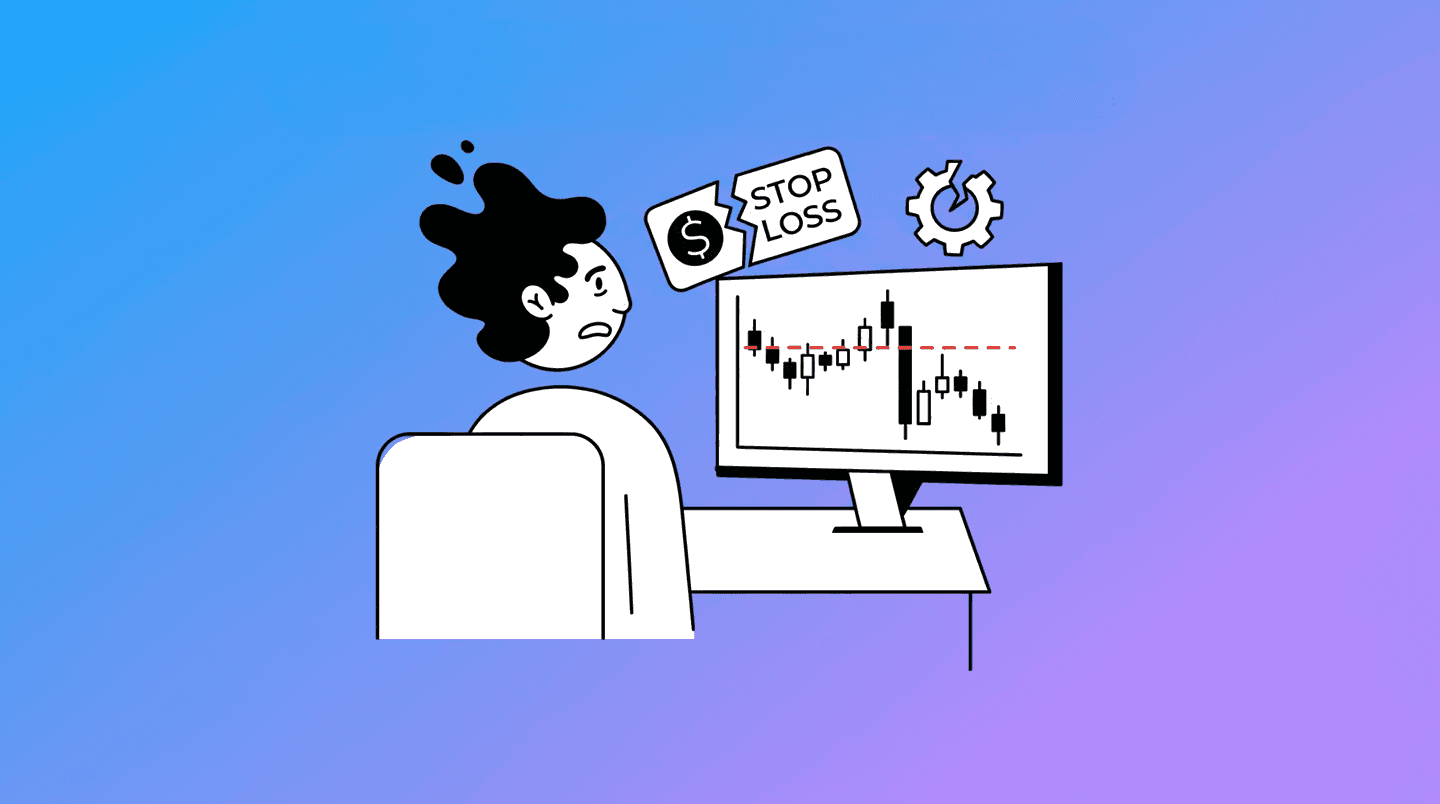
When a prop firm shows a trader the price of Bitcoin — where does that price come from? The question seems trivial, but the answer determines whether a stop-loss triggers at a fair price or at an anomaly from a single exchange. Most prop firms use a price feed from one broker or one exchange. If that exchange experiences a flash crash, a liquidity gap, or a technical anomaly — the trader gets stopped out at a price that doesn't reflect the real market. This is not a theoretical risk: crypto exchanges show price divergences of 1–3% across venues during high volatility, and during flash crashes — up to 5–10%. Oracle-based pricing solves this through aggregation: instead of a price from one exchange, the trader gets a volume-weighted average from dozens of sources, filtered for outliers and accompanied by a confidence interval. Pyth Network — the largest first-party oracle network — aggregates data from over 120 institutional publishers including Binance, OKX, Jane Street, Bybit, and Cboe Global Markets, covering 500+ price feeds. Stork complements Pyth with sub-millisecond latency (under 1ms), critical for derivatives execution. This article breaks down why the price source is a critically important parameter when choosing a prop firm, how oracle pricing works, how it differs from centralized feeds, and how it affects concrete trader outcomes.
The Single-Source Problem: Why One Exchange's Price Is a Risk
The crypto market is structurally different from forex or equities. In forex, with its $7.5 trillion daily volume per the BIS Triennial Survey 2022, prices between major liquidity providers diverge by fractions of a pip. A single broker's feed is an adequate source. In crypto, no single "central" price source exists. Bitcoin trades simultaneously on Binance, OKX, Bybit, Coinbase, Kraken, and dozens of other venues — and prices between them diverge.
Under normal conditions, divergence between major exchanges is 0.01–0.05%. During volatility: 0.5–1%. During sharp moves (liquidation cascades, major news, technical failures): 3–5% and higher. On May 19, 2021, during cascading liquidations, Bitcoin dropped to $30,000 on some exchanges while others showed a minimum of $33,000 — a divergence exceeding 10%.
What this means for a prop trader: If a prop firm uses a price feed from one exchange, and that exchange shows an anomalously low price:
- The stop-loss triggers at a price that doesn't reflect the real market
- The trader takes a loss that wouldn't have occurred on an aggregated price
- The daily drawdown limit can be breached due to a technical anomaly, not a trading error
- The account can be liquidated at a price that existed on only one venue
This isn't a question of "good" or "bad" exchanges. It's a structural feature of the crypto market: with fragmented liquidity, a price from one source will inevitably deviate from the volume-weighted market average.
The contrastive pair: A prop firm on a single-exchange feed ties the fate of a trader's account to a specific venue. A prop firm on oracle pricing ties the fate of the account to the volume-weighted market price from dozens of sources.
How Oracle Pricing Works
An oracle in blockchain is a bridge between real-world data and smart contracts. For price data, an oracle collects prices from multiple sources, aggregates them through a defined algorithm, and delivers the result as a single verifiable feed.
Pyth Network: First-Party Architecture
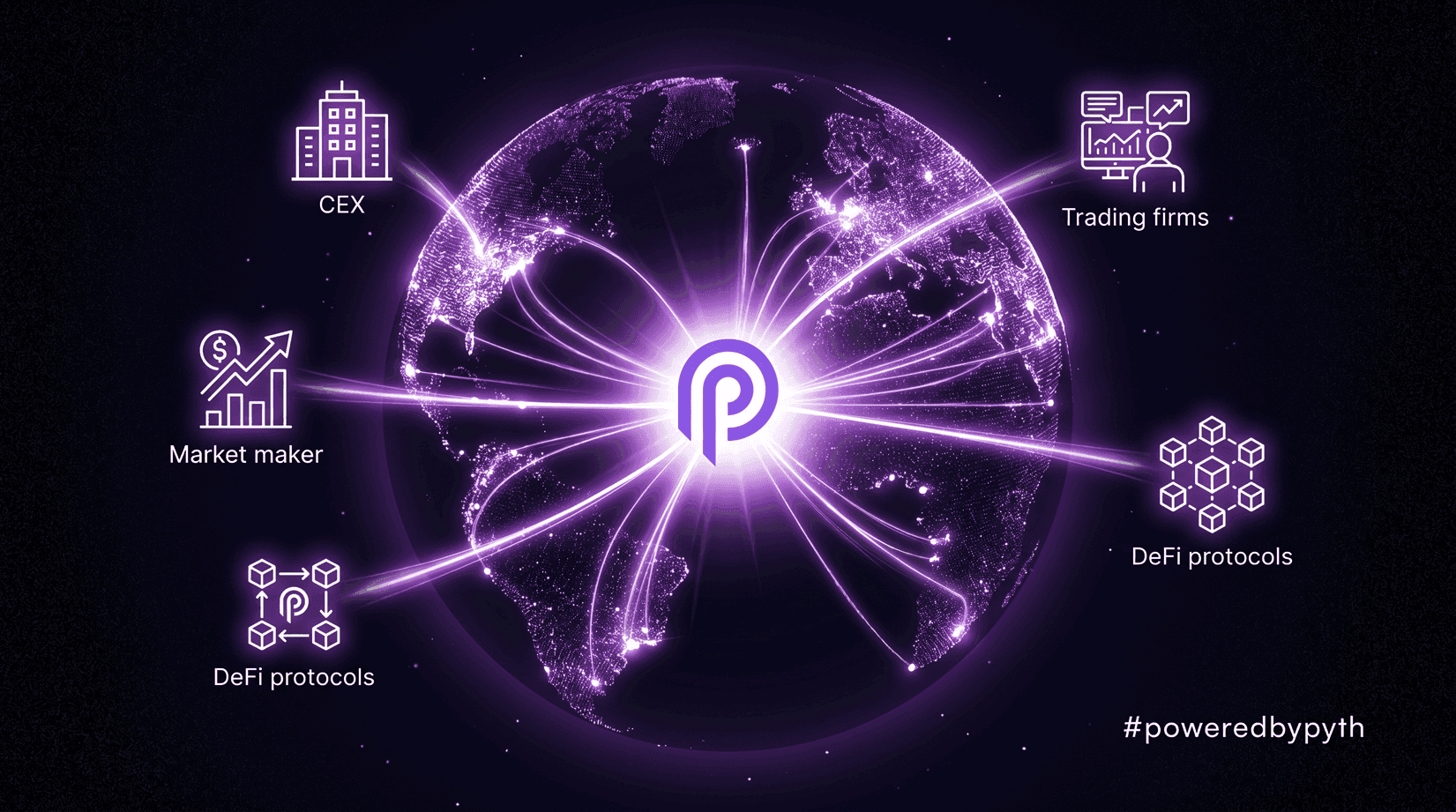
Pyth Network — the largest oracle network for financial data — operates on a fundamentally different model from traditional oracles.
Data sources: Over 120 institutional publishers submit their prices directly to the network. These are not anonymous nodes — participants include Binance, OKX, Jane Street, Bybit, Cboe Global Markets, Flow Traders, and Revolut. Each publisher submits its own market data: spreads, volumes, last trades — updated every few milliseconds.
Confidence-weighted aggregation: Pyth doesn't take a simple average. The algorithm weighs each publisher's data, filters outliers, and calculates an uncertainty metric for every price update. Each update contains three elements: the aggregated price, a confidence interval (how precise the price is), and a timestamp. If one exchange shows an anomalous price but the other 119 show normal prices, the anomaly gets filtered out.
Pull model (on-demand): Unlike traditional oracles that continuously "push" updates to the blockchain (paying fees for each), Pyth uses a "pull" model: prices are updated on-chain only when someone requests them. This allows supporting 500+ price feeds across 40+ blockchains with approximately 400ms latency — speed approaching centralized exchanges.
Coverage: Not just crypto. Pyth provides feeds for equities (including ETFs: SPY, QQQ), forex pairs, and commodities — making it applicable to prop firms offering multi-asset trading.
Stork: Sub-Millisecond Oracle
Stork is a next-generation oracle designed specifically for derivatives and high-frequency trading. Where Pyth delivers ~400ms latency, Stork operates at speeds under 1 millisecond — comparable to a direct exchange API connection.
How it works: Stork collects price data from major centralized exchanges, aggregates it off-chain (which enables the minimal latency), digitally signs each update, and delivers it to the blockchain via websockets.
Advantages: Sub-millisecond latency for traders operating on second and minute timeframes; broad data coverage from top exchanges; optimization for futures and derivatives.
Pyth + Stork together: On platforms using both oracles, they complement each other. Pyth provides breadth of coverage (500+ feeds, 40+ blockchains, equities, forex, commodities) and depth of aggregation (120+ institutional sources). Stork provides speed critical for real-time trade execution. Together they form a single price maximally aligned with the real market.
Centralized Feed: How the Alternative Works
A centralized price feed is a data stream from one source: one exchange, one broker, one liquidity provider. The prop firm connects to that source's API and uses its prices for order execution, drawdown calculation, and stop-loss triggers.
Advantages: Simple integration, minimal latency (data flows directly without aggregation), predictable behavior (one source = one logic).
Disadvantages: Dependence on a single point of failure, vulnerability to venue-specific anomalies, inability for the trader to verify the price (price is a "black box" managed by the firm or its provider).
Why Price Source Is Critical Specifically for Prop Trading
In regular trading with your own funds, a pricing anomaly is an annoyance. Stop-loss triggered on a spike — frustrating, but the account survives. In prop trading, an anomaly can be fatal due to strict drawdown limits.
Scenario: Flash Crash on One Exchange
A trader trades Bitcoin on a $50,000 funded account with a 5% daily drawdown limit ($2,500). An open long position of $10,000.
On a firm with a single-exchange feed: The exchange experiences a 3-second flash crash — price drops 4%. The trader's stop-loss triggers with slippage. Loss: $400 on the position, but the feed showed a peak drop of $500 on full exposure. Daily drawdown: $500, still within limits. But if the move was 6% (as has occurred on some exchanges), drawdown is breached — account closed due to an event that lasted 3 seconds on one venue.
On a firm with oracle pricing: Same moment. One exchange shows -6%, but the aggregated price from 120+ sources shows -2.5% (the real market move). The trader's stop-loss triggers at the fair price of -2.5%. Daily drawdown: $250. Account alive, trader continues.
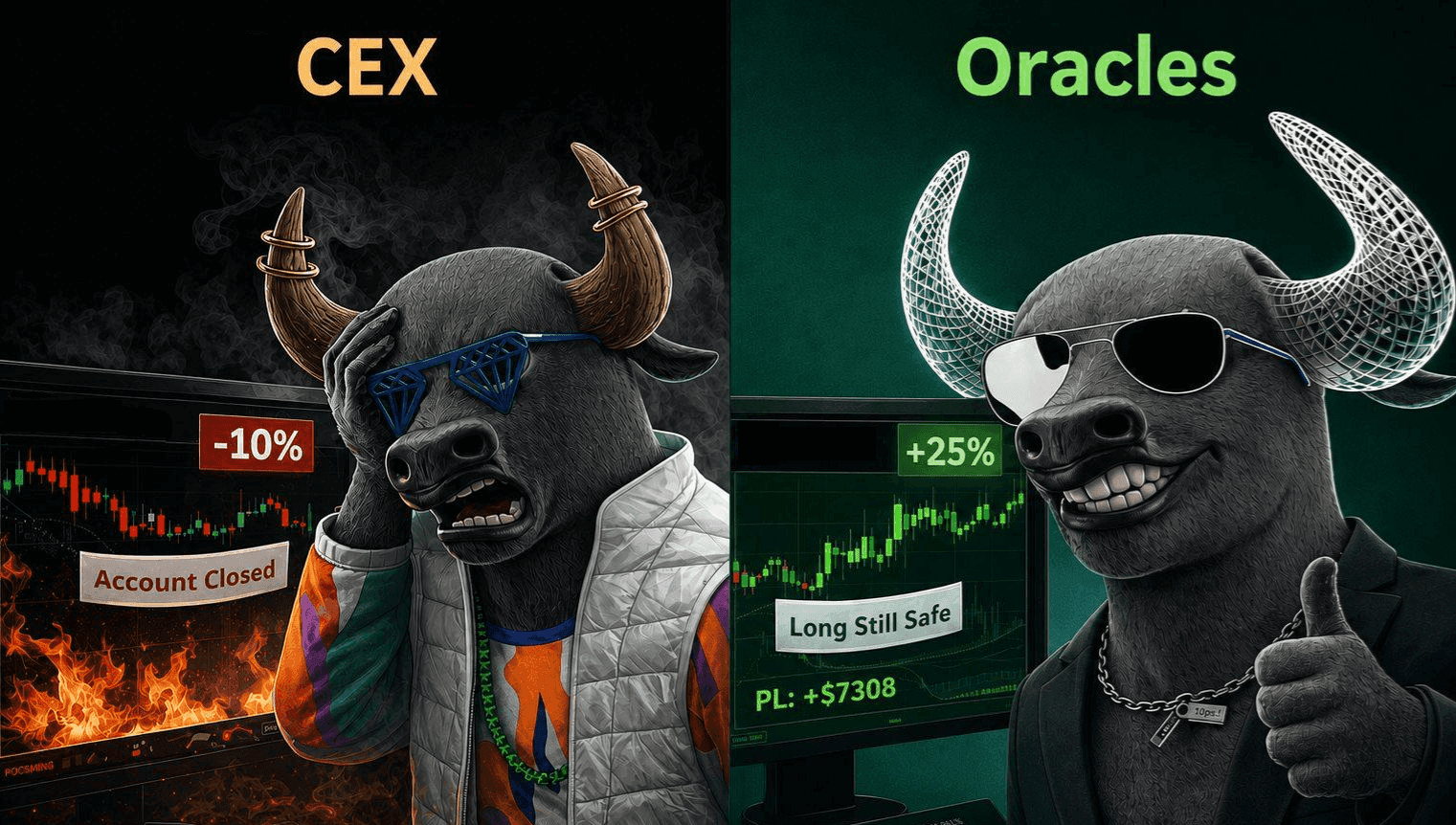
The difference: Same moment, same trader, same position — but the price source determines whether the account lives or dies.
Why This Isn't a Question of Firm "Honesty"
It's important to understand: a prop firm using a single-exchange feed isn't necessarily acting in bad faith. It's simply using the pricing infrastructure that was available at launch. Most forex-first prop firms carried the same architecture into crypto — and it works 95% of the time. The problem is the remaining 5%: precisely during high volatility, when the trader is most vulnerable, a single-source feed is least reliable.
Oracle pricing is not a moral advantage — it's an engineering solution to the problem of fragmented liquidity. As explored in more detail in the crypto prop trading guide, this is one of five structural differences that define a crypto-native prop firm.
Comparison: Oracle vs Centralized Feed
| Parameter | Centralized Feed | Oracle Pricing (Stork + Pyth) |
|---|---|---|
| Data source | 1 exchange or broker | 120+ institutional publishers |
| Anomaly protection | None (single point of failure) | Outlier filtering + confidence interval |
| Latency | <100ms (direct connection) | <1ms (Stork) / ~400ms (Pyth) |
| Verifiability | No (trader cannot verify) | Yes (data on-chain, verifiable) |
| Asset coverage | Depends on provider | 500+ feeds: crypto, equities, forex, commodities |
| Manipulation risk | Theoretically possible | Extremely difficult (120+ independent sources) |
| Cost to firm | Low | Higher (nominal fee per request) |
| Best suited for | Forex, where one provider is adequate | Crypto, where liquidity is fragmented |
The hard NO from Upscale: Upscale deliberately rejected the single-source pricing model. Not because one exchange is a "bad" provider, but because the crypto market is structurally fragmented, and tying a funded account's fate to one venue's anomalies is transplanting forex architecture onto a market it wasn't designed for. Oracle pricing through Stork and Pyth Network is a deliberate engineering decision, not a marketing feature.
How to Verify a Prop Firm's Price Source
Before purchasing a challenge, a trader can independently evaluate a firm's pricing infrastructure. Four practical steps.
Step 1: Ask directly. Submit a support question: "What price data source do you use for crypto instruments?" An answer of "our broker" or "our liquidity provider" = centralized single-source feed. An answer naming a specific oracle network (Pyth, Stork, Chainlink) = aggregated feed. No answer or evasiveness = cause for concern.
Step 2: Compare prices on demo. Open a demo account and during volatile moments (NFP releases, Fed decisions, sharp Bitcoin moves) compare the platform's price with prices on 3–4 major exchanges (Binance, OKX, Bybit, Coinbase). If the platform consistently shows one specific exchange's price — it's a single-source feed. If the price sits "in between" exchanges — likely aggregation.
Step 3: Check documentation. A serious firm documents its pricing infrastructure publicly. Look for mentions of price data sources in GitBook, FAQ, or technical documentation. Upscale's documentation describes its Stork and Pyth Network integration with technical details — this is the level of transparency to benchmark against.
Step 4: Test stop-loss behavior. On a demo account, set a stop-loss near the current price and wait for a volatile move. Record the execution price and compare with market data. Systematic slippage in one direction (always worse for the trader) is a warning signal. More on slippage mechanics and its impact on prop trading in the slippage guide.
How Upscale Implements Oracle Pricing
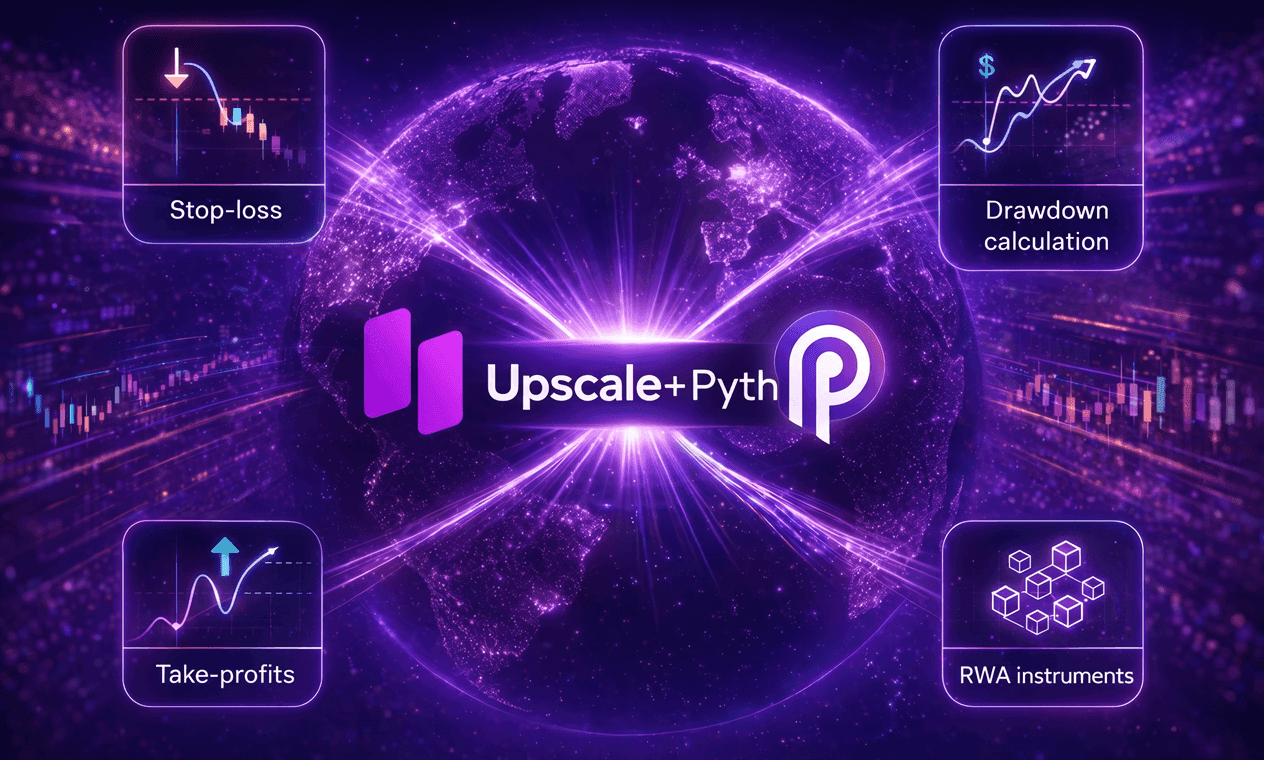
Upscale uses two oracles — Stork and Pyth Network — as price data sources for all trading instruments. Stork provides sub-millisecond latency (<1ms) for execution, Pyth provides breadth of coverage (500+ feeds) and depth of aggregation (120+ institutional sources). Together they form a single Index Price built on aggregated liquidity from the largest centralized exchanges. This isn't a checkbox integration — the platform's entire pricing infrastructure is built around oracle feeds.
What this means in practice:
For stop-losses: Triggers execute against the aggregated oracle price, not a single exchange's anomaly. If Binance shows -5% but the aggregated price is -2%, the stop executes at -2%.
For drawdown calculation: Daily and total drawdown limits are affected by price changes. Sharp price spikes on one exchange don't kill trader accounts if the oracle-aggregated price remains within limits.
For take-profits: Same principle — execution price reflects the market-wide weighted average, not one venue's peak.
For RWA instruments: Upscale's oracles cover not only crypto but also equities (ETFs: SPY, QQQ, DIA, IWM), forex pairs, and commodities. Traders operating indices and forex on Upscale get the same oracle precision.
Ernest, featured in the success stories, trades ETH and NASDAQ on Upscale — both instruments use Stork and Pyth oracle feeds. His level-based strategy on 1-minute charts requires precise pricing: breakout entries, 3:1–4:1 stops, trades lasting 1–60 minutes. On a single-exchange feed, slippage on tight stops could systematically erode profits. On oracle feeds, execution price is more stable — confirmed by his results: $1,308 in payouts over two months from a $10,000 funded account.
When a Centralized Feed Is Sufficient
Oracle pricing isn't a panacea, and there are conditions where a centralized feed works adequately.
Forex market — deeply liquid, with minimal divergence between providers. EUR/USD from one major broker is virtually identical to EUR/USD from another. For forex-only prop firms, a centralized feed is a reasonable choice.
Low-frequency trading — if a trader makes 1–2 trades per week on daily charts, brief pricing anomalies are less likely to affect outcomes. Divergences last seconds — on daily timeframes they're invisible.
Calm market conditions — 95% of the time, crypto exchanges show similar prices. The problem emerges in the remaining 5% — exactly when volatility is highest and the trader is most vulnerable.
Bitcoin-only trading — the most liquid crypto asset with minimal divergence between exchanges. On altcoins (SOL, DOGE, APT), divergences are significantly larger.
Conclusion: if a trader trades forex on daily timeframes — a centralized feed works. If a trader trades crypto (especially altcoins) on short timeframes with tight stops — oracle pricing is structurally more important.
Limitations of Oracle Pricing
An honest assessment of drawbacks is necessary for the complete picture.
Pyth latency is higher than direct connection. Pyth delivers ~400ms latency — impressive for an oracle but slower than a direct exchange API (<100ms). This is precisely why Upscale uses Stork alongside Pyth: Stork delivers under 1ms latency, closing the speed gap for high-frequency strategies.
Publisher dependency. If a significant portion of Pyth's 120+ publishers simultaneously stopped publishing data, aggregation quality would decline. In practice this is unlikely — publishers include the world's largest exchanges — but the theoretical risk exists.
Cost. Each price data request to Pyth costs a nominal fee (0.0001–0.001 tokens). For a prop firm with thousands of active traders, this creates operational costs absent from free single-exchange APIs. A firm using oracle pricing is investing in pricing infrastructure — a deliberate choice in favor of the trader.
Confidence interval is not zero. Each Pyth update contains a confidence interval — a measure of price uncertainty. In calm conditions the interval is narrow (±0.01%). In volatile moments it widens (±0.1–0.5%), reflecting real divergence between exchanges. Traders should understand that oracle price is a weighted average with stated uncertainty, not an "absolutely precise" price.
Practical Checklist for Traders
Before choosing a prop firm for crypto trading:
1. Price data source. Oracle (Pyth, Stork, Chainlink) = aggregation from multiple sources. Single-exchange API = single point of failure dependency. Unknown source = reason to ask questions.
2. Documentation transparency. Is pricing infrastructure described in public documentation? If not — the firm has nothing to show or nothing to be proud of.
3. Behavior during volatility. Test on a demo account during sharp moves. Compare execution price with the market average.
4. Strategy compatibility. Scalping on second timeframes? Stork's sub-millisecond latency handles it. Intraday on minute charts and above? Oracle precision matters more than speed.
5. Multi-asset trading. If you trade crypto, indices, and forex — verify that oracle coverage extends to all your instruments, not just BTC/ETH.
For traders comparing crypto-native and forex-first prop firms across the full set of parameters (not just pricing, but volatility calibration, trading hours, payout rails, and access model), the detailed breakdown is in the crypto prop trading guide.
Key Takeaways
The price data source is not a technical detail — it's the factor that determines whether a crypto trader's funded account survives a moment of maximum volatility. A centralized feed from one exchange works adequately 95% of the time — and becomes a structural risk in the remaining 5%, when prices between venues diverge by percentage points and stop-losses trigger on one source's anomaly. Oracle pricing through networks like Stork and Pyth Network replaces single-point dependence with aggregation from 120+ institutional publishers, filtering outliers and delivering a weighted average price with a confidence interval. For a prop trader with strict drawdown limits (5% daily, 10% total), this difference is between a routine stop and losing an account to an event that lasted three seconds on one exchange.
The choice is not moral — it's engineering. The forex market with its deep liquidity and minimal divergence between providers is perfectly served by a centralized feed. The crypto market with its fragmented liquidity, 24/7 trading, and history of flash crashes on individual venues is not. A prop firm choosing oracle pricing for crypto instruments is making a deliberate engineering decision: the cost of aggregation (~400ms Pyth latency offset by Stork's sub-millisecond speed, plus nominal per-request fees) is justified by protecting the trader from anomalies that a centralized feed cannot filter.
Upscale implemented this choice at the architecture level, integrating Stork and Pyth Network for all trading instruments — crypto, indices (SPY, QQQ), forex — not as an optional add-on for select assets. This is one of five structural differences that define a crypto-native prop firm (detailed in the crypto prop trading guide).
A prediction: As crypto prop trading scales and the number of funded traders grows, pricing anomalies from single-source feeds will generate an increasing volume of public disputes — traders who lost accounts to flash crashes on one exchange will demand accountability from firms. Oracle pricing will become the industry standard for crypto prop firms, the way liquidity aggregation became the standard for ECN brokers in forex a decade ago. Firms that adopted oracles now will be in a winning position when the market demands it from everyone.
Start now: 👉 Upscale.trade | Telegram Bot
Follow us: 📺 YouTube | 𝕏 Twitter
Community: 💬 Telegram Chat | 🎮 Discord
Frequently Asked Questions
What is oracle pricing in prop trading?
Oracle pricing determines asset prices by aggregating data from multiple sources through decentralized networks (oracles), rather than relying on a single exchange's or broker's price feed. In prop trading, this means stop-losses, take-profits, and drawdown calculations are tied to a market-wide weighted average price, not to one venue's quote. Upscale uses two oracles: Stork (sub-millisecond latency, optimized for derivatives) and Pyth Network (120+ institutional publishers, 500+ price feeds covering crypto, equities, and forex).
Why do prices differ across crypto exchanges?
The crypto market is decentralized: Bitcoin trades simultaneously on dozens of exchanges, each with its own order book and liquidity pool. Under normal conditions, divergence between major exchanges is minimal (0.01–0.05%). During volatile moments, prices can diverge by 1–3%, and during liquidation cascades or technical failures — up to 5–10%. This is a structural feature of the crypto market, unlike forex where deep liquidity ($7.5 trillion daily per the BIS) ensures minimal divergence between providers.
How does the price source affect a prop trader's outcome?
Directly and critically. If a prop firm uses a single-exchange feed and that exchange experiences an anomaly (flash crash, liquidity gap), the trader's stop-loss triggers at a price that doesn't reflect the real market. With strict drawdown limits (5% daily on Basic accounts), one anomaly can breach the limit and close the account. With oracle pricing, the same anomaly gets filtered: if one exchange shows -6% but the aggregated price from 120+ sources shows -2%, the stop executes at -2%. The difference is between losing an account and continuing to trade.
Does Upscale use oracle pricing for all instruments?
Yes — Upscale uses two oracles (Stork and Pyth Network) for all trading instruments: crypto (BTC, ETH, SOL and others), indices (SPY, QQQ, DIA, IWM), forex pairs, and commodities. Stork provides execution speed (<1ms), Pyth provides coverage breadth and aggregation depth. This isn't an add-on for select assets — it's the foundation of the platform's pricing infrastructure. Implementation details are in the oracles documentation.
Does oracle pricing have disadvantages?
Three main ones. First: Pyth latency (~400ms) is higher than a direct exchange API (<100ms) — this is why Upscale also uses Stork (under 1ms) alongside Pyth, closing the speed gap for high-frequency strategies. Second: the confidence interval — each price update contains an uncertainty metric that widens during volatile moments (±0.1–0.5%), reflecting real divergence between exchanges. Third: cost — each data request carries a nominal fee, creating operational costs for the firm that don't exist with free single-exchange APIs.
How can I check what price source my prop firm uses?
Four practical steps. First: ask support directly — a specific answer naming an oracle network (Pyth, Stork, Chainlink) means aggregation; "our broker" means single-source. Second: compare demo account prices during volatile moments with prices on 3–4 major exchanges — if the platform consistently matches one exchange, it's a single-source feed. Third: check public documentation — a serious firm describes its pricing infrastructure in GitBook or FAQ. Fourth: test stop-losses on demo — systematic one-directional slippage signals pricing problems.
Is oracle pricing necessary for forex trading?
For pure forex trading — generally no. The forex market with its $7.5 trillion daily volume provides deep liquidity and minimal divergence between providers. A centralized feed from one major broker is an adequate source for EUR/USD, GBP/USD, and other major pairs. Oracle pricing becomes critically important specifically for crypto, where liquidity is fragmented across dozens of exchanges and price divergences during volatile moments are measured in percentages, not pip fractions. If a trader trades both crypto and forex on one platform — oracle coverage of both asset classes (as Upscale provides through Stork and Pyth) ensures a unified pricing standard.