Quit for Prop, Withdrew $11,573: Roman's Story | Upscale

In early August 2026, Roman was working as a marketer in another city and barely trading. Two months later he had two prop account payouts totaling $11,573 — and he had already quit his job, before the first payout even arrived. He passed the challenge — a paid evaluation after which a trader gets a funded account, meaning an account with a set nominal size whose profits the trader splits with the platform — in 10 days.
Roman himself calls his fast start a "brutal rollercoaster" and admits it honestly: he passed the challenge so quickly because of risky trading, not in spite of it. This story is about how Roman trades ETH off liquidity, why he lost his first funded account, why he unsubscribed from 90% of his Telegram channels, and why he thinks prop beats trading on an exchange.
Quit before the first payout

Roman has known about trading for more than four years, but by his own account he has been doing it seriously only since August 5, 2026 — the day he signed up on Upscale. That is also when he started studying systematically.
He decided to quit his job before he had made any money from prop. There were several reasons: Roman was living away from his hometown — he had moved for work when he was invited to build a marketing department — and had wanted to go home for a long time. Then, in early August, something happened that finally pushed him.
$3 → $3,900: "pure gambling"
Roman got a voucher on an exchange, pulled about $3 out of it, and ran it up to $3,900 trading ETH futures. He doesn't fool himself about it:
"I don't consider it any kind of real achievement. I think it was pure gambling. That bit of luck just made me realize you can make money from this and it needs to be systematized."
From that point on, Roman started treating trading as a job rather than a game. We don't recommend copying his move of quitting: the U.S. Securities and Exchange Commission (SEC) warns that new day traders typically suffer severe financial losses in their first months of trading. Leaving a job before you have consistent results is a big risk.
How he found Upscale
Roman came to the platform through his mentor's community chat, where members shared results and screenshots from Upscale. He asked what the platform was, and they explained how prop trading works.
"At that point I was thinking a lot about risk, and I realized this was the perfect way for me to trade."
A 10-day challenge — and why it's nothing to brag about
Roman got his first $50,000 funded account on August 15 — 10 days after he started. His mentor helped: Roman analyzed market structures and chart patterns, found setups, and sent them in for review. The mentor approved the entry, adjusted it, or suggested a better one. He also advised Roman to trade a paid challenge from day one, so he would be "in the fight" right away.
Risk was another story:
"When I was passing my first prop account, I had a brutal rollercoaster. There were take-profits of $3,000 and $2,000, and losses of $1,500 and $2,000."
On a $50,000 account, that's a lot. With a 5% daily drawdown limit — $2,500 — two losses like that in one day would have been enough to close the account (participation requirements). Roman understands this:
"I think I passed that fast only because of inadequate risk management. I'm still working my way toward proper risk management, and the risk system on the prop account helps me with that: the daily drawdown and everything else."
We covered how to size risk to your account limits so you don't depend on luck in our guide to risk per trade in prop trading.
From this funded account, Roman withdrew $6,516 (September 11) and $5,057 (October 1) — $11,573 in total.
Strategy: ETH, liquidity, and USDT dominance

Roman mostly trades Ethereum (ETH):
"I like how it moves, I like its volatility. It's not like small altcoins, but it gives you room to work."
He looks for entries off liquidity and imbalances. Liquidity, as he uses the term, means clusters of other traders' stop-losses and liquidation levels, which price is often drawn toward. An imbalance, or FVG (fair value gap), is a section of the chart where price moved sharply in one direction, leaving a gap between candles. The market often comes back to fill it.
Every day, Roman looks at three things:
- The ETH chart — the instrument itself.
- USDT dominance (USDT.D) — the share of the USDT stablecoin in total crypto market capitalization. If dominance rises, people are moving money out of coins into USDT and the market falls. If it drops, the opposite. According to Roman, this helps him understand the overall market narrative.
- The CoinGlass liquidation heatmap over 30 days — where the levels cluster at which leveraged positions will be liquidated. He ignores clusters right next to price, because positions with huge leverage add them every hour. He waits for the big ones to get swept.
Roman only factors in Brent oil around news:
"A lot of people say that if oil falls, crypto rises. But that's not always true. You have to look at the news: why oil fell, why it rose."
Intraday only
Roman holds trades from one to five hours and never carries them overnight. Sometimes he hedges — opens an opposite position in the same instrument — also within the day.
"It's super cool that you can hedge on Upscale. As I started finding out, that's not possible everywhere. I'm really glad that on prop you get all the features of a regular exchange."
One important detail: on Upscale, hedging is allowed only within a single account. Holding opposite positions in the same instrument across different accounts of the same trader is prohibited (participation requirements).
Roman's risk-to-reward ratio is usually 1:2, though he doesn't calculate it deliberately yet: "I'm still a beginner, I'm still learning."
Three accounts and a lost funded account
In total, Roman has had three accounts on Upscale: two at $50,000 and one at $100,000. He took both $50,000 accounts to the funded stage but couldn't pass the $100,000 one. His first funded account — the one both payouts came from — he lost about a week before the interview and chose not to restore.
For two weeks before that, he had been trading at breakeven or at a loss. Roman sees the cause in himself, not the market:
"I got really deep into the crypto industry. I just went crazy over channels, chats, all of it, and started forgetting that I'm the one trading, not other people. I couldn't keep up with all the information in my head."
Around October 17, he unsubscribed from roughly 90% of his channels and went back to working "bluntly": analysis every day, finding an entry, one or two trades. His results leveled out right away. Kirill came to the same conclusion — his first piece of advice for beginners is also to unsubscribe from trading channels.
According to Roman, he has restored accounts more than once, and despite the two losing weeks he is still up about $9,000:
"It doesn't bother me at all. I'm ready to do this 10 times — I'm just not going to stop trading."
A clarification is needed here: restoration on Upscale is neither unlimited nor guaranteed. It's available for Basic and Accelerated accounts within 48 hours of a violation at the funded stage, and the decision is made by an automated review that takes into account, among other things, previous violations and restorations. Learn more in our article on funded account restoration.
Why prop instead of an exchange
Roman's explanation is simple:
"In crypto, absolutely everyone is a gambler. With a $100 account and with a $100 million account. We're all human."
Prop, he says, keeps you disciplined: the drawdown limits don't let you step out of bounds. The second advantage is keeping what you earn. Roman withdraws every payout to cash right away and leaves nothing on an exchange:
"It gives you the understanding that you've already earned something, that trading gives you an income. And it keeps you from going to gamble it away on an exchange, like a lot of people do with their withdrawals."
What's missing
Roman couldn't name any downsides of the platform, but he does have one wish: managing all accounts in a single window. When he had three accounts, he once forgot about an open trade on one of them. He remembered, closed it at a small loss, "but it was scary."
What's next
Five years from now, Roman sees himself in the commodities business, and trading may turn out to be a stepping stone. But for now:
"Right now I've fallen in love with charts. How candles close, what they draw, how it lines up with the news, with what's happening in the world, and with how big players behave. It just blows my mind."
Roman's advice
Be interested in charts, not money
"If you're interested in money, I don't think you'll make any. That's the paradox. You have to be interested in the charts themselves, in how money works, how it moves, how it passes from one set of hands to another. You just have to go crazy about it."
Don't overload your head
"Don't let too much information into your head. You don't need to subscribe to 100,000 Telegram channels."
Roman posts his trade breakdowns in his informal Telegram channel t.me/tvhhigh (in Russian).
Payout certificates
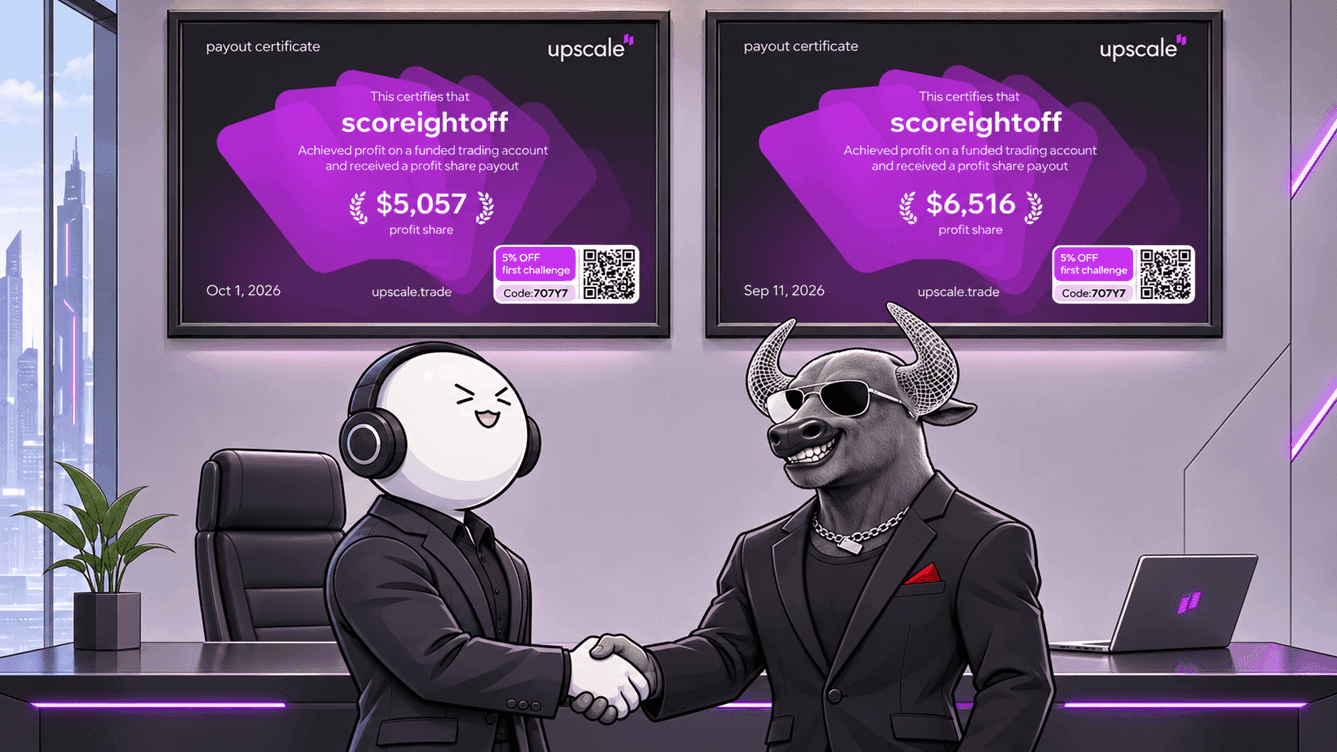
Roman's payouts from the $50,000 funded account: $6,516 (September 11, 2026) and $5,057 (October 1, 2026). Total: $11,573.
Verification
Roman's results are verified by:
- An interview on the Upscale YouTube channel
- 2 Upscale payout certificates
All Upscale payouts are made on-chain and can be independently verified on the blockchain.
Key takeaways
Roman's story is about a fast start and its price. In 10 days he passed a $50,000 challenge, and over the next month and a half he withdrew $11,573 from the funded account. But Roman doesn't pass this off as skill: he got through the challenge on a "brutal rollercoaster" of $2,000–3,000 wins and losses, and it's the drawdown limits on the prop account that are teaching him proper risk management.
The second takeaway is about information noise. Roman links his two losing weeks and the loss of his first funded account not to his strategy but to overload: dozens of channels and chats made him forget that he was the one trading. Once he unsubscribed from 90% of his sources and went back to a simple routine — analysis, one or two trades a day — his results leveled out. His trading is built on ETH, liquidity and imbalances, USDT dominance as a guide for the whole market, and the liquidation heatmap.
The third takeaway is about his attitude to money. Roman withdraws every payout immediately and leaves nothing on an exchange, so he won't gamble away what he's earned. His advice to beginners is to be interested in charts rather than money, and not to let excess information into your head. Quitting a job before you have consistent results, as he did, is a high-risk decision that's only worth making after a sober look at your own situation.
Start now: 👉 Upscale.trade | Telegram Bot
Follow us: 📺 YouTube | 𝕏 Twitter
Community: 💬 Telegram chat | 🎮 Discord
Frequently Asked Questions
How much has Roman earned on Upscale?
$11,573 in two payouts from a $50,000 funded account: $6,516 (September 11, 2026) and $5,057 (October 1, 2026). He started trading seriously on August 5, 2026, and got his first funded account on August 15.
How did Roman pass the challenge in 10 days?
His mentor helped: Roman found setups based on market structure and sent them in for review, and the mentor approved or adjusted the entry. At the same time, Roman admits he passed so quickly because of overly risky trading — with wins and losses of $2,000–3,000 on a $50,000 account.
What strategy does Roman trade?
He mostly trades ETH intraday, holds trades from one to five hours, and looks for entries off liquidity and imbalances (FVG). Every day he checks the ETH chart, USDT dominance, and the 30-day CoinGlass liquidation heatmap. His risk-to-reward ratio is usually 1:2.
Why does a trader need USDT dominance?
USDT dominance shows the share of the USDT stablecoin in total crypto market capitalization. In Roman's logic, if it rises, money is flowing out of coins into USDT and the market falls; if it drops, the market rises. He uses it as a guide to the market's overall direction.
Why did Roman lose his first funded account?
By his own account, because of information overload: he subscribed to dozens of channels and chats and started trading other people's ideas. After two weeks at breakeven or a loss, the account was closed. Roman unsubscribed from about 90% of his channels, went back to one or two trades a day, and his results leveled out.
Can you hedge on Upscale?
Yes, within a single account: you can hold a long and a short in the same instrument at the same time. Holding opposite positions in the same instrument across different accounts of the same trader is prohibited.
What does Roman advise beginners?
Be interested in the charts themselves and in how money moves, not just in earnings. And don't overload yourself with information: don't subscribe to hundreds of Telegram channels. Roman posts his breakdowns in his Telegram channel t.me/tvhhigh.