Best Crypto Prop Firms 2026: 9 Firms Compared | Upscale


Between February 2024 and late 2025, an estimated 80–100 prop trading firms shut down — roughly 13% of global operators — taking millions in unpaid trader capital with them.
- True Forex Funds collapsed in May 2024 with approximately $1.2 million owed to traders.
- The Funded Trader paused operations in March 2024 with over $2 million in denied payouts.
- SurgeTrader, Indigo Trader Funding, and dozens of others followed.
The trigger: MetaQuotes terminated MT4/MT5 licenses for prop firms, and every company built exclusively on that infrastructure either adapted or died.
Now the question "which crypto prop firm should I choose in 2026" requires a fundamentally different evaluation framework than it did in 2023. The old criteria — cheapest challenge, highest profit split, biggest funded account — selected for marketing promises. The new criteria select for structural reliability:
- Can you verify the firm's payouts independently?
- Are the trading rules published before you pay?
- Does the pricing infrastructure protect you from single-exchange anomalies?
- Will the firm deny your funded account after you pass the challenge because your strategy doesn't fit their risk template?
This comparison evaluates nine crypto prop trading firms across these structural criteria, using publicly available data verified as of May 2026. The comparison is built on a simple principle: trust infrastructure first, trading conditions second, marketing claims last.
The Comparison Table
The table below covers nine firms that offer crypto prop trading as of May 2026. Data is sourced from official firm websites, PropTradingVibes, PropFirmMatch, Fortunly, and FXEmpire reviews, cross-referenced where possible.
| Firm | Max Funded | Profit Split | Min Challenge | Crypto Leverage | KYC | Pricing Model | Platform | Unique Feature |
|---|---|---|---|---|---|---|---|---|
| Upscale | $400K (up to $200K/account) | up to 90% | $59 | 5× | No KYC | Oracle (Stork + Pyth) | TradingView + Telegram | On-chain payouts, full GitBook docs |
| Breakout (Kraken) | $200K | up to 90% | ~$50 | 5× BTC/ETH, 2× others | Required for funded | Proprietary | Breakout Terminal | Kraken-backed, USDC payouts |
| HyroTrader | $1M (scaled) | 70→90% | $89 | up to 100× (Bybit) | Required for funded | Bybit direct | Bybit + CLEO | Real exchange execution |
| Crypto Fund Trader | $1.28M (Instant) | 80→90% | $45–50 | up to 100× | Required for funded | Bybit + MT5 | MT5, MatchTrader, Bybit | 715+ crypto pairs |
| FundedNext | $4M (scaled) | up to 95% | $59.99 | 1:1–1:2 | Required | Broker CFD | MT4/5, cTrader | 15% eval profit bonus |
| FTMO | $400K→$2M | 80→90% | €89 (promo) | up to 1:100 | Required | Broker CFD | MT4/5, cTrader, DXtrade | OANDA acquisition, 11yr track record |
| BrightFunded | $400K | 80→90→100% | ~€55 | up to 1:100 | Required | Broker CFD | MT5, cTrader, DXtrade | 100% split after 3rd scaling |
| Goat Funded Trader | $2M (scaled) | 80→100% | $36 | 1:2 | Required | Broker CFD | MT5, MatchTrader + 3 more | Cheapest entry ($5) |
| Velotrade | $200K | up to 90% | $35 | up to 6× | Required for funded | CFD (reference exchanges) | DXtrade | Institutional founders (ex-JP Morgan) |
Data is current as of the time of writing.
Firm-by-Firm Breakdown
Upscale
What it is: A crypto-native prop firm built from the ground up for digital assets, not a forex broker that added a crypto tab. Founded in 2025. Accounts up to $200,000 each (up to $400,000 total across multiple accounts) with up to 90% profit split. Three challenge types: Basic, Accelerated, and Turbo — from $59 minimum.
What sets it apart:
No KYC — full cycle. From challenge purchase to payout, no government ID, no proof of address, no bank verification at any stage. This is not a partial no-KYC model (where you can buy without ID but need it for payouts). The entire lifecycle operates via wallet connection and crypto payments. For why this matters structurally, see the detailed no-KYC prop trading analysis.
On-chain verifiable payouts — fast. When a firm claims "$X million paid to traders," the question is: can you verify that independently? Upscale payouts settle on-chain — visible on the blockchain, checkable by anyone. Processing takes approximately 24 hours. This is a qualitatively different trust signal than self-reported payout totals that cannot be independently audited.
Public documentation on GitBook. Every trading rule — drawdown mechanics, profit targets, challenge parameters, oracle integration, fee structure — is published in full on GitBook before you pay anything. Not buried in a FAQ, not behind a registration wall, not summarized in marketing language. The complete rulebook is public. After 80+ firms collapsed with traders saying "the rules changed after I paid," public documentation is not a nice-to-have — it's a trust baseline.
Oracle pricing (Stork + Pyth Network). Price feeds aggregate from 120+ institutional sources instead of relying on a single exchange. This means stop-losses trigger at a market-representative price, bypassing the risk of a price anomaly on a single exchange. For the full technical breakdown: oracle pricing vs centralized feeds.
No trading-style rejection. If you pass the challenge within the rules, you get a funded account — regardless of whether your R:R is 2:1 or 9:1, whether you scalp or swing, whether you use Fibonacci or SMC. Other firms rejected profitable traders after they passed the challenge because their strategy was deemed "too risky." Upscale does not evaluate trading style — only results.
TradingView terminal + Telegram mini-app. The only prop firm that operates natively inside Telegram — buy challenges, monitor accounts, and manage positions through a Telegram bot. This is unique in the industry.
5× crypto leverage by design. Crypto pairs are capped at 5× — a deliberate calibration for crypto's volatility (forex and indices use market-standard leverage). See the leverage section below.
Breakout (by Kraken)
What it is: A crypto-only prop firm acquired by Kraken in September 2025. Founded November 2023, Tampa, Florida. Max $200K funded, up to 90% split. Crypto-only since February 2025 (dropped all forex). Proprietary Breakout Terminal with 50+ crypto pairs.
Strengths: Kraken institutional backing — the strongest corporate trust signal in the category. USDC on-demand payouts processed within ~24 hours. Over $38M paid to traders per Breakout's own reporting. No minimum trading days, no time limit on challenges.
Limitations: KYC mandatory for funded accounts (SumSub verification — ID + selfie + proof of address). 5× leverage on BTC/ETH, 2× on everything else. Explicitly bans 23 countries. No third-party platform integration — must use Breakout's proprietary terminal.
HyroTrader
What it is: A crypto-native firm executing directly on Bybit's API — the only major prop firm offering real exchange execution rather than synthetic CFDs. Founded 2022, Bratislava (Slovakia). Max $200K initial scaling to $1M over 12 months.
Strengths: Real exchange execution (Bybit + CLEO with 700+ pairs). Over $3.5M in verified payouts. Payout processing in 12–24 hours. Challenge fee fully refunded with first payout. Free 10-day trial available.
Limitations: Profit split starts at only 70% and takes 8+ months to reach 90% — the slowest scaling in the comparison. Tick-by-tick trailing drawdown (the most aggressive model — a momentary spike can breach your limit even if price recovers). 40% consistency rule during evaluation (no single day >40% of total profit). Mandatory stop-loss within 5 minutes of opening any position. These rules make HyroTrader's evaluation genuinely harder than peers.
Crypto Fund Trader (CFT)
What it is: The most established pure-crypto prop firm with 3+ years of operations. Founded November 2022, Zug (Switzerland). Max $300K standard, up to $1.28M via Instant Challenge. 715+ crypto pairs through Bybit integration (added April 2025).
Strengths: Largest crypto pair selection (715+). Fast payouts (8–24 hours, industry-leading speed). Over $18M paid. Multi-platform: MT5, MatchTrader, and native Bybit. Accepts traders globally with no country restrictions.
Limitations: KYC required for payouts. Banned strategies include reverse trading under 60 seconds, HFT, tick scalping, and "gambling all-in" trades. Daily profit cap of $10K on Instant accounts. Up to 100× leverage — see leverage concerns below.
FundedNext
What it is: A major multi-asset prop firm where crypto is secondary to forex. Founded March 2022, UAE. Max $200K per account, scaling to $4M aggregate. Over $68M paid across ~23K payouts.
Strengths: Highest profit split ceiling (up to 95%). Unique 15% profit share from challenge phase (paid after reaching 10% funded growth). Largest Trustpilot review base in the industry. No consistency rules.
Critical limitation for crypto traders: Crypto leverage is capped at 1:1 to 1:2 with only 9 crypto pairs. This makes FundedNext functionally unusable for active crypto strategies. A $50K account with 1:1 leverage means your maximum position size is $50K — producing returns too small to justify the challenge fee. Additionally, news trading rules reduce crypto profits within 5 minutes of high-impact events to 40% while counting 100% of losses. FundedNext is a forex prop firm with a crypto checkbox, not a crypto prop firm.
FTMO
What it is: The oldest and most recognized prop firm globally. Founded 2015, Prague (Czech Republic). Acquired OANDA Global Corporation in December 2025. Max $400K scaling to $2M. Over $500M in cumulative payouts.
Strengths: 11-year operating history — the longest in the industry. Only firm offering MT5 access in the US (via OANDA). Expanded to 32 crypto instruments in July 2025. $250M credit line from UniCredit-led syndicate.
Limitations for crypto traders: All crypto positions must be closed by Friday market close on non-Swing accounts — fundamentally incompatible with 24/7 crypto strategies. Crypto as CFD through broker pricing, not exchange execution or oracle aggregation. KYC required. Payout restrictions apply in certain jurisdictions due to sanctions compliance. FTMO also rejected traders after passing challenges due to strategy-based "risk review" (documented in Saul's case, where FTMO denied a funded account citing "too much risk" despite a passed evaluation).
BrightFunded
What it is: A Netherlands-based multi-asset firm founded September 2023 with an ex-ECB advisor and ex-Optiver executive on the advisory board. Max $400K funded. Notable for offering up to 100% profit split after the third scaling milestone.
Strengths: The only firm in this comparison where 100% split is already achievable (not just planned). EOD trailing drawdown (kinder than tick-by-tick — intraday spikes don't breach your limit). $12.8M+ paid.
Limitations: 2-Step challenge only (no 1-Step option). 30-day inactivity rule. Copy trading between own accounts is allowed, but cross-account hedging is prohibited. Crypto is offered via CFD with broker pricing, not oracle or exchange-based.
Goat Funded Trader (GFT)
What it is: A mass-market prop firm with one of the cheapest entries — from $36 and the broadest platform support (5 platforms). Founded May 2023, entities in Hong Kong and Saint Lucia. Max $2M scaled.
Strengths: Low entry barrier ($36). Ten different challenge models including Instant Funding. Five-platform support.
Significant concerns: Crypto leverage is only 1:2. Bans traders from 27 countries including the US and Singapore. Multiple documented payout disputes in 2025–2026 citing "copy trading" accusations on legitimate trades. Absorbed TradeXMastery in April 2026 with unresolved customer claims. Self-reported payouts ($20M+) significantly exceed third-party tracked payouts ($11.2M on Payout Junction). Only buy the cheapest challenges — do not commit significant money.
Velotrade
What it is: The newest entrant, launched March 2026. Founded by former JP Morgan and Dresdner Kleinwort derivatives traders. Hong Kong-based. Max $200K, up to 90% split, up to 6× leverage. Crypto-only via DXtrade.
Strengths: Strongest institutional founder credentials in the category. Free retry on evaluation failures. $35 minimum challenge ($5K 1-Step Pro). 4 qualifying trading days minimum (lowest in comparison).
Limitations: Only ~2 months of operating history as of May 2026. Approximately 9 Trustpilot reviews — too thin to assess reliability. DXtrade only (no TradingView, no MT5, no Telegram). Self-publishes competitor comparisons on its own blog — a soft conflict-of-interest signal. Wait 6–12 months for payout track record before committing significant challenge fees.
Why 5× Crypto Leverage Is a Feature, Not a Limitation
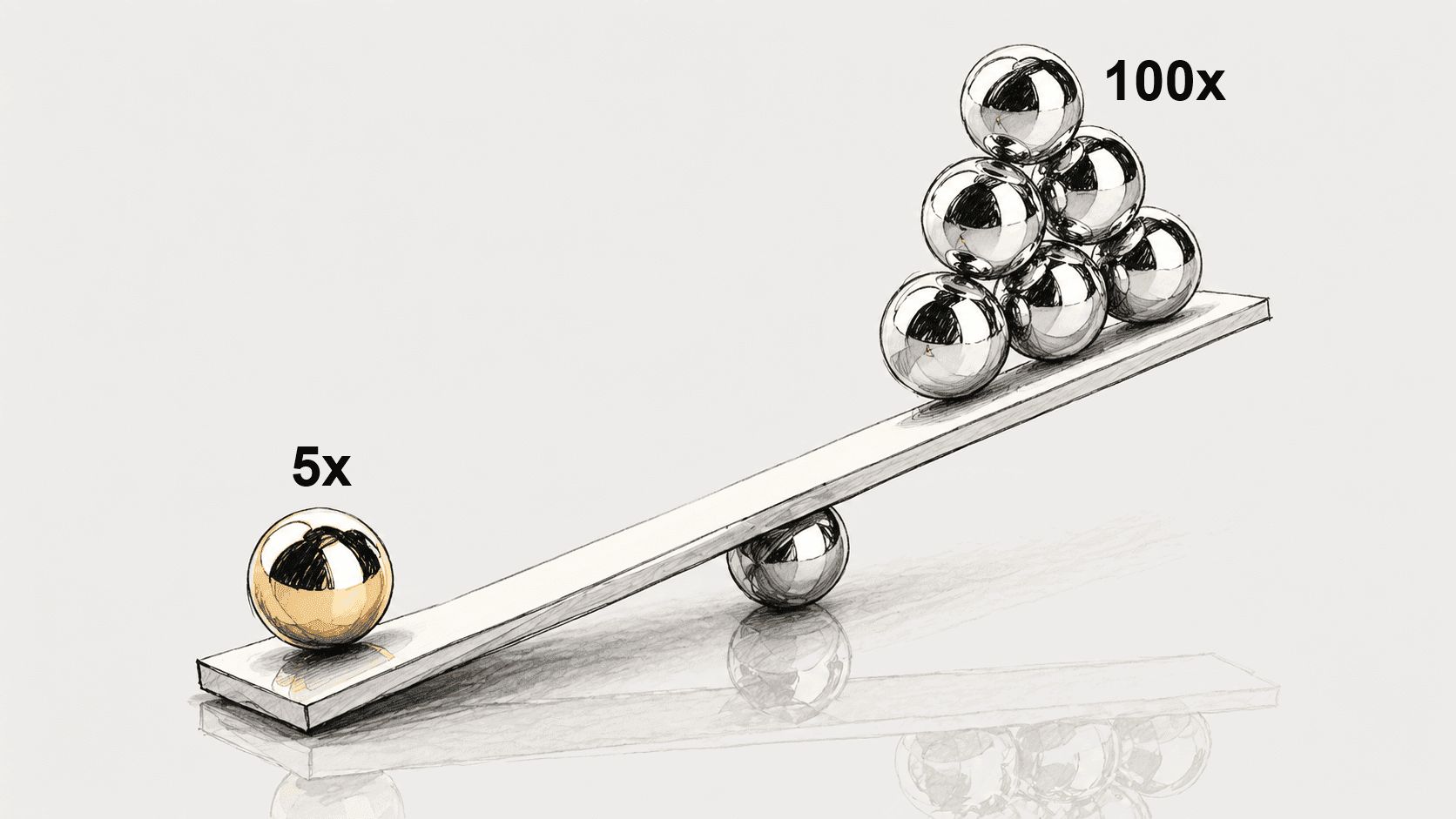
This deserves its own section because the marketing around "100× leverage on crypto pairs in your prop account" obscures a structural reality.
The math: On a $100K funded account with 100× crypto leverage, a 1% adverse move on a full-size position wipes out the entire account. One candle. One wick. One flash crash on one exchange. The 5% daily drawdown limit becomes irrelevant because the account is gone before the drawdown calculation can even trigger.
Who benefits from 100× crypto leverage on a prop account? Not the trader — the firm. A trader who opens a 100× position on a funded account will almost certainly breach drawdown limits quickly, keeping the challenge fee without paying out. Firms offering 100× crypto leverage on prop accounts are optimizing for challenge-fee revenue, not trader survival.
The Upscale and Breakout approach — 5× crypto leverage — is calibrated for the opposite outcome: enough leverage to generate meaningful returns on funded capital (a 5% move on a 5× BTC position = 25% return), but low enough that a single bad trade doesn't end the account. For other asset classes (forex, indices), Upscale offers market-standard leverage — the 5× cap is specifically calibrated to crypto's volatility profile. This is why Upscale's drawdown rules (5% daily / 10% total on Basic) are actually achievable with 5× crypto leverage — and nearly impossible to maintain with 100×.
The contrastive pair: A firm offering 100× crypto leverage and 5% daily drawdown is setting contradictory rules — the leverage makes the drawdown limit unachievable for any position size that would generate meaningful profit. A firm offering 5× crypto leverage and 5% daily drawdown is setting compatible rules — the trader can take real positions with real risk management and stay within limits.
As explored in the crypto prop vs forex prop guide, crypto leverage calibration is one of five structural differences between crypto-native and forex-transplanted prop firms. The firms that calibrate crypto leverage to volatility and their drawdown model protect traders; the ones that advertise maximum crypto leverage as a feature optimize for failed challenges.
How to Evaluate a Crypto Prop Firm in 2026

After 80+ firms disappeared with trader money in 2024, the evaluation framework needs to start with trust infrastructure, not trading conditions. Six structural checks, in order of importance.
1. Can You Verify Payouts Independently?
This is the single most important question. Every firm claims payout totals — "$18M paid," "$68M paid," "$500M paid." The question is whether those claims are auditable.
On-chain payouts are verifiable by anyone — the transaction exists on the blockchain with amount, date, and wallet address. You don't need to trust the firm's marketing; you check the chain. Upscale's payouts settle on-chain, making every payout independently auditable.
Third-party tracked payouts (via Payout Junction or similar) provide a middle ground — not as trustworthy as on-chain (the tracker can have gaps) but better than self-reporting. Multiple firms in this comparison show significant discrepancies between self-reported and tracked figures.
Self-reported payouts only — the lowest trust tier. The firm says they paid $X million. You have no way to verify. In the context of 80+ firms collapsing, this is insufficient.
2. Are Trading Rules Published Before You Pay?
A firm that documents every rule in a public GitBook or knowledge base — drawdown mechanics, profit targets, challenge parameters, fee schedules, payout processes — before you create an account or pay anything is structurally different from a firm that reveals rules only after payment, or buries them in a Terms of Service that can change without notice.
Upscale's GitBook documentation publishes the complete rulebook publicly. FTMO's trading updates document rule changes with effective dates. These are the transparency benchmarks.
If you cannot find the exact drawdown model, profit target, and payout schedule on a firm's website without registering — treat that as a red flag.
3. What Determines Your Execution Price?
Three models exist in the market:
Oracle pricing (Stork + Pyth Network, 120+ sources) — aggregated, filtered for outliers, verifiable on-chain. Used by Upscale. Protects against single-exchange anomalies triggering stop-losses or breaching drawdown limits.
Direct exchange execution (Bybit API) — real order book, real liquidity. Used by HyroTrader and CFT's Bybit integration. Transparent but tied to one exchange's price.
Broker CFD pricing — synthetic price derived from one or more liquidity providers. Used by FTMO, FundedNext, BrightFunded, GFT. The trader cannot independently verify the price source, and the firm or its broker controls the feed.
For the detailed comparison of these models: oracle pricing vs centralized feeds.
4. Does the Firm Reject Profitable Traders Based on Style?
Some firms deny funded accounts after the trader has passed the challenge — not because the trader broke rules, but because the firm's "risk review" flagged the trading style as unacceptable. This was documented in Saul's case: FTMO denied his funded account after he passed Phase 2, telling him "too much risk — we don't take traders like this." The5ers did the same. His strategy (R:R 8–9:1, Fibonacci-based) didn't fit their standard risk parameters — despite being profitable.
Upscale does not reject traders based on trading style. If the challenge is passed within the published rules, the funded account is issued. Period.
This is a structural decision, not leniency. A firm that defines "acceptable" trading styles beyond its published rules introduces a hidden evaluation layer that the trader cannot see or prepare for. A firm that evaluates by results only — pass the rules, get funded — is transparent about what it measures.
5. What Happens If You Lose Wallet Access?
On no-KYC platforms, losing access to the connected wallet means losing access to the account. No government ID on file means no identity-based recovery. This is the structural tradeoff of no-KYC — privacy in exchange for self-custody responsibility. Standard crypto security practices apply: seed phrase backup, hardware wallet, never connect from compromised devices.
On KYC platforms, wallet or account recovery is possible through identity verification. This is a genuine advantage of KYC models — but it comes with the tradeoff of providing personal documents to an international platform.
Neither model is inherently superior. The choice depends on the trader's priorities.
6. Is the Leverage Calibrated to the Drawdown Model?
If a firm offers 100× leverage and a 5% daily drawdown limit, the rules are structurally contradictory — a full 100× position breaches the drawdown on a 1% move. This means the leverage is either unusable at full size (in which case advertising it is misleading) or it's a trap that accelerates challenge failures (in which case the firm profits from the inconsistency).
If a firm offers 5× leverage and a 5% daily drawdown limit, the rules are structurally compatible — a full 5× position needs a 1% move to create a 5% account impact, giving the trader room to manage risk.
Check: does the leverage number make mathematical sense given the drawdown rules? If not, the firm is selling a number, not a trading condition.
Who Should Pick Which Firm

The "best" crypto prop firm depends on what the trader needs. Here are five trader profiles and the firms that structurally fit each:
Profile 1: Privacy-first trader, no documents
Need: Full no-KYC cycle — buy, trade, and receive payouts without providing ID.
Best fit: Upscale — the only firm in this comparison offering a complete no-KYC lifecycle from challenge purchase through payout. All other firms require KYC at minimum for funded-account payouts.
Runner-up: None. Partial no-KYC (buy without ID, but KYC for payouts) is available at Breakout and HyroTrader, but the payout stage still requires identity verification.
Profile 2: Maximum leverage, exchange execution
Need: High leverage with real order book execution, willing to accept strict evaluation rules.
Best fit: HyroTrader (up to 100× via Bybit, real exchange execution) or Crypto Fund Trader (up to 100× via Bybit, 715+ pairs). Both offer genuine exchange execution — not CFD synthetics.
Caveat: Read the leverage section above carefully. 100× leverage on a prop account with 5% daily drawdown means a 0.05% move on a full position breaches the limit. In practice, traders on these platforms use 10–20× at most.
Profile 3: Established track record, maximum trust
Need: The safest possible firm with the longest history and strongest institutional backing.
Best fit: FTMO (11 years, $500M+ paid, OANDA acquisition, $250M credit line) or Breakout (Kraken-backed since September 2025).
Caveat: FTMO's crypto offering requires Friday position closure on non-Swing accounts — structurally incompatible with 24/7 crypto strategies. Breakout bans 23 countries and requires KYC for funded accounts.
Profile 4: Fair pricing and transparent rules
Need: Oracle-based execution, publicly documented rules, verifiable payouts.
Best fit: Upscale — the only firm combining oracle pricing (Stork + Pyth), on-chain verifiable payouts, and full public documentation on GitBook. This is the structural trust trifecta: you can verify the price, verify the rules, and verify the payouts — all independently.
Profile 5: Maximum scaling potential
Need: Start small, grow to the largest possible funded capital.
Best fit: FundedNext ($4M aggregate via scaling) or Goat Funded Trader ($2M) for pure size. HyroTrader ($1M in 12 months) for crypto-specific scaling.
Caveat: FundedNext's crypto leverage (1:1–1:2) makes it unsuitable for active crypto strategies. GFT has documented payout disputes. Upscale is introducing account scaling — check current account options for the latest tiers.
Verified Trader Results Across Firms
Numbers from traders who have publicly documented their experience:
On Upscale:
- Saul — 18 years old, $27,054 in payouts. FTMO and The5ers both rejected him. Upscale funded him four times.
- Ernest — $1,308 in two months from $10K. Previously traded on CFT, FundedNext, and Trade the Pool.
- Maru Joshua Sugon — $3,296 from $25K.
- Wade — $41,000 at age 19.
- Ten additional verified traders with published certificates and video interviews in the success stories section.
On FTMO: Over 2.3 million open trading accounts in 2024. Approximately 7% of prop trading accounts achieve payouts industry-wide per Finance Magnates reporting.
On HyroTrader: $3.5M+ total payouts across 30,000+ traders.
On CFT: $18M+ paid. Partner of CA Osasuna (Spanish football club).
On FundedNext: $68M+ across ~23K payouts (verified by Payout Junction, September 2025).
The difference is not in the total numbers — larger firms naturally pay more in aggregate. The difference is in verifiability: Upscale's payouts are auditable on-chain. Most competitors' totals are self-reported or third-party tracked with varying degrees of transparency.
Methodology: Firms were compared using official websites, published documentation, payout records, platform rules, KYC policies, pricing models, and third-party review databases (PropTradingVibes, PropFirmMatch, Fortunly, FXEmpire). All data verified as of May 2026.
Disclosure: Upscale is included in this comparison. We explicitly state where Upscale is stronger and where competitors are stronger.
Key Takeaways
The crypto prop trading landscape in 2026 is structurally divided. On one side: crypto-native firms built from the ground up for digital assets — Upscale, Breakout, HyroTrader, Crypto Fund Trader, Velotrade. On the other: forex-first firms that added crypto as a secondary product — FTMO, FundedNext, BrightFunded, Goat Funded Trader. The division matters because architecture determines trading conditions: leverage calibration, pricing infrastructure, weekend trading, payout rails, and KYC requirements all follow from whether the firm was designed for crypto or adapted for it.
The 2024 collapse eliminated 80+ firms and exposed a structural truth: marketing promises are worthless without trust infrastructure. Three verifiable criteria now separate reliable firms from unreliable ones. First, payout verifiability — can you check payouts independently (on-chain), or are you trusting self-reported numbers? Second, rule transparency — are all trading rules published publicly before you pay, or are they revealed after purchase? Third, pricing integrity — does the firm use aggregated oracle data, direct exchange execution, or opaque broker CFD feeds?
No single firm wins on every parameter. FTMO has the longest track record but restricts crypto trading hours and rejects traders based on style. Breakout has institutional backing (Kraken) but requires KYC and bans 23 countries. HyroTrader offers real exchange execution but starts at only 70% split with the industry's most aggressive drawdown model. CFT has the largest crypto pair selection but requires KYC. FundedNext has the highest aggregate payouts but only offers 1:1–1:2 crypto leverage. Upscale offers the only full no-KYC lifecycle with oracle pricing and on-chain payouts — but its maximum funded capital is $400K (up to $200K per account) and it lacks a decade-long track record.
The honest recommendation: match the firm to your specific constraints. Privacy priority → Upscale. Maximum trust → FTMO or Breakout. Exchange execution → HyroTrader or CFT. And regardless of which firm you choose — verify payouts, read the published rules, and test the platform on a demo before committing challenge fees. After 80+ firms disappeared with trader money, trust is not a feature. It's the minimum requirement.
Start now: 👉 Upscale.trade | Telegram Bot
Follow us: 📺 YouTube | 𝕏 Twitter
Community: 💬 Telegram Chat | 🎮 Discord
Frequently Asked Questions
What is the best crypto prop firm in 2026?
There is no single "best" — the answer depends on the trader's priorities. For full privacy without KYC: Upscale is the only firm offering a complete no-KYC lifecycle from purchase to payout. For maximum institutional trust: FTMO (11-year track record, OANDA acquisition) or Breakout (Kraken-backed). For real exchange execution: HyroTrader or Crypto Fund Trader, both executing directly on Bybit. For maximum funded capital: FundedNext scales to $4M, though crypto leverage is limited to 1:1–1:2. The critical question is not which firm ranks first on a list but which firm matches your specific constraints — KYC tolerance, leverage needs, platform preference, jurisdiction, and payout method.
How many crypto prop firms shut down in 2024?
Between 80 and 100 prop trading firms shut down between February 2024 and late 2025, approximately 13% of global operators, per Finance Magnates Intelligence. The collapse was triggered by MetaQuotes terminating MT4/MT5 licenses for prop firms, which destroyed every company built exclusively on that infrastructure. Casualties included True Forex Funds (May 2024, ~$1.2M owed to traders), The Funded Trader (March 2024, $2M+ denied payouts), and SurgeTrader. All nine firms compared in this article survived — the crypto-native firms (Upscale, Breakout, HyroTrader, CFT, Velotrade) were resilient because they were never dependent on MT4/MT5.
Is 100× leverage on a prop account a good thing?
No — it's structurally counterproductive. On a $100K funded account with 100× leverage and a 5% daily drawdown limit, a 0.05% adverse move on a full position breaches the drawdown. That's less than the typical spread on many crypto pairs. In practice, traders on 100× platforms use 10–20× at most. Firms advertising 100× leverage are selling a number that's mathematically unusable at full size — and it accelerates challenge failures that generate fee revenue. Upscale and Breakout cap leverage at 5× by design: enough for meaningful returns (a 5% BTC move with 5× leverage = 25% account return), low enough that one trade doesn't end the account.
Can I verify a prop firm's payouts independently?
Depends on the firm. Upscale's payouts settle on-chain — visible on the blockchain, verifiable by anyone without relying on the firm's claims. Some firms use third-party payout trackers (like Payout Junction), which provide partial verification but can have gaps. Most firms self-report payout totals that cannot be independently audited. In a post-collapse market where firms disappeared with trader money, on-chain payout verification is the highest available trust standard.
What is oracle pricing and why does it matter for prop trading?
Oracle pricing aggregates price data from multiple sources (120+ institutional publishers in Pyth Network's case) instead of using a single exchange or broker feed. In prop trading, this matters because stop-losses and drawdown calculations are tied to the price feed. If a single exchange experiences a flash crash (prices diverge 3–10% from the market average for seconds), a single-source feed triggers stops and breaches drawdowns at that anomalous price. Oracle pricing filters such outliers and delivers a market-representative weighted average. Upscale uses two oracles — Stork (sub-millisecond latency) and Pyth Network (120+ sources) — for all instruments. Detailed comparison in the oracle pricing guide.
Do all crypto prop firms require KYC?
Almost all firms require KYC at some point — most commonly before the first payout from a funded account. Breakout, HyroTrader, CFT, FTMO, FundedNext, BrightFunded, Goat Funded Trader, Velotrade — all require identity verification for payouts. Upscale is the exception: no KYC at any stage, from challenge purchase through payout. Payouts go to the crypto wallet the trader connected at signup. For the full analysis of why no-KYC prop trading is a structurally distinct category: no-KYC prop trading explained.
Which crypto prop firm is best for beginners?
Beginners should prioritize three things: low entry cost, clear documentation, and a platform they already know. On entry cost: Upscale starts at $59, Breakout at ~$50, CFT at ~$50, Velotrade at $35. On documentation: Upscale's GitBook and FTMO's knowledge base are the most comprehensive public documentation in the category. On platform: Upscale uses TradingView (widely known) plus a Telegram bot; HyroTrader and CFT use Bybit (familiar to crypto-native traders); FTMO and BrightFunded use MT5 (standard in forex). Start with the smallest account size available, validate the full payout cycle before scaling up — this approach was demonstrated by Ernest, who started with $10K, confirmed payouts, then scaled to $200K.